The government has diagnosed that the economy is showing signs of recovery as inflation slows down and exports and domestic demand continue to perform well.
On the 14th, the Ministry of Economy and Finance released the June issue of the "Recent Economic Trends (Green Book)" and stated, "Recently, our economy is gradually expanding its recovery trend as inflation slows, manufacturing and exports remain strong, and domestic demand recovery signs are added with an increase in inbound tourists and improvement in the service sector."
The government's perception of inflation has become more optimistic. In last month's Green Book, the government noted that the inflation rate had "somewhat slowed" but added a caveat about a "volatile trend" due to sharp fluctuations in prices of fruits, agricultural products, and petroleum products. In this month's Green Book, it clearly stated that inflation is slowing, with the inflation rate at 2.7%.
In fact, prices of agricultural, livestock, and fishery products are gradually improving thanks to weather and supply-demand conditions. The prices of these products, which were 10.6% higher year-on-year in April, dropped to 8.7% last month. Petroleum prices rose 3.1% compared to the same month last year, but gasoline prices have turned downward due to falling international oil prices. The core inflation index, which excludes food and energy, was 2.2% year-on-year, down from 2.3% the previous month.
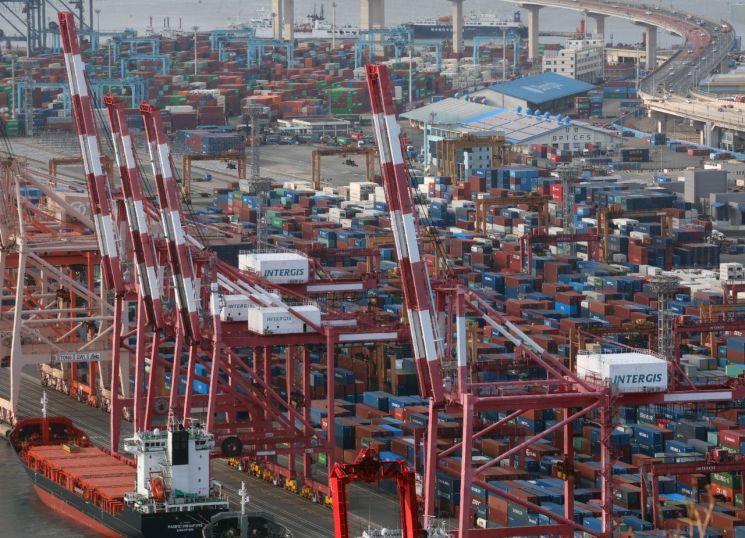
Exports continued a clear upward trend. Last month's export value was $58.15 billion, up 11.7% year-on-year. This marks eight consecutive months of growth since October last year. Semiconductor exports led the increase with a 55% rise. Major IT items such as displays, computers, and wireless communication devices also recorded positive growth for three consecutive months.

Expectations for domestic demand recovery were also maintained. At the beginning of this year, the government judged that consumption was slowing. However, since last month, signs of domestic demand recovery have been added, supported by improvements in tourism and the service sector. However, retail sales in April decreased by 1.2% month-on-month due to a 5.8% decline in durable goods. For May retail sales, the increase in card approvals and inbound tourists is expected to act as positive factors.
Regarding facility investment, the preliminary GDP data for the first quarter showed a 2.0% decrease compared to the previous quarter. The facility investment index fell 0.2% month-on-month as investment in transportation equipment increased by 0.3%, but machinery decreased by 0.4%. The government expects that although domestic machinery orders have declined, the rising adjustment pressure on facility investment will act as a positive factor in the future.
External uncertainties remain ongoing. Although the global economy is showing an overall recovery due to improvements in manufacturing and trade, geopolitical risks such as instability in the Middle East have not been resolved, and trade restrictions among major countries are being strengthened.
Kim Gwi-beom, head of the Economic Analysis Division at the Ministry of Economy and Finance, said, "We will prioritize stabilizing people's livelihoods through a swift establishment of a price stabilization policy and spreading warmth in domestic demand," adding, "We will also manage potential risks thoroughly while making efforts to enhance the dynamism of our economy."
© The Asia Business Daily(www.asiae.co.kr). All rights reserved.
![Clutching a Stolen Dior Bag, Saying "I Hate Being Poor but Real"... The Grotesque Con of a "Human Knockoff" [Slate]](https://cwcontent.asiae.co.kr/asiaresize/183/2026021902243444107_1771435474.jpg)
















