Fed Holds Interest Rate Steady at 5.25~5.5% for 7th Consecutive Time
Year-End Rate Cut Forecasts Reduced from 3 to 1
Market Focuses on CPI Slowdown Over Dot Plot and Powell's Remarks
"The most recent inflation indicators have been more favorable than earlier this year, and there has been quite good progress toward the target in recent months. However, more positive data is needed before cutting interest rates."
Jerome Powell, Chair of the U.S. Federal Reserve (Fed), stated that additional confidence in the slowing of inflation is necessary before lowering the benchmark interest rate. At the Federal Open Market Committee (FOMC) meeting held that day, the Fed kept the benchmark interest rate unchanged for the seventh consecutive time and lowered the forecast for rate cuts this year from three to one. Despite the Fed’s hawkish (preference for monetary tightening) rate outlook, investors reacted positively to the May Consumer Price Index (CPI) report released that morning, which showed a slowdown in inflation, and the Fed’s assessment of progress on inflation, pushing the S&P 500 and Nasdaq indices to record highs.
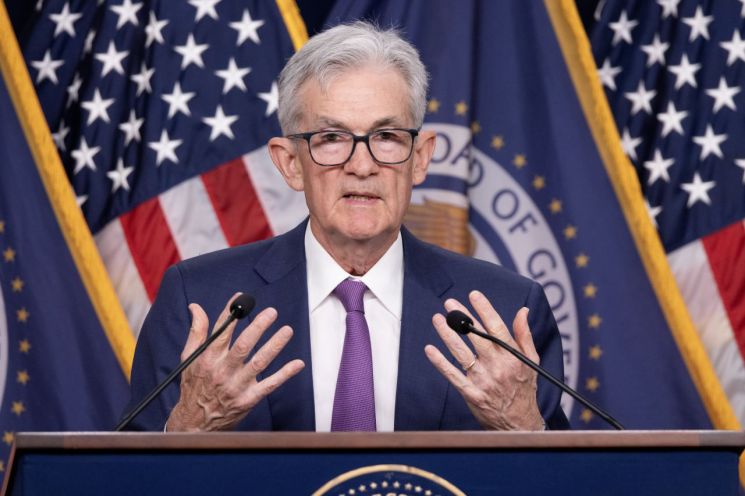
At a press conference following the June FOMC meeting on the 12th (local time), Chair Powell said, "There was progress in the May CPI report, but it is not sufficient to ease policy." He added, "Although inflation has eased recently, it remains high," and said, "We need to wait to cut rates until we gain more confidence that inflation is slowing toward the 2% target."
The Fed announced at this meeting that it would keep the federal funds rate unchanged at 5.25?5.5%. This marks the seventh consecutive hold following decisions in September, November, and December of last year, and January, March, and May of this year. The interest rate differential with South Korea remained at 2 percentage points at the upper bound.
The key focus of this FOMC was the dot plot showing members’ rate projections. The Fed raised its year-end rate forecast from 4.6% presented in March to 5.1%. Initially, it was expected that the Fed would cut rates three times by 0.25 percentage points each within the year from the current 5.25?5.5%, but this time it signaled only one 0.25 percentage point cut. Regarding rate cut expectations this year, among the 19 FOMC members, seven expected one cut, four expected no cuts, and eight expected two cuts. The 2025 rate forecast was raised from 3.9% to 4.1%, revising the expected cuts from three to four. The 2026 rate forecast remained unchanged at 3.1%. The medium- to long-term rate forecast was raised from 2.6% to 2.8%.
As the Fed raised its inflation forecast for this year, the expected number of rate cuts within the year decreased. In the Summary of Economic Projections (SEP) update released that day, the Fed raised the core Personal Consumption Expenditures (PCE) price index forecast for this year by 0.2 percentage points to 2.8%. It expects it to slow to 2.3% in 2025 and 2% in 2026. The GDP growth forecast for this year remains at 2.1%, and the unemployment rate forecast remains at 4%.
However, regarding the May CPI report released a few hours before the FOMC, which confirmed a slowdown in inflation, the Fed viewed the progress as insufficient but present. According to the U.S. Department of Labor, last month’s CPI and core CPI rose 3.3% and 3.4% year-over-year, respectively, both below market expectations (3.4%, 3.5%) and the previous month’s figures (3.4%, 3.6%). Chair Powell acknowledged the progress at the press conference but reiterated a cautious stance that the trend must continue for some time before the Fed can be confident enough to begin cutting rates.
Powell also diagnosed that the labor market, which had fueled inflation, is gradually cooling. He mentioned job creation, retirement rates, and increased labor supply, stating, "Labor market conditions have generally returned to pre-pandemic levels," and assessed that "the labor market is gradually cooling, and demand and supply are progressively rebalancing."
The FOMC policy statement released before Powell’s press conference also included an assessment of progress on inflation. The Fed stated in the policy statement that "there has been modest further progress toward the 2% target in recent months" but added that "inflation remains elevated, and it is not appropriate to reduce the target range until there is greater confidence that inflation will move sustainably toward 2%." The May FOMC policy statement had included language indicating a "lack" of further progress on inflation.
The market focused on the Fed’s assessment of additional progress on inflation despite lowering the expected number of rate cuts this year from three to one. On the New York Stock Exchange (NYSE) that day, the S&P 500 and Nasdaq indices rose 0.85% and 1.53%, respectively, reaching record highs. The Dow Jones Industrial Average closed down 0.09% from the previous trading day.
Quincy Crosby, Chief Global Strategist at LPL Financial, said, "The data-dependent Fed is demanding a cooler inflation report before starting a rate easing cycle," adding, "That is likely why the dot plot does not want to unnecessarily ease financial conditions."
Jay Hatfield, founder and Chief Investment Officer (CIO) of Infrakap, analyzed, "The CPI has neutralized the hawkish Fed," and said, "Most market participants believe the economy is slowing and that the Fed should cut rates. The market is ignoring the Fed’s hawkish outlook of only one cut this year."
© The Asia Business Daily(www.asiae.co.kr). All rights reserved.
![Clutching a Stolen Dior Bag, Saying "I Hate Being Poor but Real"... The Grotesque Con of a "Human Knockoff" [Slate]](https://cwcontent.asiae.co.kr/asiaresize/183/2026021902243444107_1771435474.jpg)















