The Personal Information Protection Commission Announces Customized Advertising Guidelines Within the Year
Small and Medium Advertisers and Advertisers Shrink... "Sanctions Should Be Careful"
As the government announced guidelines for personalized advertising within the year, related industries such as online platforms and advertising businesses have expressed concerns. Blocking personalized advertising is likely to impact small and medium-sized advertising businesses and corporate advertisers that have grown based on it. There are even forecasts that it will only exacerbate the concentration of big tech companies like Google and Meta.
On the 11th, the Internet Enterprise Association held a forum titled "The Positive Functions and Effectiveness of Personalized Advertising, and the Proper Direction for Industry Development" at the 'Startup Alliance & Space' in Gangnam-gu, Seoul.
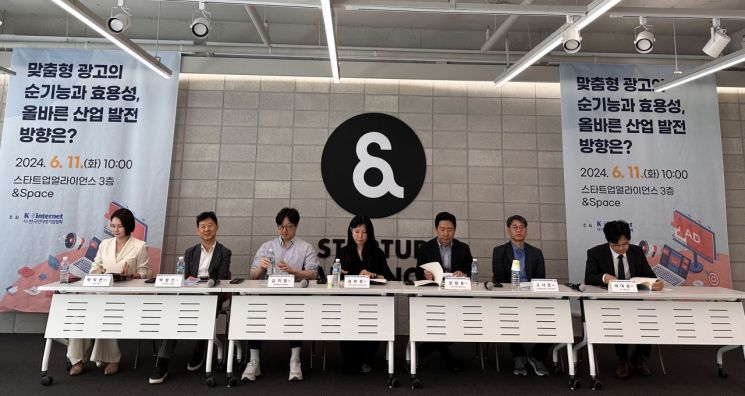 The Korea Internet Corporations Association held a forum on the 11th at 'Startup Alliance & Space' in Gangnam-gu, Seoul, under the theme "The Positive Functions and Effectiveness of Personalized Advertising, and the Proper Direction for Industry Development." [Photo by Korea Internet Corporations Association]
Personalized advertising is a form of individualized advertising that analyzes users' interests and tendencies to provide tailored content. As the online advertising market has grown, the scale of personalized advertising has also increased. According to the Korea Digital Advertising Association, 73.8% of its 141 member companies operate businesses related to personalized advertising.
As the related market expanded, controversies arose over online businesses indiscriminately collecting personal information for personalized advertising. Beyond controversy, this led to sanctions against businesses. In September 2022, the Personal Information Protection Commission imposed fines of about 100 billion KRW on Google and Meta for collecting behavioral information without user consent and using it for personalized advertising. As a follow-up, guidelines for personal information collection practices in personalized advertising have been initiated.
Experts have expressed concerns about regulatory moves. From the consumer perspective, while personalized advertising makes it easier to obtain desired information, it may also expose users to unnecessary information. In particular, there is a possibility that free online services such as email and messengers may disappear. Moon Jang-ho, a professor in the Department of Public Relations and Advertising at Sookmyung Women’s University, emphasized, "Internet businesses provide free services and develop new technologies through advertising revenue. Advertising regulations, which have been the driving force behind the growth of the digital ecosystem, should be approached cautiously."
Concerns are even greater among small and medium-sized businesses. Small business owners and SME advertisers have been able to achieve high advertising effects with relatively small budgets, but that path is being blocked. Small and medium-sized advertising businesses that have grown on the foundation of digital advertising will inevitably be affected. Kwak Dae-seop, a team leader at the Korea Digital Advertising Association, said, "Google and Meta collect behavioral information and personally identifiable information together, but small and medium-sized advertising businesses cannot obtain personal information. It will be difficult for small businesses to review whether the information is personal one by one, so there will be considerable confusion if regulations are imposed."
There are also forecasts that the concentration of big tech companies will worsen. This is because advertising will be concentrated on large platforms and advertisers that have secured many users.
Experts proposed an 'opt-out' method that guarantees users' rights and autonomy instead of imposing sanctions on personalized advertising. Opt-out is a system introduced by the United States in 2010. Unlike the 'opt-in' method, which requires prior user consent for personalized advertising, opt-out allows users to refuse personal information collection and personalized advertising proposals if they wish. Ji-yeon Park, a lawyer at the law firm Taepyungyang, explained, "It protects both personal information and autonomy because consumers understand how their data is used and can control it."
In response, the Personal Information Protection Commission stated that it will prepare guidelines after carefully considering the economic impact of advertising. Ko Nak-jun, head of the New Technology Personal Information Division at the Commission, said, "We are considering various options such as whether consent must be obtained for personally identifiable information, and if so, how and when to obtain that consent."
© The Asia Business Daily(www.asiae.co.kr). All rights reserved.
![Clutching a Stolen Dior Bag, Saying "I Hate Being Poor but Real"... The Grotesque Con of a "Human Knockoff" [Slate]](https://cwcontent.asiae.co.kr/asiaresize/183/2026021902243444107_1771435474.jpg)















