Concerns Over Union Risks Domestically and Abroad
Micron's New York Plant Announces Union Formation
Biden and Trump Ahead of November Election
Possible Pressure for Union Formation for Workers
Likely Impact on Samsung's US Plants
Jeon Young-hyun Urges Internal Unity in First Message
Samsung Electronics is facing concerns that it could be hampered by 'labor union issues' not only domestically but also overseas. As movements to establish unions among semiconductor companies are becoming visible in the United States, similar patterns may emerge at Samsung’s Texas foundry (semiconductor contract manufacturing) plant currently under construction. Jeon Young-hyun, the new head (Vice Chairman) of Samsung Electronics' Device Solutions (DS) division, which oversees the semiconductor business, urged in his first message after taking office, "Let’s unite management and employees with one heart and vigorously strive to restore the status of the top semiconductor company."
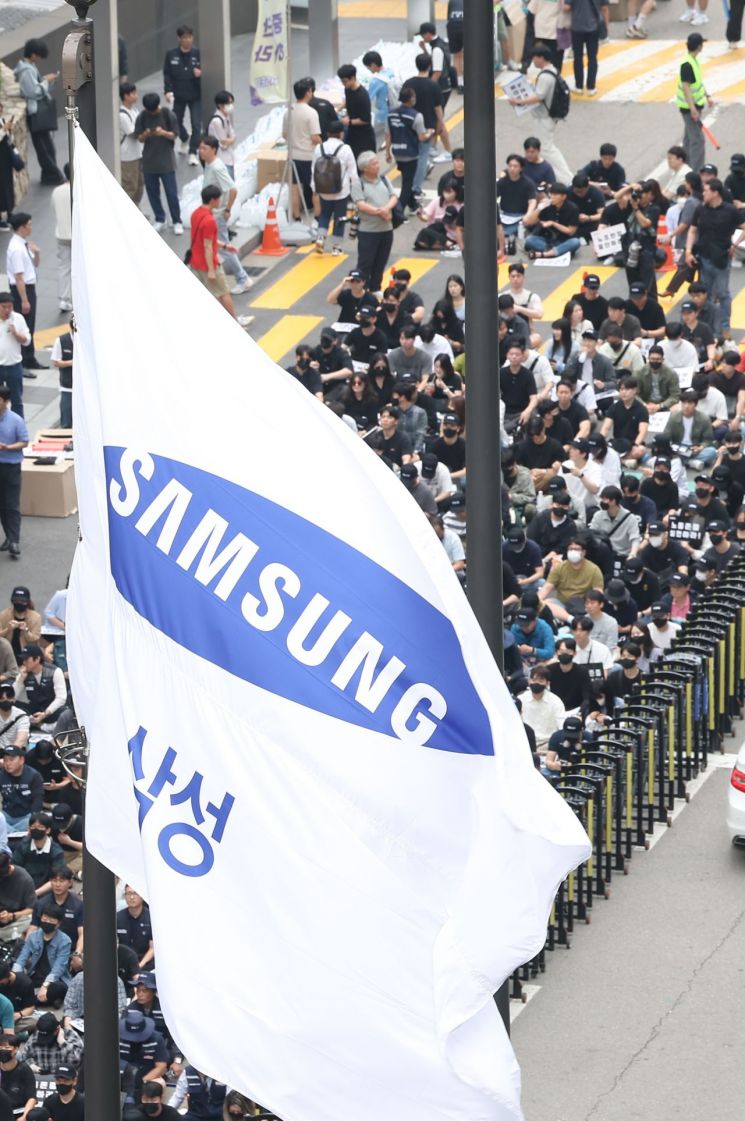 Members of the Samsung Electronics labor union held a cultural event on the afternoon of the 24th in front of the Samsung Electronics headquarters in Gangnam-gu, Seoul, urging negotiations with the labor union.
 [Image source=Yonhap News]
According to major foreign media such as Bloomberg and business circles on the 29th (local time), the Communications Workers of America (CWA), a group representing U.S. technology and media workers, will soon begin negotiations to establish a 'labor peace agreement' related to Micron’s factory construction in Clay, northern New York. CWA has proposed to Micron, "Please do not obstruct the establishment of a union," while Micron is expected to ask CWA, "Please refrain from protests and strikes when the factory opens in 2028." If both sides reach an agreement in these negotiations, a union is likely to be established at Micron’s New York factory.
The negotiations reportedly stem from an informal condition following the Biden administration’s decision to provide Micron with $6.14 billion (approximately 8 trillion KRW) in subsidies under the CHIPS and Science Act (CSA). Earlier, in September 2022, Commerce Secretary Gina Raimondo announced plans to distribute $52.7 billion (approximately 72 trillion KRW) in subsidies to semiconductor companies, stating that "companies that support union establishment will be preferred."
The attention on Micron’s negotiations is due to their significant impact on Samsung Electronics as well. If Micron establishes a union at its factory, it will become difficult for Samsung Electronics, which is building a foundry plant in Taylor, Texas with a $6.4 billion (approximately 8.9 trillion KRW) subsidy, to prevent union formation. There is also a possibility that a union could be formed at Samsung’s foundry plant operating in Austin, Texas. Labor union issues in the U.S. may intensify around the upcoming U.S. presidential election in November. Both President Biden and former President Donald Trump, who are presidential candidates, could flood the market with promises to pressure foreign companies’ factories to allow union formation in order to gain support from semiconductor factory workers.
This is expected to add another layer of pressure on Samsung, which is already facing urgent domestic strikes. Starting from the 7th of next month, members of the largest in-house union, the National Samsung Electronics Labor Union (Jeonsamno), will begin a 'paid leave strike.' This means employees will not work by using their paid leave, which they are guaranteed to use freely. Although this strike method is more legal and passive compared to sit-ins or protests, concerns about Samsung falling behind amid fierce semiconductor competition are bound to grow. Samsung has lost leadership in high-bandwidth memory (HBM) to SK Hynix and has not been able to close the gap with Taiwan’s TSMC, the global number one in foundry.
In his inaugural speech, Vice Chairman Jeon emphasized, "I know better than anyone that employees are working diligently day and night," and as both the division head and a senior colleague, he pledged to "take the lead."
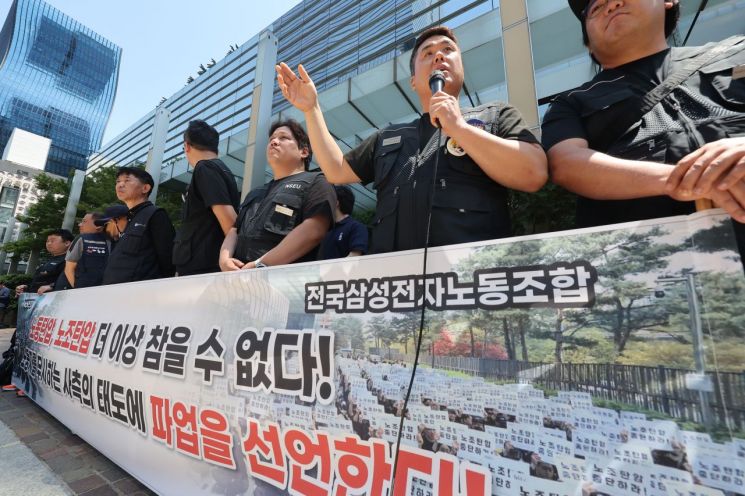 On the morning of the 29th, a press conference declaring the strike of the National Samsung Electronics Labor Union is being held in front of the Samsung Electronics Seocho Building in Seocho-gu, Seoul. [Image source=Yonhap News]
Particularly burdensome is the growing likelihood of a prolonged domestic union strike. Jeonsamno has set the paid leave strike as the first phase and plans to proceed step-by-step. Company officials anticipate that if union members collectively take paid leave, some production lines for semiconductors and home appliance equipment may not operate normally. The number of Jeonsamno union members is currently estimated at about 28,000, which is approximately 22% of Samsung Electronics’ total workforce of about 125,000. Considering that Samsung Display has 21,216 employees, it is almost equivalent to one or two affiliates temporarily shutting down.
Inside the company, opinions on the union strike are reportedly divided. The prevailing view is that demands for wage increases are unreasonable criticisms given the company’s difficult situation amid an economic downturn, but there is also strong sentiment that the ultimate goal of the strike?wage increases?should be achieved, even if only slightly. The union has proposed a 6.5% wage increase, while management has offered 5.1%.
There is also internal criticism regarding the support from members of the Korean Confederation of Trade Unions (Minju-nochong), rather than from higher-level union organizations, for Jeonsamno’s rallies. Executives are reportedly busy from this day onward checking the impact of the strike by department.
© The Asia Business Daily(www.asiae.co.kr). All rights reserved.
![Clutching a Stolen Dior Bag, Saying "I Hate Being Poor but Real"... The Grotesque Con of a "Human Knockoff" [Slate]](https://cwcontent.asiae.co.kr/asiaresize/183/2026021902243444107_1771435474.jpg)
















