The First Half Led by the Executive Branch
The Second Half Led by the Legislative Branch
Scenario Response Strategies Must Be Established
This year, while large-cap stocks such as finance, automotive, utilities, and holding companies showed strong performance in the first half, there is a claim that attention should be paid to small and mid-cap stocks in the second half. Additionally, if the first half was a period dominated by executive-led policy announcements, the second half is a time when the responsibility shifts to the legislature, and it is advised to devise scenario-based response strategies according to the second half policy schedule.
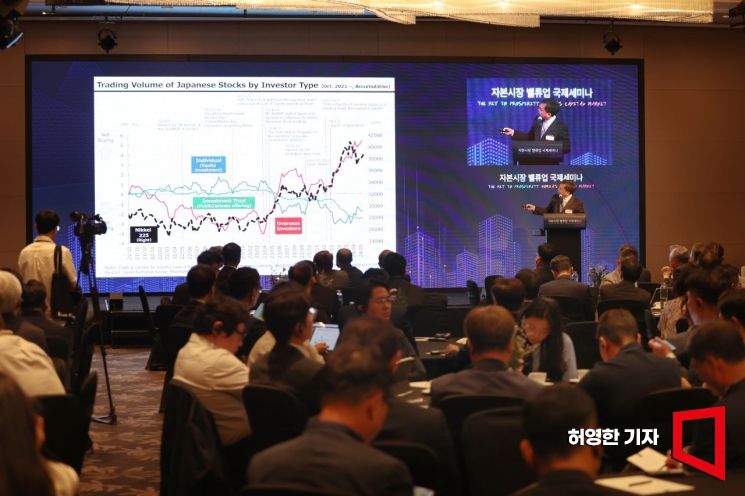 At the Capital Market Value-Up International Seminar hosted by the Korea Financial Investment Association on the 28th at the Conrad Hotel in Yeouido, Seoul, Yoshio Horimoto, Director General of the Japan Financial Services Agency, is delivering the keynote speech. Photo by Younghan Heo younghan@
On the 30th, Ha In-hwan of KB Securities stated in a report, "The first half can be divided into Round 1.0, which showed a strong trend centered on large-cap stocks such as finance, automotive, utilities, and holding companies, and Round 1.5, where financial stocks showed a particularly strong flow," adding, "From the second half, we expect a transition to the Value-Up Program Round 2.0."
Researcher Ha advised that various government policies are anticipated in the second half, so response strategies should be prepared accordingly. In particular, attention should be paid to the 'Measures to Ease the Requirements for the Exit of Insolvent Companies (Korea Exchange),' expected to be announced in the fourth quarter of this year. He said, "Although the specific details need to be confirmed, such measures will be grounds for paying attention to small and mid-cap stocks."
The tax law amendment bill to be disclosed in late July should also be closely watched. In the case of separate taxation on dividend income, it is expected to be positive for high-dividend stocks, and in the case of inheritance tax reform, it is expected to be positive for holding companies.
Regarding the amendment to the Commercial Act, it was also suggested that access to holding companies should be considered depending on whether it passes the National Assembly. Researcher Ha said, "Currently, the government is mentioning roughly three items, and it is expected that some, rather than all three, will pass."
Researcher Ha presented the major schedules related to the Value-Up Program in the second half as △tax benefits for shareholder returns, △inheritance tax reduction, △separate taxation on dividend income, △abolition/suspension of financial investment income tax, and △improvement of the IAS system. He added, "What investors should pay attention to is exactly this part, which policies the government will emphasize," and said, "Currently, the areas of particular interest are corporate tax benefits when canceling treasury shares, separate taxation on dividend income, and abolition/suspension of financial investment income tax."
He said that while the Value-Up policy is important, changes in interest rate trends (financial stocks) and the earnings season (possibility of shareholder return announcements) should also be considered important. Researcher Ha advised, "In particular, regarding interest rates, I expect a decline in the third quarter and that the decline will come to an end in the fourth quarter, so it is important to approach financial stocks accordingly."
© The Asia Business Daily(www.asiae.co.kr). All rights reserved.
![Clutching a Stolen Dior Bag, Saying "I Hate Being Poor but Real"... The Grotesque Con of a "Human Knockoff" [Slate]](https://cwcontent.asiae.co.kr/asiaresize/183/2026021902243444107_1771435474.jpg)















