Outdoor Signboards Line the Street
Limitations in Enforcement Despite Jung-gu Office Guidance
Ownership Verification Required for Penalties
Complete Eradication Difficult Due to Commercial Area Characteristics
On the afternoon of the 27th at around 3:40 PM, a narrow alley in Myeongdong-daero, Jung-gu, Seoul was visited. The area was crowded with tourists trying to avoid illegal street obstructions installed by various businesses. An outdoor signboard fixed with bricks wobbled and eventually fell after hitting a tourist's arm. The road width in this alley was about 4 meters, wide enough for 10 adults to walk side by side. However, due to indiscriminately placed street obstructions, the road narrowed to barely allow five adults to pass side by side.
As the road width narrows due to illegal street obstructions placed along the roadside, concerns are rising that securing access routes for fire trucks and ambulances in emergencies could become problematic. It is also pointed out that the 'golden time' for dispatch, generally considered to be 5 minutes in the event of a large fire or casualties, could be missed.
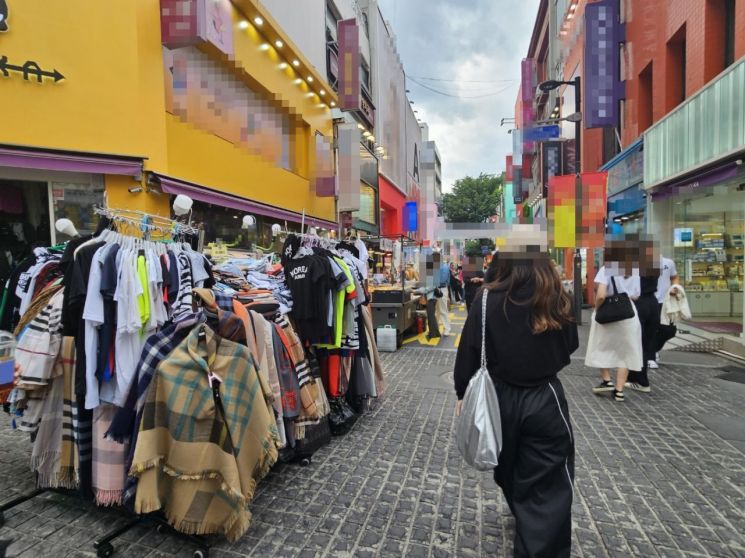 On the 27th, a clothing stall was placed in the middle of a street in Myeongdong, Jung-gu, Seoul.
 [Photo by Lee Ji-eun]
Road Narrowed by Street Stalls and Outdoor Signboards... Limitations Despite Jung-gu Office Crackdown
The Fire Agency classifies roads difficult for fire trucks to access due to street obstructions as either fire truck access difficult areas or no-access areas based on their own standards. According to the criteria, locations where the road width is 2 meters or less, or where obstacles make fire truck access impossible for a stretch of 50 meters or more, are classified as no-access areas. Areas where the road width is 3 meters or more but habitual obstacles block fire truck access for more than 50 meters are classified as access difficult areas. In Seoul, a total of 328 locations are classified as fire truck access difficult or no-access areas.
The alley previously visited was also far too narrow for a medium-sized fire pump truck with a width of 2.5 meters to enter. In fact, one street stall was left alone right in the middle of the alley, forcing pedestrians to walk around it.
Jung-gu, Seoul, recognizing this issue, is cracking down on illegal street obstructions. Three management service staff patrol the Myeongdong area from 2 PM to 11 PM, verbally warning merchants. Merchants who repeatedly fail to remove their stalls are fined. Under the current Road Act, illegal street obstructions can be fined up to 1.5 million KRW.
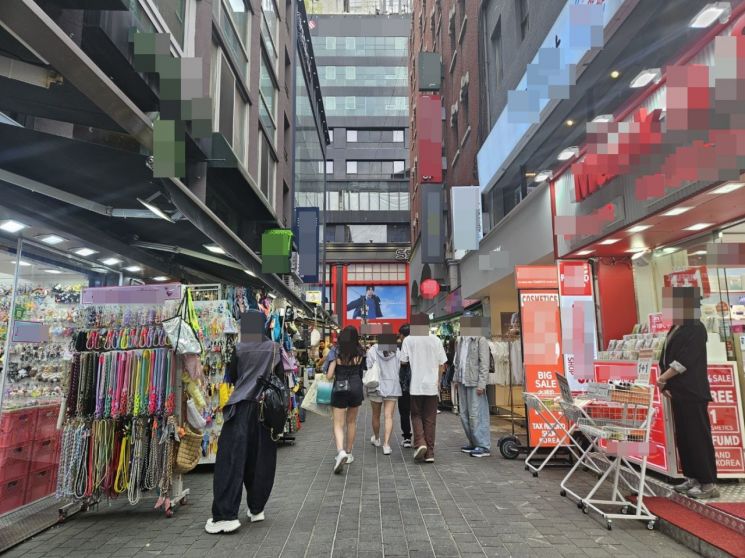 On the 27th, outdoor signs and stalls set up by merchants lined the street in a lane of Myeongdong, Jung-gu, Seoul.
 [Photo by Lee Ji-eun]
Complete Ban Is Practically Difficult... Rehearsal Training Needed for Emergencies
However, completely eradicating illegal street obstructions is realistically difficult. Merchants temporarily remove signboards to avoid enforcement officers’ eyes but put them back out later, and when some merchants violate regulations, others competitively place obstructions along the roadside. A Jung-gu Office official said, "Because some merchants excessively place street obstructions, surrounding merchants also come out onto the street in competition. We are considering administrative measures against those merchants, but we have yet to determine whether the problematic alley is private property, so we have not been able to take proper action."
On the other hand, merchants argue that the rent in the Myeongdong area is so high that they have no choice but to competitively place street stalls. Kim (45), who runs a currency exchange in Myeongdong, said, "Monthly rent for a shop in Myeongdong exceeds 10 million KRW. Everyone knows it’s illegal, but they try to put even one signboard on the street to make some profit."
Given this situation, Jung-gu Office cannot fully ban illegal street obstructions. A Jung-gu Office official said, "Considering the characteristics of the tourist area Myeongdong, we have drawn a 50 cm voluntary maintenance line and conduct daily guidance measures against shops that exceed this line."
Experts also point out that due to regional characteristics, there are limits to removing all illegal street obstructions. However, they suggest that local city, county, and district offices should prepare measures such as rehearsal drills for clearing obstructions in case of emergencies.
Professor Lee Chang-woo of Soongsil Cyber University said, "Although illegal, it is practically difficult to ask merchants in the tourist area of Myeongdong to remove all outdoor signboards and street stalls. Traditional markets that have faced similar situations have installed wheels on stalls and conduct rehearsal drills to clear obstructions in emergencies."
He added, "To avoid missing the dispatch golden time, Myeongdong merchants should undergo prior training to quickly remove obstructions in preparation for crisis situations."
© The Asia Business Daily(www.asiae.co.kr). All rights reserved.
![Clutching a Stolen Dior Bag, Saying "I Hate Being Poor but Real"... The Grotesque Con of a "Human Knockoff" [Slate]](https://cwcontent.asiae.co.kr/asiaresize/183/2026021902243444107_1771435474.jpg)
















