Sergeant Chae's Special Prosecutor Act to Be First Proposed in 22nd National Assembly
Ruling Party Signals Veto on Jeonse Fraud Special Act
The opposition has predicted a legislative dominance in the 22nd National Assembly following the rejection of the special investigation law on the death of Corporal Chae (Corporal Chae Special Investigation Law) amid allegations of external pressure on the investigation. If bills vetoed by President Yoon Seok-yeol, including the Corporal Chae Special Investigation Law, are reintroduced, a 'veto deadlock' is expected to recur.
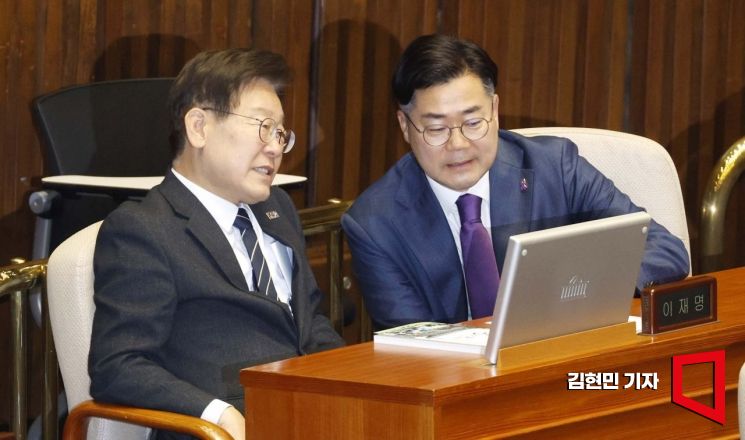 Lee Jae-myung, leader of the Democratic Party of Korea, and Park Chan-dae, floor leader, are talking at the National Assembly plenary session on the 28th. Photo by Hyunmin Kim kimhyun81@
On the 29th, Park Chan-dae, floor leader of the Democratic Party of Korea, stated at a supreme council meeting at the National Assembly in Yeouido, Seoul, "We will definitely uncover the truth about the death of the Marine Corps member and the reality of external pressure on the investigation," adding, "We will push to reintroduce the Corporal Chae Special Investigation Law as a party bill in the 22nd National Assembly and ensure its swift passage." He continued, "The 22nd National Assembly starts tomorrow, and it will be completely different from the 21st National Assembly," emphasizing, "We will no longer be dragged around by the ruling party's tantrums." Lee Jae-myung, leader of the Democratic Party, also said, "No matter how much President Yoon abuses his veto power against the will of the people, we will block it to the end," and added, "In the 22nd National Assembly, we will fully utilize the powers of the National Assembly to prevent any contempt of the legislature."
The Democratic Party is expected to pressure the government and ruling party, focusing on bills vetoed by President Yoon. The party plans to reintroduce not only the Corporal Chae Special Investigation Law but also the special investigation law on allegations of stock price manipulation involving First Lady Kim Keon-hee, the Yellow Envelope Act (amendment to the Labor Union Act), the three broadcasting laws (amendments to the Korea Educational Broadcasting System Act, Broadcasting Act, and Broadcasting Culture Promotion Act), the Nursing Act, and other eight bills vetoed by President Yoon. On the 22nd, Jin Sung-jun, chairman of the Democratic Party's Policy Committee, said at a workshop held in Yesan, Chungnam, "There are livelihood reform tasks that were vetoed and failed even after a re-vote by President Yoon," adding, "They must be re-pursued first in the 22nd National Assembly."
Other opposition parties are also expected to join the Democratic Party in reintroducing the Corporal Chae Special Investigation Law. Cho Guk, leader of the Cho Guk Innovation Party, told reporters at the Social Rights Advanced Countries Forum held at the National Assembly that day, "We will submit bills in coalition with the Democratic Party and other opposition parties, including the Corporal Chae Special Investigation Law." Heo Eun-ah, leader of the Reform New Party, also emphasized at a press conference the day before, "We will actively take the lead more than any other party in not only re-pursuing the special investigation but also uncovering the truth about Corporal Chae's death."
For this reason, the veto deadlock that continued until the end of the 21st National Assembly is expected to persist in the 22nd National Assembly. If the opposition passes bills unilaterally, the president is likely to exercise veto power, and the bills may be defeated again in the re-vote, repeating the same scenario.
© The Asia Business Daily(www.asiae.co.kr). All rights reserved.
![Clutching a Stolen Dior Bag, Saying "I Hate Being Poor but Real"... The Grotesque Con of a "Human Knockoff" [Slate]](https://cwcontent.asiae.co.kr/asiaresize/183/2026021902243444107_1771435474.jpg)















