Joint Meeting of Presidential Office and Related Ministries
Regular Presidential Report on Core Infrastructure Protection Activities
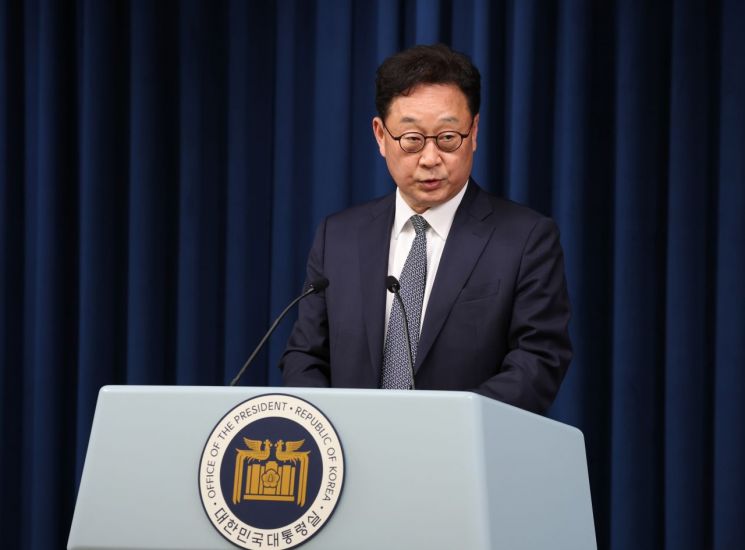
The government launched the "Pan-Government Core Infrastructure Security Council" on the 28th to strengthen security for the nation's key infrastructure facilities.
The Presidential Office announced that on the same day, a joint meeting of related ministries and agencies was held under the chairmanship of Wang Yoon-jong, the 3rd Deputy Director of the National Security Office, to enhance the security of national core infrastructure facilities.
Attendees included officials from agencies managing and supervising national core infrastructure facilities such as the National Intelligence Service, Ministry of Science and ICT, Ministry of Foreign Affairs, Ministry of the Interior and Safety, Ministry of Trade, Industry and Energy, Ministry of Environment, Ministry of Land, Infrastructure and Transport, Ministry of Oceans and Fisheries, Korea Communications Commission, Financial Services Commission, and Public Procurement Service.
The participants agreed that, as seen in recent events such as the Russia-Ukraine war and the Hamas-Israel conflict, physical threats using drones and paragliders are diversifying, and attempts at cyberattacks by external forces are increasing, making it necessary for Korea to establish an integrated response system at the pan-government level.
Previously, each ministry operated and protected individual infrastructure according to their respective regulations, but with the launch of this pan-government council, the Presidential Office and related agencies are expected to identify and manage core infrastructure at the national level in an integrated manner.
The Presidential Office explained, "We have decided to eliminate barriers between agencies and respond through active information sharing and cooperation against various new threats."
On this day, the council defined "national core infrastructure" as "facilities, equipment, systems, and assets that are extremely important and whose destruction or functional impairment would have a critical impact on the national economy and security."
Core infrastructure will be selected across 10 sectors including government agencies, industry, energy, information and communications, transportation, airports, ports, broadcasting, water resources, and finance, and activities for risk management, prevention, and infrastructure protection will be carried out, with results regularly reported to the President.
Major advanced countries such as the United States and Japan are also recently strengthening systems to protect core infrastructure.
As the connectivity of major infrastructure domestically and internationally, and across private and public sectors deepens due to network expansion worldwide, the council plans to establish a joint response system with allied countries.
© The Asia Business Daily(www.asiae.co.kr). All rights reserved.
![Clutching a Stolen Dior Bag, Saying "I Hate Being Poor but Real"... The Grotesque Con of a "Human Knockoff" [Slate]](https://cwcontent.asiae.co.kr/asiaresize/183/2026021902243444107_1771435474.jpg)















