If Over 10 Votes Against, Government and Ruling Party's National Power Expected to Weaken
If Rejected, Will Reintroduce as First Bill in 22nd National Assembly
The Democratic Party of Korea is closely monitoring the scale of dissenting votes from the ruling party regarding the re-vote on the 'Chae Sang-byeong Special Prosecutor Act' at the National Assembly plenary session on the 28th. This is because even if the special prosecutor bill is rejected, if double-digit dissenting votes occur within the ruling party, it is believed that the opposition-led bloc can push forward with controversial legislation in the 22nd National Assembly.
The result of the re-vote on this day serves as a barometer for whether the ruling party will be bypassed in the future National Assembly. This calculation became possible as the opposition bloc holds a total of 192 seats in the 22nd National Assembly. For bills on which President Yoon Seok-yeol has exercised the right of reconsideration (veto), approval by two-thirds or more (200 seats) of the 300 total members of the National Assembly is required to pass. In fact, based on the 22nd National Assembly, if only 8 members of the ruling party defect, the ruling party cannot block the legislative offensive of the opposition bloc.
From the opposition bloc’s perspective, passing bills in the 22nd National Assembly is considerably easier than in the 21st National Assembly. As of this day, the 21st National Assembly had 296 members. Excluding independent lawmaker Yoon Kwan-seok, who was indicted and detained in connection with the Democratic Party’s party convention cash envelope scandal, 295 members are able to attend the plenary session. If all these members participate in the vote, the quorum for approval is 197 seats, and the opposition bloc holds 180 seats. Considering this, 17 dissenting votes from the ruling party are needed to pass the Chae Sang-byeong Special Prosecutor Act.
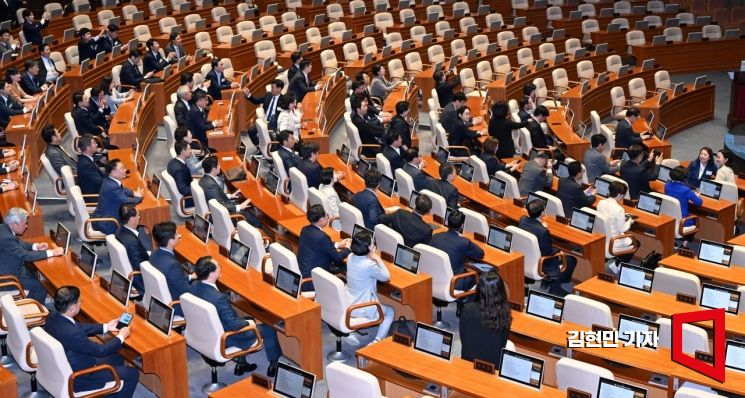 The first-term winners of the 22nd National Assembly are learning the electronic voting method on the 21st at the National Assembly plenary session hall. Photo by Hyunmin Kim kimhyun81@
In political circles, the likelihood of the Chae Sang-byeong Special Prosecutor Act passing at the plenary session on this day is considered low. The key issue is whether dissenting votes from the ruling party will exceed 10 seats. The Democratic Party is likely to regard the re-vote result as a victory if more than 10 dissenting votes occur within the ruling party. Kim Yong-min, the Democratic Party’s senior deputy floor leader, said, "The best outcome is passage, and if there are more than 10 dissenting votes from the People Power Party, the government and ruling party’s momentum in the 22nd National Assembly will be significantly undermined." The Democratic Party’s position is to reintroduce the special prosecutor bill as the first bill in the 22nd National Assembly even if it is rejected.
© The Asia Business Daily(www.asiae.co.kr). All rights reserved.
![Clutching a Stolen Dior Bag, Saying "I Hate Being Poor but Real"... The Grotesque Con of a "Human Knockoff" [Slate]](https://cwcontent.asiae.co.kr/asiaresize/183/2026021902243444107_1771435474.jpg)















