'Guaranteeing Judicial Independence' Budget Research
Divided into Four Areas: Tasks, Organization, etc.
Seeking Opinions on Independent Budget Formulation
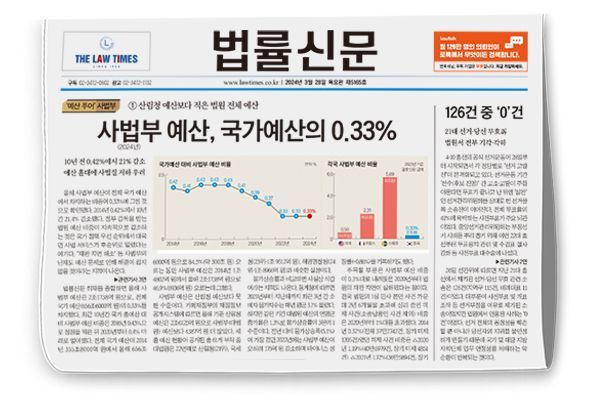
A survey targeting active judges has been confirmed to have been conducted regarding the issues of the judiciary budget, which accounts for only 0.33% of the national total budget. This survey included many questions directly asking judges about the judiciary budget related to trial work, such as whether they believe they are adequately provided with the necessary budget and material resources to perform their duties, and whether the overall judiciary budget is sufficient for swift and fair judgments. As the Legal Times has reported a series of articles pointing out the 'judiciary budget shortage' issue five times since March (photo), attention is focused on whether the opinions of judges on the judiciary budget will lead to meaningful results through this research project.
According to Legal Times' coverage, the Korean Association for Public Administration, which is conducting the research commissioned by the Court Administration Office, is understood to have conducted a survey via email from the 16th to the 25th of this month targeting judges and others on the necessity of independent judiciary budget proposals. The email contained survey questions along with explanations stating that the survey would be used as basic data to gather internal opinions on the independence of the judiciary budget, together with a perception survey on court personnel management and organizational operations.
Earlier, in October last year, the Supreme Court announced a bid for a study titled 'Improvement Plan for Budget Proposal Procedures to Guarantee the Independence and Autonomy of the Judiciary' at the request of the Budget Officer's Office, and the Korean Association for Public Administration was commissioned to conduct the research.
The survey was broadly divided into △ workload, intensity, and stress section △ organizational commitment, job and salary satisfaction, turnover intention section △ opinions on independent budget formulation △ personal-related matters.
Specifically, in the workload, intensity, and stress section, questions included whether judges think they are adequately provided with material resources such as the necessary budget to perform their duties, whether they are adequately provided with information resources such as information or IT facilities needed for their work, whether their work interferes with their family (personal life), whether they think they have a large number of cases in charge, and how much of their weekly work time is spent on 'work outside the courtroom.' Questions about organizational commitment, job and salary satisfaction included whether the salary is appropriate considering work performance, whether they receive fair compensation given the difficulty of the work, and if they have turnover intentions, what the reasons are.
In particular, questions asking for opinions on independent budget formulation included an analysis of changes in the judiciary budget, such as the ratio of the judiciary budget to the total national budget decreasing from 0.42% in 2014 to 0.33% in 2023. Starting with this explanation, the questions were composed to ask judges about their personal views on whether the judiciary's overall budget is sufficient for swift and fair judgments, and whether the judiciary's project budget is adequate to provide appropriate judicial services and improve quality.
Regarding the conduct of this survey, judges generally expressed that simply asking members about their thoughts on the judiciary budget is meaningful.
A chief judge of a district court said, "Isn't this an attempt to directly hear the voices of judges regarding the budget?" and added, "Asking about the budget issues felt by judges as members of the judiciary, including their work, and the fact that results will come out is meaningful in itself."
A judge from a metropolitan court said, "It is meaningful for institutions like the Court Administration Office to reveal through numbers that the budget is insufficient, but the actual perception of judges during their work is likely greater," and added, "I hope meaningful results come out from the survey, are reflected in the research, and lead to practical budget increases."
The research period is until the end of June, and after a review process, the results are expected to be released around mid-July if disclosure is possible.
Han Suhyun, Park Suyeon, Legal Times reporters
※This article is based on content supplied by Law Times.
© The Asia Business Daily(www.asiae.co.kr). All rights reserved.
![Clutching a Stolen Dior Bag, Saying "I Hate Being Poor but Real"... The Grotesque Con of a "Human Knockoff" [Slate]](https://cwcontent.asiae.co.kr/asiaresize/183/2026021902243444107_1771435474.jpg)















