Bank of Korea Releases Economic Outlook Report on High Inflation and Consumption
Consumption Growth Rate Reduced by 4 Percentage Points Due to High Inflation in 2021-2022
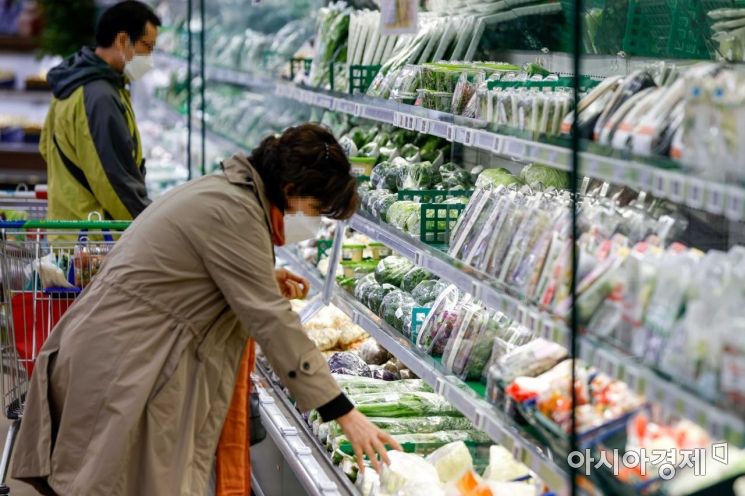 Nonghyup Hanaro Club Yangjae Branch, Seocho-gu, Seoul. (File photo) / Photo by Jinhyung Kang aymsdream@
A study has found that the rapidly rising domestic inflation since 2021 has significantly slowed down private consumption.
According to the economic outlook report on high inflation and consumption released by the Bank of Korea on the 27th, the cumulative consumer price inflation rate from 2021 to recently was 12.8% (annual rate 3.8%), more than twice the average annual rate of the 2010s (1.4%).
Inflation affects private consumption through two channels: reducing households' real purchasing power and lowering the real value of assets and liabilities. The extent of the impact varied depending on the composition of household consumption items (consumption basket) and financial conditions.
The composition of household consumption expenditures differed by age and income level. Households that consumed more items with higher inflation rates experienced a higher effective inflation rate, thus being more affected by inflation.
Accordingly, the effective inflation rate was higher among the elderly and low-income groups, who have a larger share of essential goods such as food, compared to other households like young and middle-aged or high-income groups.
The impact of inflation also varied depending on how much financial assets and liabilities households held. Inflation reduces the real value of both financial assets and liabilities.
The negative impact of inflation was greater among the elderly, who hold more financial assets relative to liabilities. On the other hand, although young adults typically hold more debt due to their life cycle stage, they were negatively affected by inflation due to the decline in the real value of jeonse deposits for those living in jeonse rental housing.
Considering these effects, inflation between 2021 and 2022 lowered the consumption growth rate by about 4 percentage points through a reduction in real purchasing power. Although the magnitude of high inflation has decreased since 2023, it still acts as a factor reducing consumption.
Additionally, changes in the real value of financial assets and liabilities by household further suppressed consumption by about 1 percentage point during 2021?2022. The study found that the contraction in consumption due to asset value deterioration outweighed the consumption improvement from reduced debt burdens caused by inflation.
Jung Dong-jae, head of the macro analysis team at the Bank of Korea’s Research Department, stated, "The rapidly rising inflation since 2021 is judged to have significantly slowed private consumption. High inflation not only generally weakens households’ real purchasing power but also has a negative redistributive effect that exacerbates economic difficulties for vulnerable groups. Therefore, it is important to maintain a price stability policy."
© The Asia Business Daily(www.asiae.co.kr). All rights reserved.
![Clutching a Stolen Dior Bag, Saying "I Hate Being Poor but Real"... The Grotesque Con of a "Human Knockoff" [Slate]](https://cwcontent.asiae.co.kr/asiaresize/183/2026021902243444107_1771435474.jpg)















