"In spring, we used to just wait for the rain. Now, it's the opposite. It's less about fickleness and more like the feelings of parents who have children selling umbrellas and straw shoes."
The spring wildfire caution period has passed, and the time to prepare for summer landslide response has arrived. Especially this summer, heavy rainfall is expected. The Korea Forest Service plans to maintain a higher level of vigilance than usual and strengthen inter-agency cooperation to minimize landslide damage.
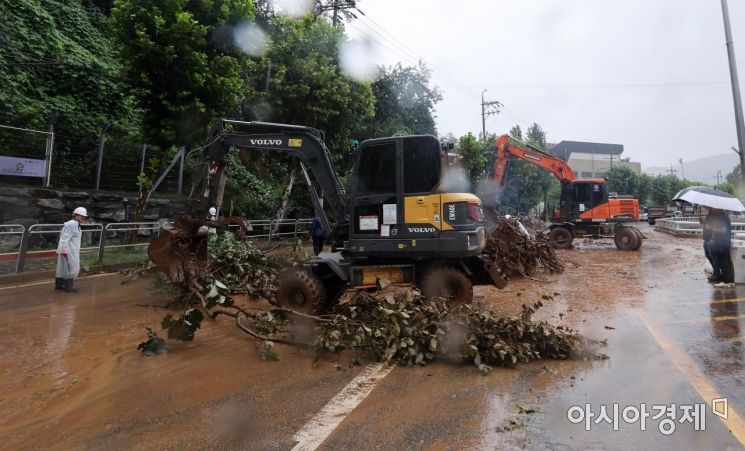 Due to record-breaking heavy rain last year, a landslide occurred on a hillside near Sillim Middle School in Gwanak-gu, Seoul. Workers are clearing the fallen soil and trees and repairing the road. Photo by Hyunmin Kim kimhyun81@
◆ Continuous Response to ‘Forest Disasters’ = On the 14th, the Korea Forest Service exchanged plaques at the Central Forest Disaster Situation Room, replacing the Central Wildfire Prevention Headquarters plaque with the Landslide Prevention Support Headquarters plaque. This marked the end of the spring wildfire caution period (February 1 to May 15) and the beginning of landslide response.
During this spring's wildfire caution period, a total of 175 wildfires occurred, destroying 58 hectares of forest. This is the second-lowest frequency and damage scale since wildfire statistics began in 1986. The lowest on record was in 2012, when 102 wildfires destroyed 49 hectares of forest.
Compared to the average wildfire status over the past 10 years (416 incidents with 3,865 hectares lost), this year's wildfire situation is not bad. The number of wildfires decreased by 58%, and the damaged area decreased by 98%. This justifies calling it a "record-breaking" year, and as the spring wildfire caution period was ending, phrases like "If only every year were like this!" were frequently heard within the Korea Forest Service.
Periodic spring rains played a role in reducing wildfire risk factors. It is analyzed that timely rainfall maintained a certain moisture level in the forest, which contributed to wildfire suppression.
However, the spring rains become a hidden threat in summer. Behind the sighs of relief saying "If only every year were like this!" concerns are growing that summer heavy rains will lead to landslides.
Abroad, damage cases caused by heavy rains are already frequently reported. For example, recently in Brazil, over 300 mm of rain fell in a single day, and in Dubai, which has a desert climate, over 100 mm of heavy rain fell in one day, causing numerous casualties and facility damages.
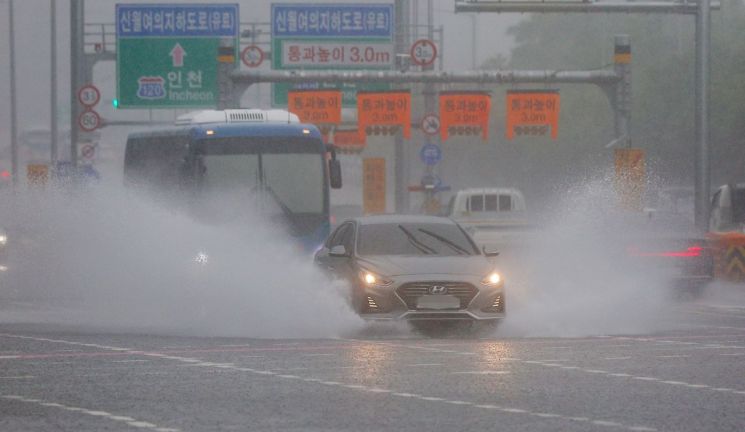 Last year during the monsoon season, a heavy rain advisory was issued in Seoul, and vehicles on Yeouidaero were passing by, creating splashes of water. Photo by Yonhap News
◆ Extreme Rainfall During the Monsoon Increases Landslide Risk = According to the Korea Forest Service and the Korea Meteorological Administration, the annual average precipitation in South Korea has been increasing from 1,225 mm before the 1990s to 1,316 mm between 1991 and 2000, and 1,380 mm between 2021 and 2023. The number of extreme rainfall events exceeding 50 mm per hour also increased from an average of 16 times per year in the 2000s and 2010s to 23 times per year between 2021 and 2023.
Especially, last year's monsoon season (June 23 to July 24) recorded 662.9 mm of rainfall, the third highest on record. Compared to the average year, rainfall increased by 86%, and the average number of rainy days increased by 28%. This indicates that there were more days with concentrated rainfall than usual last year.
This year’s situation is expected to be similar. The Korea Meteorological Administration forecasts that due to low pressure and atmospheric instability this summer, precipitation from June to August will be similar to or greater than the average (622.7 mm to 790.5 mm).
With heavy rainfall expected this summer, the risk of landslides also rises. In fact, last year, which recorded the third highest rainfall, a total of 2,410 landslides occurred nationwide (covering 459 hectares), causing 13 casualties. All casualties were concentrated in the southern regions (11 in Gyeongbuk and 2 in Chungnam). The monsoon rainfall in the southern regions last year was 712.6 mm, the highest ever recorded.
The Korea Forest Science Institute predicted that under climate change scenarios (increased rainfall and sudden localized heavy rains), the risk of landslide occurrence could double by 2050.
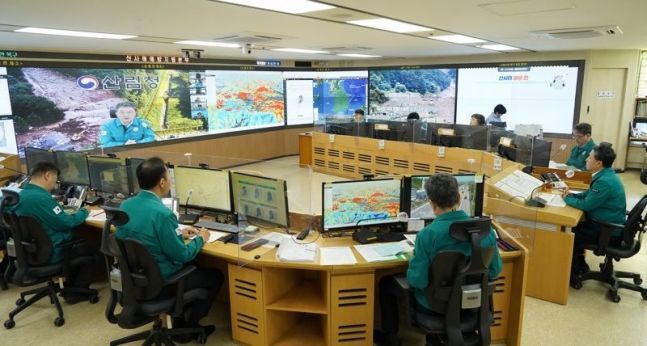 Nam Seong-hyun, Commissioner of the Korea Forest Service, presides over a nationwide landslide prevention officials video conference after holding the plaque ceremony for the Landslide Prevention Support Headquarters at the Central Forest Disaster Situation Room in the Government Daejeon Complex on the 14th. Photo by Korea Forest Service
◆ Korea Forest Service Busy Ahead of Disasters = As the frequency of summer landslides is expected to increase due to climate change, the Korea Forest Service is focusing on field inspections and proactive measures to prevent damage.
This year, the establishment and operation of a digital-based integrated risk slope management system across ministries was also implemented as part of this effort. Previously, risk slope information was managed separately by ministries (steep slopes by the Ministry of the Interior and Safety, solar facilities by the Ministry of Trade, Industry and Energy, etc.). Now, the Korea Forest Service produces and sends landslide prediction information by integrating this data, and each ministry uses the received prediction information to manage slope safety and respond accordingly.
Emphasis is also placed on expanding landslide-prone areas and preventing risk factors in advance. The Korea Forest Service increased the number of pre-investigated landslide-prone sites from 25,000 last year to 45,000 this year, and designated sites from 29,000 to 34,000, thereby expanding the scope of landslide risk management.
Collaboration systems among related agencies have been strengthened to prevent casualties in the event of landslide situations. Support systems have been established in advance with the National Police Agency and the National Fire Agency, and local residents such as community leaders in landslide risk areas are utilized as evacuation assistants to help evacuate those who refuse to evacuate or vulnerable groups during emergencies.
Earlier, the Korea Forest Service completed inspections of 29,703 landslide-prone sites nationwide during January to March (first phase) and April to May (second phase). Since last month, joint inspections with the Ministry of the Interior and Safety have been conducted focusing on areas at risk of soil erosion and forest multi-use facilities.
Nam Sung-hyun, Administrator of the Korea Forest Service, said, "This year, with expected high rainfall, the risk of landslides has increased more than ever. The Korea Forest Service will fully respond to minimize landslide damage by strengthening inter-agency cooperation such as integrated risk slope management and joint inspections of landslide-prone areas."
© The Asia Business Daily(www.asiae.co.kr). All rights reserved.
![Clutching a Stolen Dior Bag, Saying "I Hate Being Poor but Real"... The Grotesque Con of a "Human Knockoff" [Slate]](https://cwcontent.asiae.co.kr/asiaresize/183/2026021902243444107_1771435474.jpg)

















