Only 1,500 Couples Have Combined Income Over 3 Million Won
As of January this year, the number of couples where both husband and wife receive the National Pension monthly for their livelihood was 671,857 couples (1,343,714 people). The average monthly amount for couples receiving the National Pension is 1.03 million KRW. Compared to the average appropriate monthly living expenses for retired couples at 3.24 million KRW and the minimum living expenses at 2.31 million KRW (based on the 2023 Household Finance and Welfare Survey), this amount is far from sufficient. Only 1,500 couples receive a combined monthly National Pension of over 3 million KRW.
 The photo is not related to any specific expressions in the article. [Image source=Getty Images Bank]
However, there are pension king couples who receive more money from their pensions than most salaried workers earn annually. The protagonists are an elderly couple in their 70s living in Busan.
How much do the highest-earning couples receiving 'dual pensions' get? The wife receives 2,482,000 KRW per month, and the husband receives 2,377,000 KRW per month. Together, the couple receives 4,859,000 KRW monthly, which amounts to an annual income of 58.3 million KRW. What is their secret?
Increase Payment Frequency and Duration
Undoubtedly, the most important factors are the number of payments and the amount paid. The National Pension system allows individuals who pay premiums at least 120 times (once a month for 10 years) by age 60 to receive lifelong pensions. The pension amount is determined by the number of payment months and the monthly income during the subscription period. The pension king couple both joined the National Pension system in its inaugural year, 1988, so their subscription period is long. Additionally, the couple deferred their pension receipt by 5 years. For each year the pension receipt is delayed, the pension amount increases by 7.2% annually, up to a maximum of 36% more.
Moreover, the couple paid into the pension during the period when the income replacement rate was 70% (1988?1998), resulting in a higher pension amount. The income replacement rate refers to the ratio of the pension amount received in retirement compared to the average income during the premium payment period. For example, a 50% income replacement rate means a person earning 1 million KRW monthly would receive 500,000 KRW from the National Pension. The initial 70% income replacement rate has steadily decreased. As of 2024, the income replacement rate is 42%. It is likely to continue declining. In other words, this couple benefits from both the early subscription advantage and the pension deferral advantage.
The National Pension can be received starting the month after the birthday of the eligible age once the minimum subscription period of 10 years (120 months) is met. The eligible age varies by birth year. For example, those born up to 1952 could receive pensions starting at age 60. Those born between 1953 and 1956 start at 61. Those born between 1957 and 1960 start at 63, and those born between 1965 and 1968 start at 64. Those born after 1969 are eligible from age 65. This structure is disadvantageous for the MZ generation (Millennials + Generation Z).
Both Spouses Must Be Healthy
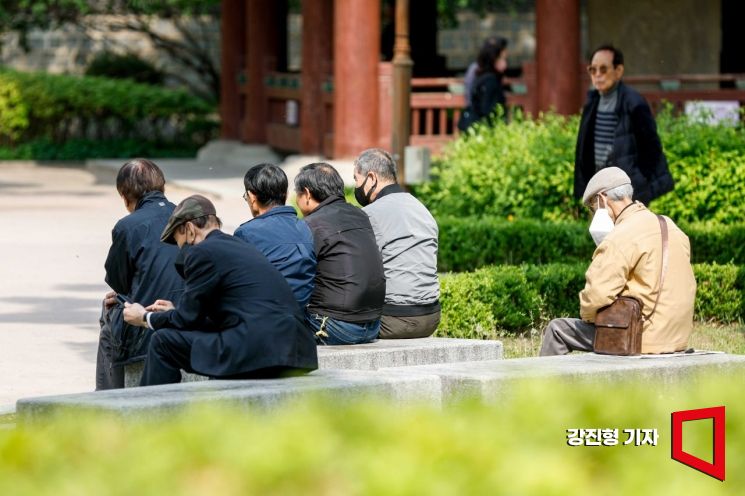 Middle-aged men are gathered in small groups at Tapgol Park in Jongno-gu, Seoul.
 Photo by Jinhyung Kang aymsdream@
When both spouses are enrolled, they each receive pensions during retirement based on the period they paid premiums, so health management is also important.
If both spouses receive their own old-age pensions (the standard form of National Pension received upon reaching the eligible age) and one spouse passes away first, the surviving spouse must choose between their own old-age pension and the survivor’s pension left by the deceased spouse due to the 'overlapping benefit adjustment.' The surviving spouse can select whichever is more advantageous. If the survivor’s pension is much higher than their own old-age pension, they can choose the survivor’s pension but will forfeit their own old-age pension.
There are more considerations with the National Pension. If only the husband has the National Pension and he passes away, the surviving wife can receive the survivor’s pension (60% of the original pension). However, if the wife also has the National Pension, the situation changes. She can choose between ‘my pension + 30% of the survivor’s pension’ or the survivor’s pension alone (in which case her own pension is forfeited).
For example, consider a couple where both husband and wife each receive 1 million KRW monthly from the National Pension. If the husband dies, the survivor’s pension is 60% of the original pension, which is 600,000 KRW. For the wife, choosing the survivor’s pension would be a loss since it is less than her own pension. Therefore, she must choose ‘my pension + 30% of the survivor’s pension.’ In this case, the wife would receive 1.18 million KRW (1 million + 180,000 KRW), which is significantly less than the combined 2 million KRW they received before. If planning to rely on dual pensions for retirement, maintaining good health and living a long life together is crucial to avoid pension disadvantages.
Consider Prepayment of Insurance Premiums
The National Pension Service also recommends the prepayment system. The prepayment system allows National Pension subscribers to pay their premiums up to one month before the due date. Paying premiums in advance offers a discount benefit. Subscribers aged 50 and above, belonging to the 'baby boom generation,' can prepay premiums for up to 5 years. However, the subscription period is only recognized after the prepayment period has passed.
© The Asia Business Daily(www.asiae.co.kr). All rights reserved.
![Clutching a Stolen Dior Bag, Saying "I Hate Being Poor but Real"... The Grotesque Con of a "Human Knockoff" [Slate]](https://cwcontent.asiae.co.kr/asiaresize/183/2026021902243444107_1771435474.jpg)
















