KOSPI Up 2.57% This Year... Worst Performance Compared to Major Global Markets
Samsung Electronics' Weakness Leads to KOSPI's Underperformance
Samsung Electronics Stock Returns Gains This Year, Back to Late Last Year Level
The KOSPI continues to show sluggish movement, unable to break out of its box range trading. Analysts attribute the KOSPI's underperformance compared to major global stock markets this year to its leading stock, Samsung Electronics. Samsung Electronics, which seemed to be on an upward trend after hitting a 52-week high last month, has shown weakness this month, with its stock price returning to levels seen at the end of last year.
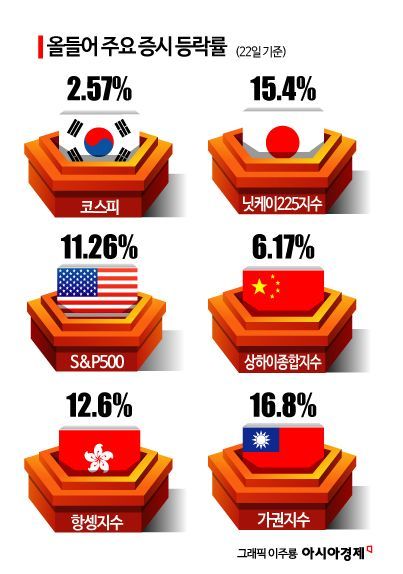
According to the Korea Exchange on the 24th, as of the 22nd, the KOSPI has risen 2.57% this year, marking the weakest performance among major global stock markets. During the same period, the U.S. S&P 500 index rose 11.26%. On the 21st, it closed at 5321.41, setting a new all-time closing high. The S&P 500 index has recorded new highs 24 times this year. The Hong Kong Hang Seng Index rose 12.6%, Japan's Nikkei 225 Index increased by 15.40%, China's Shanghai Composite Index climbed 6.17%, and Taiwan's Weighted Index also rose 16.80%, all significantly outperforming the KOSPI.
The KOSPI's sluggishness is closely related to the underperformance of its leading stock, Samsung Electronics. Recently, the KOSPI has tended to rise when Samsung Electronics rises and fall when Samsung Electronics falls.
The influence of the leading stock is even more evident when compared to the Taiwan stock market. Like Korea, Taiwan's stock market is heavily influenced by the semiconductor industry, but this year it has shown a different trend from the domestic market. Park Sang-hyun, a researcher at Hi Investment & Securities, explained, "Recently, the differentiation between the Taiwan and Korean stock markets has become more pronounced, especially with the widening gap in market capitalization between Taiwan and Korea. Although Taiwan's market capitalization temporarily surpassed Korea's during the pandemic, there has never been a case like now where Taiwan's market cap significantly exceeds Korea's and the gap has widened."
This widening market capitalization gap between Taiwan and Korea is analyzed to be due to the differentiated stock price trends of their leading stocks. This year, Taiwan's leading stock, TSMC, surged more than 40%, while Samsung Electronics fell by 0.25%. Samsung Electronics hit a 52-week high of 86,000 KRW intraday on the 8th of last month but has since shown weakness, giving back gains and returning to year-end levels.
Samsung Electronics' recent stock weakness is attributed to a weakened expectation of competitiveness recovery in the high-bandwidth memory (HBM) sector. Following Nvidia's strong earnings announcement, SK Hynix hit a 52-week high, pushing its stock price above 200,000 KRW, but Samsung Electronics only rose 0.77%. Song Myung-seop, a researcher at Hi Investment & Securities, said, "The recent relative underperformance of Samsung Electronics' stock price appears to be due to weakened expectations for competitiveness recovery in the HBM sector. Reflecting the possibility that the HBM sector's competitiveness may not improve significantly in the near term, we are lowering the target price from 95,000 KRW to 91,000 KRW."
For the KOSPI to break out of its box range and surpass previous highs, a recovery in Samsung Electronics' stock price is necessary. To achieve this, the visibility of HBM supply to major customers must materialize. Currently, Nvidia is reportedly conducting quality tests on Samsung Electronics' HBM3E products. Researcher Song stated, "Above all, news of supply of HBM3 or higher products to the largest customers is needed." Kim Hyung-tae, a researcher at Shinhan Investment Corp., forecasted, "The total HBM market size this year is expected to be around 17 billion USD, with SK Hynix holding over 60% market share. Although Samsung Electronics' HBM3E quality issues continue to be mentioned, we believe performance visibility will be secured in the second half of this year, accelerating HBM market penetration from next year."
© The Asia Business Daily(www.asiae.co.kr). All rights reserved.
![Clutching a Stolen Dior Bag, Saying "I Hate Being Poor but Real"... The Grotesque Con of a "Human Knockoff" [Slate]](https://cwcontent.asiae.co.kr/asiaresize/183/2026021902243444107_1771435474.jpg)















