Brewing Beer with Extracts from Highly Aggressive 'Salinbeol'
Generally, beer is brewed from malt derived from barley. But can it also be made from insects? Interest has been piqued as the world's first beer made by extracting yeast from bees has emerged. Cardiff University in Wales, UK, announced on the 16th (local time) that, in collaboration with a research team from the University of Namibia in Africa, they have created the world's first 'bee beer.' The bee used to extract the yeast is the African honeybee, colloquially known as the 'killer bee.'

This bee is a hybrid created by crossing the European honeybee with the African honeybee. It was expected to aid the beekeeping industry as it can survive in harsh environments such as jungles, but the problem lies in its extreme aggressiveness. It attacks in groups and stings if approached even slightly, requiring careful handling, and it does not collect much honey inside the hive, making it a burdensome presence nowadays.
The research team leading the project came up with the idea of beer while pondering how to utilize these killer bees. Typically, beer is brewed using yeast such as malt yeast. Microorganisms residing in the bee's gut also produce a type of beer yeast called Saccharomyces cerevisiae. Based on this, the team succeeded in isolating yeast from the bee's microorganisms and using it as a beer ingredient.
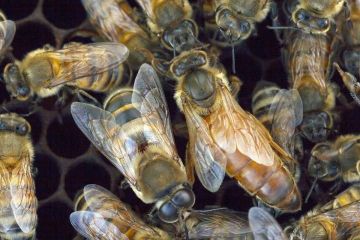 Killer bee. It survives even in harsh environments but is difficult to handle due to its extreme aggressiveness. However, recently, some breeds with somewhat tamed aggressiveness have emerged through continuous breeding and improvement.
 [Image source=Yonhap News]
The Cardiff University team first traveled to Africa to extract beer ingredients from the killer bees, then returned to Wales to isolate yeast from European honeybees, mixing the two yeast sources. As a result, they were able to produce proper beer.
In fact, this idea is a byproduct of the 'Pharmabees' project, which extracts new drug materials from killer bees. While continuing drug research, the Cardiff team is also exploring cooperation with breweries to mass-produce 'killer bee beer.' All profits will be reinvested into the Pharmabees project.
Dr. Rhys Bailey of Cardiff University, who led the research, stated, "Through bee research like killer bee beer, we can solve various problems in nature," adding, "It is significant to uncover what role bee byproducts can play in challenges such as antibiotics and superbugs."
© The Asia Business Daily(www.asiae.co.kr). All rights reserved.
![Clutching a Stolen Dior Bag, Saying "I Hate Being Poor but Real"... The Grotesque Con of a "Human Knockoff" [Slate]](https://cwcontent.asiae.co.kr/asiaresize/183/2026021902243444107_1771435474.jpg)
















