"Constitutional Amendment" Issue Arises but Many Obstacles Remain
Significant Disagreements on the Basic Framework
Without Bipartisan Agreement, Difficult Even in the 22nd Assembly
As the 22nd National Assembly convenes, the ruling and opposition parties have once again raised the issue of 'constitutional amendment.' However, the opposition party is focusing on limiting presidential powers and regime judgment, while the ruling party demands a comprehensive amendment, showing differences.
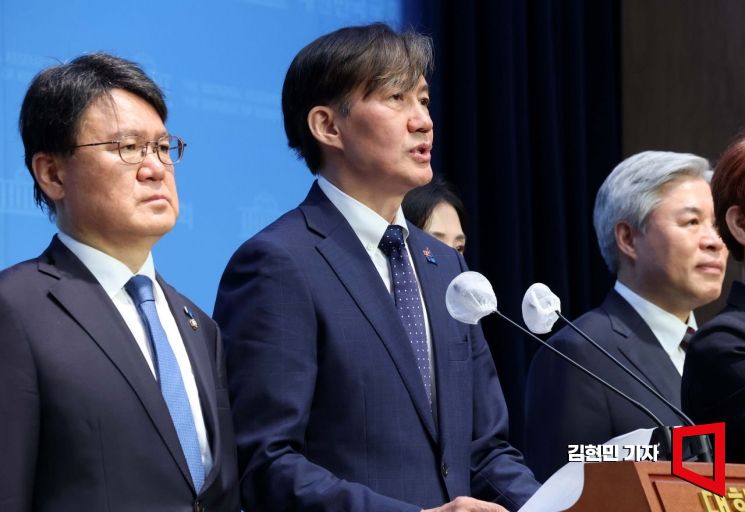 On the 17th, Cho Kuk, leader of the Cho Kuk Innovation Party, held a press conference at the National Assembly Communication Office, proposing the establishment of a constitutional amendment special committee in the National Assembly and the 7th Republic constitutional amendment. Photo by Kim Hyun-min kimhyun81@
The Democratic Party advocates for a 'one-point constitutional amendment' to reduce presidential powers. On the 13th, Yoon Ho-jung, a Democratic Party lawmaker and chair of the party's Constitutional Amendment Special Committee, proposed a 'one-point constitutional amendment' that limits the president's veto power and stipulates that the president, like the Speaker of the National Assembly, cannot hold party affiliation. On the other hand, the People Power Party calls for a comprehensive constitutional amendment. Since the constitution has not been revised since 1987, they suggest reflecting necessary parts in this opportunity. On the 18th in Gwangju, Hwang Woo-yeo, emergency committee chairman of the People Power Party, said, "If we do (the amendment), wouldn't it be better to set the scope and address fundamental issues together?"
The National Innovation Party proposed a more specific constitutional amendment plan. On the 17th, Cho Guk, leader of the National Innovation Party, suggested contents such as a four-year renewable presidential term and the codification of equal pay for equal work of equal value during a briefing titled 'Proposal for the Establishment of a National Assembly Constitutional Amendment Special Committee and the 7th Republic Constitutional Amendment.'
'Both Ruling and Opposition Agree on the 'Old Era Constitution'... But Clash over Regime Judgment'
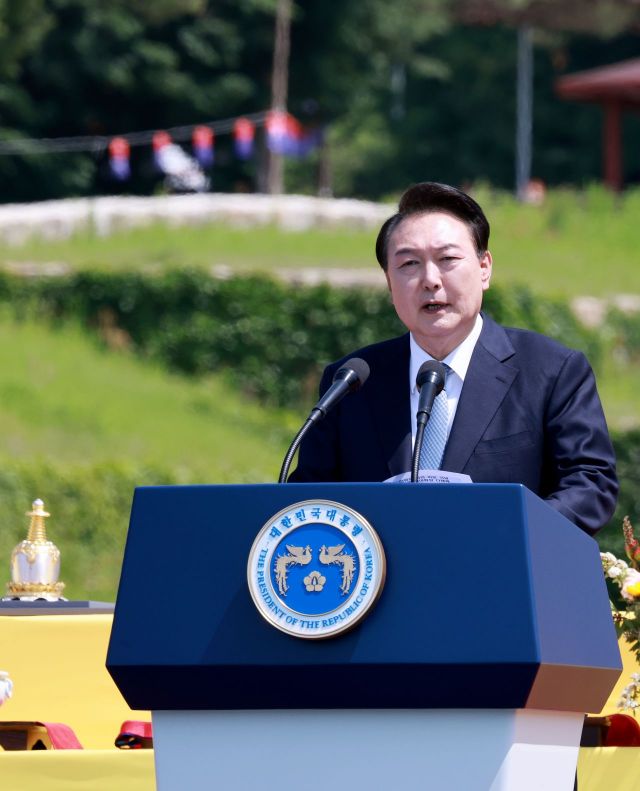 President Yoon Suk-yeol is delivering a congratulatory speech at the 'Hoeamsa Relics Transfer Commemorative Cultural Festival and Samdae Hwasang Daryejae' held on the 19th at Hoeamsaji in Yangju-si, Gyeonggi-do.
 [Image source=Yonhap News]
However, there are many obstacles to 'constitutional amendment.' Representative Cho emphasized that it should apply from the Yoon Suk-yeol administration even if through supplementary provisions. According to Article 128 of the Constitution, constitutional amendments for extending or changing the presidential term have no effect on the president at the time of the proposal. Regarding this, Choo Kyung-ho, floor leader of the People Power Party, said on the 16th, "Limiting the president's veto power is an idea that denies the constitution."
There are also significant disagreements about the basic framework of the amendment itself. While there is consensus on including the May 18 Democratic Uprising in the preamble of the constitution, opinions differ on including liberal democracy in the constitution. The People Power Party wants to include the spirit of liberal democracy in the constitution. In contrast, the Democratic Party has made no particular mention of including liberal democracy in the constitution. In 2018, when the Democratic Party was the ruling party, it removed 'liberal' from 'liberal democratic basic order' in its amendment proposal but later reversed this, calling it a mistake.
Without consensus between the ruling and opposition parties, constitutional amendment is expected to be difficult even in the 22nd National Assembly. To amend the constitution, approval by two-thirds of the total members and a majority in a national referendum are required. In the 22nd National Assembly, the opposition holds 191 seats, so the ruling party must gain the agreement of at least nine opposition members to push for an amendment. Professor Han Sang-hee of Konkuk University Law School said, "This is a time when the limitations of the presidential system are clearly revealed," but added, "Constitutional amendments that change the governance structure, such as a four-year renewable presidential term, may lead to political controversy and seem difficult."
© The Asia Business Daily(www.asiae.co.kr). All rights reserved.
![Clutching a Stolen Dior Bag, Saying "I Hate Being Poor but Real"... The Grotesque Con of a "Human Knockoff" [Slate]](https://cwcontent.asiae.co.kr/asiaresize/183/2026021902243444107_1771435474.jpg)
















