Able to Sit and Stand Gradually Through Surgical Operation
"Separation Surgery Difficult... Possibility of Corrective Surgery Exists"
Conjoined twins from Indonesia, born with three legs joined at the pelvis, have been able to sit up for the first time in three years.
Conjoined twins born with fused ischial bones... able to sit up after 3 years
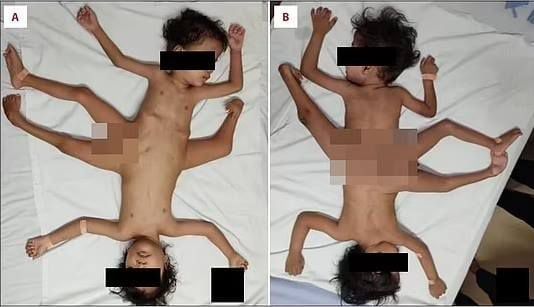 Siamese twin brothers born in Indonesia in 2018. They were born with their pelvic area joined and had three legs, making it impossible for them to sit.
 [Image source=American Case Reports]
On the 17th, the Daily Mail and others reported a case of Indonesian conjoined twin brothers introduced by American Case Reports in 2018. These twins were originally born with their ischial bones fused. Each had an upper body with four arms, and three legs were present at birth, but one leg was non-functional. They shared one penis, anus, bladder, and rectum. Among the twins, one had underdeveloped kidneys, and the other had only one kidney.
Due to their physical structure, the brothers could not sit and lived lying down for three years after birth. Later, medical staff performed surgery to allow them to sit by amputating the non-functional leg and stabilizing the pelvic bones. The surgery was successful, and the brothers gradually began to stand and sit. Fortunately, no complications were observed during the three-month follow-up after surgery. However, it is not yet known whether separation surgery will be performed in the future. The researchers explained, "Separation surgery for ischial conjoined twins is very difficult due to the lack of cases and high complexity," but added, "This case study shows that there is still room for surgical correction besides separation surgery." They also noted, "Their lifespan may be shorter than that of normal twins."
Cases of conjoined twins born joined at the pelvis are rare. It is estimated that 6-11% of conjoined twins are fused at the ischial region. The parents of the conjoined twin brothers reported in this study already had two children and stated there was no family history of the condition. Additionally, the twins' mother had no complications during pregnancy and did not take supplements, medications, or traditional herbal remedies during the pregnancy.
The cause of conjoined twins is unclear... twins not sharing organs have higher survival rates
 The appearance of Indonesian conjoined twins who have become able to sit through Suseul. [Image source=American Case Reports]
Meanwhile, the exact cause of conjoined twins remains unknown. It is believed that identical twins form when a fertilized egg splits into two separate embryos between days 13 and 15 after fertilization, but conjoined twins occur when this process is incomplete and parts remain joined. Another hypothesis suggests that two separate embryos may fuse during early development.
Conjoined twins are three times more common in females than males, and in two-thirds of cases, at least one twin is stillborn or dies shortly after birth. Conjoined twins often share one or more internal organs, which affects survival rates and the success of separation surgery. Twins with separate organs have higher survival rates than those sharing organs.
© The Asia Business Daily(www.asiae.co.kr). All rights reserved.
![Clutching a Stolen Dior Bag, Saying "I Hate Being Poor but Real"... The Grotesque Con of a "Human Knockoff" [Slate]](https://cwcontent.asiae.co.kr/asiaresize/183/2026021902243444107_1771435474.jpg)
















