Government to Ban Direct Import of Some Non-Certified Items from Next Month
No Enforcement for KC Certification... Customs Monitoring Also Limited
Consumer Groups Say "Ineffective Policy... Too Little, Too Late"
Government "Discussing Detailed Measures... Further Discussion Needed"
C-Commerce Platforms Also Discussing Related Measures
The government has taken decisive action against C-commerce (Chinese e-commerce). It announced measures to block overseas direct purchases (direct imports) of certain items that have not received safety certification. Since a significant portion of products sold through C-commerce lack KC certification, the impact appears inevitable, but some also point out that the effectiveness of this measure may be insufficient.
According to the distribution industry on the 17th, the government held a National Affairs Ministerial Meeting chaired by Prime Minister Han Duck-soo at the Incheon Airport Customs Headquarters the day before and announced the "Measures to Strengthen Consumer Safety and Enhance Corporate Competitiveness in Response to the Surge in Overseas Direct Purchases." According to the measures announced by the government that day, overseas direct purchases of certain items without safety certification will be completely banned starting next month.

Until now, most products sold through overseas direct purchase methods on C-commerce platforms such as AliExpress and Temu have been imported into Korea without safety certifications like KC certification. This was because products purchased overseas could be brought into the country without separate safety verification procedures. Investigations conducted by Incheon Customs and Seoul City found that children's products and accessories sold on C-commerce contained harmful substances far exceeding domestic standards. In safety inspections of overseas online platform products conducted by Seoul City in the third week of May, phthalate plasticizers in children's products were detected at levels up to 270 times the standard.
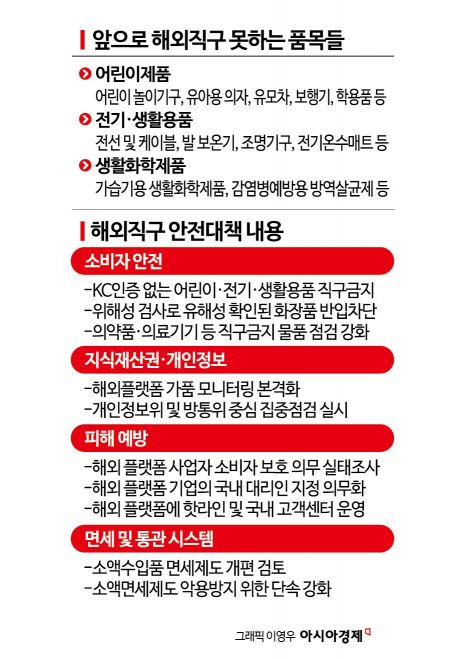
Under the government's new measures, overseas direct purchases of products without safety certifications such as KC certification will be prohibited starting next month. The target items are children's products for those under 13 years old that require special management, and electrical and household goods where accidents such as fire or electric shock are a concern. These products can only be purchased through overseas direct purchase if they have obtained KC certification.
Specifically, 34 children's product items including children's playground equipment, infant chairs, strollers, walkers, and school supplies, as well as 34 electrical and household items such as wires and cables, thermos bottles, lighting fixtures, and electric heating mats, will be banned from overseas direct purchase if they lack KC certification. Additionally, 12 household chemical products including humidifier chemicals and disinfectants for infectious disease prevention will also be prohibited from overseas direct purchase if they have not been registered or approved.
Measures will also be implemented to prevent the import of products containing harmful substances even if they have safety certification. First, cosmetics and hygiene products that come into direct contact with the skin will be inspected for 1,050 prohibited ingredients. Products found to be harmful during this process will be banned from import. Accessories and household chemical products will also be monitored and surveyed, and products exceeding harmful substance standards will be blocked from import.
Experts evaluated that the government's measures are meaningful in that they create an environment where domestic small-scale distributors can compete on equal footing with C-commerce. Professor Seo Yong-gu of the Department of Business Administration at Sookmyung Women's University said, "The government has taken appropriate measures to level the playing field in competition with C-commerce," adding, "Now domestic companies must develop differentiated competitiveness to compete against C-commerce."
However, the effectiveness of the government's measures remains uncertain. Currently, there is no proper means to enforce KC certification on overseas sellers. Sellers on overseas platforms like Ali and Temu sell products not only to Korea but also to various other countries where these platforms operate. Considering the procedures and costs related to KC certification, it is unlikely that they will obtain certification solely for the Korean market. The cost of KC certification varies by product type but ranges from at least several hundred thousand won to several million won per item.
It also seems difficult to filter out uncertified products one by one during the customs clearance process. Currently, some items such as pharmaceuticals are completely banned from overseas direct purchase, but due to the excessive volume of customs clearance, it is known that thorough inspection of each item is difficult. According to the Korea Customs Service, about 41.33 million customs clearance cases entered Korea through e-commerce in the first quarter of this year. This means an average of 460,000 customs clearance cases per day in the first quarter alone. For similar reasons, it is expected to be difficult to filter out uncertified products during customs clearance of products purchased through C-commerce.
Some criticize the government's overseas direct purchase measures as lacking effectiveness. A representative from the consumer rights group Consumer Sovereignty Citizens' Council called the measures "too little, too late," stating, "With the current insufficient customs personnel in Korea, inspecting overseas direct purchase products one by one within a short period is inherently ineffective," and pointed out, "There is also ambiguity about who should obtain KC certification for products sold on overseas direct purchase platforms."
There are also assessments that customs procedures should be strengthened to enhance the effectiveness of government measures. Professor Seo also said, "The government's announcement of overseas direct purchase measures is symbolic, and various problems will inevitably arise during implementation," advising, "Since the problem arises from excessive customs volume, sampling inspections on a portion of the volume or allowing more time in customs procedures could be considered."
In response, a Korea Customs Service official said, "Before the related measures are implemented in June, we plan to consult with related agencies such as the National Institute of Technology and Standards to prepare detailed measures," adding, "Specific plans have not yet been finalized, so further discussions are needed."
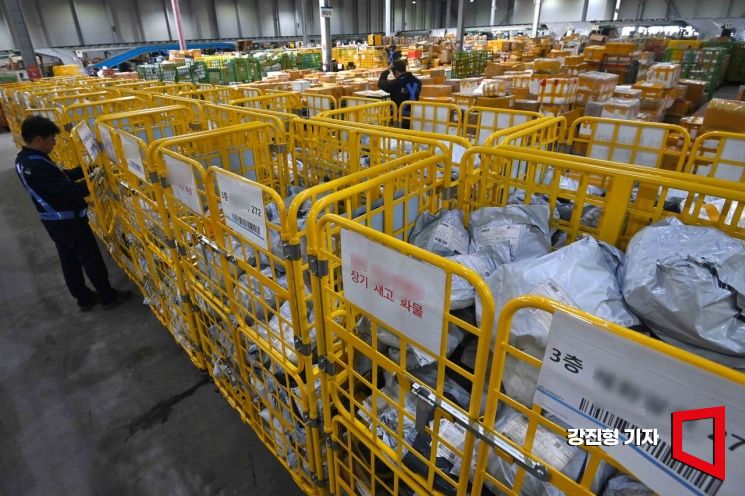 On the 16th, a customs official at the Incheon Airport Customs Express Logistics Center is organizing long-term stock cargo delivered from China. Photo by Jinhyung Kang aymsdream@
C-commerce companies directly affected by these measures expressed a fundamental stance of complying with domestic laws to protect consumers while striving to block harmful products. An Ali representative said, "We are doing our best to comply with Korean laws and regulations," and added, "We will continue monitoring to maintain a safe platform for consumers." However, it is reported that both Ali and Temu are internally reviewing the impact of the government's measures through their legal and related departments and discussing corresponding countermeasures.
Meanwhile, separate from the government's measures, Ali and Temu signed a voluntary agreement with the Korea Fair Trade Commission on the 13th to work on blocking harmful products. Through this agreement, both parties will monitor whether harmful products are being distributed and sold based on collected information. If harmful products are confirmed to be distributed or sold through monitoring results, the government will provide this information to Ali and Temu to induce sales blocking. Ali and Temu will also autonomously block sales if harmful products are found during their own monitoring.
© The Asia Business Daily(www.asiae.co.kr). All rights reserved.
![Clutching a Stolen Dior Bag, Saying "I Hate Being Poor but Real"... The Grotesque Con of a "Human Knockoff" [Slate]](https://cwcontent.asiae.co.kr/asiaresize/183/2026021902243444107_1771435474.jpg)

















