The medical community's appeal court ruling on the suspension of the enforcement of the decision to increase and allocate medical school quotas will be announced on the afternoon of the 16th.
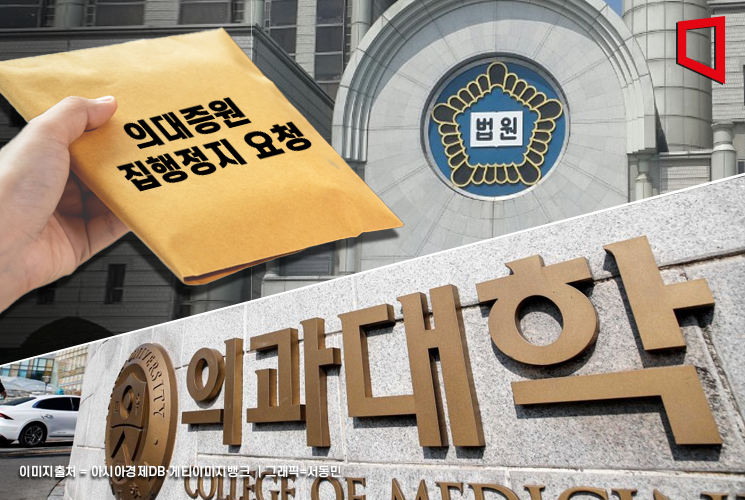
According to the legal community on the 16th, the Seoul High Court Administrative Division 7 (Presiding Judges Gu Hoe-geun, Bae Sang-won, Choi Da-eun) will issue a decision around 5 p.m. on the same day regarding the appeal for the suspension of enforcement filed by 18 individuals, including examinees, medical students, residents, and medical school professors, who requested the government to halt the enforcement of the policy to increase and allocate 2,000 medical school quotas. A Seoul High Court official stated, "Unless there are special circumstances, a decision on the suspension of enforcement for the medical school quota increase is expected around 5 p.m. today."
This case was filed together with an administrative lawsuit by medical school professors, university hospital residents, and medical students against the Ministers of Health and Welfare and Education, requesting the cancellation of the 2,000 medical school quota increase for the 2025 academic year. A suspension of enforcement refers to a court decision to temporarily halt the execution of an administrative disposition or the continuation of procedures when an administrative disposition cancellation lawsuit is filed.
The first trial court, the Seoul Administrative Court, dismissed the suspension of enforcement application, citing the plaintiffs' lack of 'standing.' Dismissal means ending the trial without examining the merits when the lawsuit does not meet the requirements or the claim is not subject to judgment.
However, during the appeal hearing on the 30th of last month, the appellate court pointed out, "If no one is recognized as having standing, it means that when the state increases medical school quotas, there is no one to challenge it, raising the question of whether such a state decision can be subject to judicial review or control," suggesting the possibility of a different conclusion from the previous court.
The court ordered the government to submit additional materials related to the medical school quota increase. The government submitted a total of 49 documents, including the agenda and minutes of the Health and Medical Policy Deliberation Committee (Bojeongshim), and the results of the subordinate Medical Personnel Expert Committee. After the government's submission, a dispute arose between the government and the medical community over whether these materials could be considered as grounds for the quota increase discussion.
If the court decides to dismiss (lack of lawsuit requirements) or reject (not accepting the application), the final confirmation of the medical school quota increase for the first time in 27 years will enter its final countdown. However, if the court accepts the application, the government's plan to increase medical school quotas next year will be halted.
Regardless of the outcome, it is highly likely that one side will appeal to the Supreme Court. However, even if an appeal is filed, it is physically difficult for the Supreme Court to make a ruling by the end of this month, so it is expected that the decision this time will effectively determine whether the medical school quota increase will proceed this year. This is because each university must finalize the quota by reflecting the medical school recruitment numbers in the 2025 academic year early admission guidelines by the end of this month.
© The Asia Business Daily(www.asiae.co.kr). All rights reserved.
![Clutching a Stolen Dior Bag, Saying "I Hate Being Poor but Real"... The Grotesque Con of a "Human Knockoff" [Slate]](https://cwcontent.asiae.co.kr/asiaresize/183/2026021902243444107_1771435474.jpg)















