Korea, US, Japan, and China Gather in Tokyo to Discuss North Korea Issue
Jung Park: "China, Do Not Forcefully Repatriate North Korean Defectors"
Experts: "Yoon Government's Value Diplomacy, Blatant Deviation"
Following last year, hundreds of North Korean defectors residing in China were once again forcibly repatriated, but the government remains tight-lipped. In this situation, with the United States taking the lead in raising the issue of forced repatriation with China, attention is focused on whether Foreign Minister Cho Tae-yeol, who is about to visit China for the first time in six years, can bring this matter to the surface. It is a challenging task as it requires simultaneously addressing improvements in relations, including the Korea-China-Japan summit.
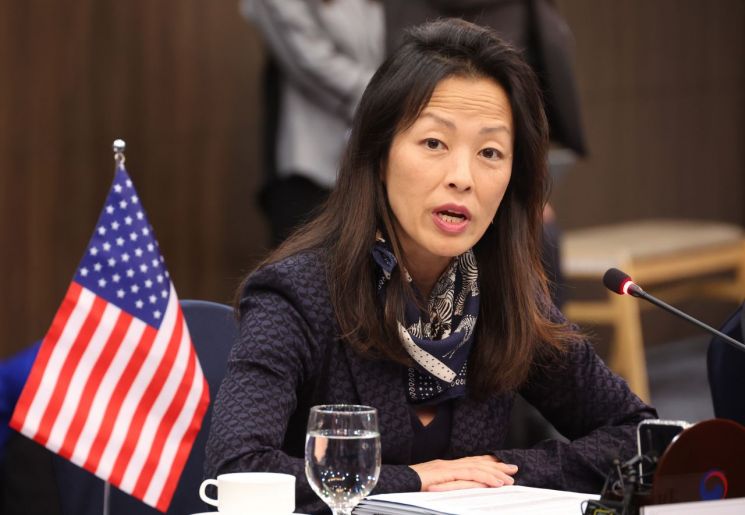
According to the U.S. Department of State, on the 9th (local time), Senior U.S. Official for North Korea Policy Jeong Park met with Liu Xiaoming, China's Special Representative for Korean Peninsula Affairs, in Tokyo during the Northeast Asia Cooperation Dialogue (NEACD) to exchange views on North Korea issues. While expressing concern over security threats posed by North Korea's nuclear and missile development, they particularly pointed out China's forced repatriation of North Korean defectors, including asylum seekers. China, as a permanent member of the UN Security Council and a party to international legal principles such as the Refugee Status Convention and the Convention Against Torture, was reminded of its obligation to protect defectors.
South Korea Silent on 'Forced Repatriation'... U.S. Points Out China's Wrongdoing
Earlier, China forcibly repatriated about 500 North Korean defectors immediately after the closing of the Hangzhou Asian Games in October last year. The repatriation continued, and on the 26th of last month, news emerged that an additional 200 defectors detained in facilities such as the Baishan Detention Center in Jilin Province were sent back, raising concerns. The international human rights organization Human Rights Watch (HRW) also confirmed on the 8th that the Chinese government recently repatriated about 60 North Korean defectors. The concern arises from the human rights abuses North Korean residents face after repatriation. The UN Commission of Inquiry on Human Rights in the Democratic People's Republic of Korea (COI) has repeatedly warned that defectors face risks of forced labor in political prison camps, arbitrary detention, torture, sexual violence, and even execution if repatriated.
While the South Korean government confirmed that "it is true that many defectors have recently been sent back to North Korea," it has only repeated a principled stance in response. The relevant ministries, the Ministry of Foreign Affairs and the Ministry of Unification, have only stated that "the government holds the position that overseas North Korean defectors should never be forcibly repatriated against their will," but have remained silent about any discussions with China on this issue. During the large-scale repatriation last year, the government said it would "sternly raise the issue," but this time it did not express any separate regret.
On the same day that the U.S. raised the forced repatriation issue first, a meeting among South Korea, the U.S., and Japan's representatives for North Korea negotiations was held in Tokyo. Lee Jun-il, head of the North Korea Nuclear Diplomacy Planning Division at the Ministry of Foreign Affairs, Jeong Park, senior U.S. official for North Korea policy, and Namazu Hiroyuki, Director-General of the Asian and Oceanian Affairs Bureau at Japan's Ministry of Foreign Affairs, shared concerns about North Korea's provocations, illegal weapons of mass destruction (WMD), ballistic missile programs, and deepening military cooperation between North Korea and Russia. Even in a situation where allies gathered to discuss North Korea issues, which are South Korea's top priority, it was the U.S., not South Korea, that voiced concerns about the repatriation of defectors.
'Value Diplomacy' Promised... Silence on Defector Human Rights
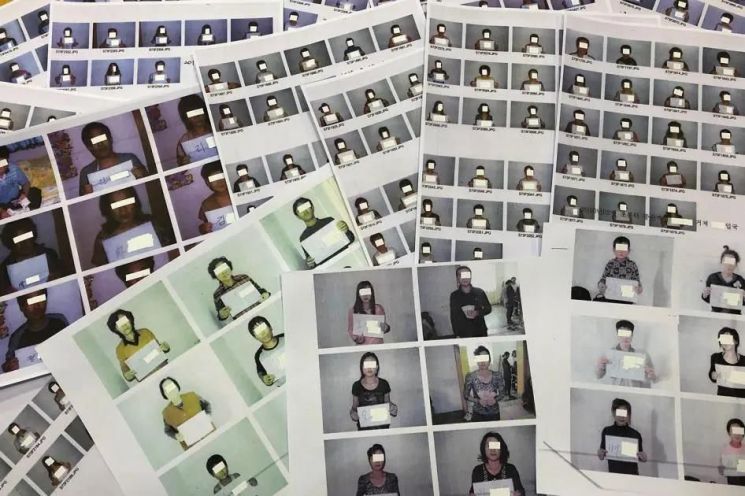 Photos of North Korean defectors revealed through an exhibition held in Seoul in 2019 [Image source=Human Rights Watch (HRW)]
The government has maintained a policy of "quiet diplomacy." The aim is to avoid conflicts arising from public remarks while achieving effective results behind the scenes. However, human rights organizations on North Korea have evaluated that this approach showed its limitations during the first large-scale repatriation last year. Moreover, the Yoon Seok-yeol administration has promoted "value diplomacy," emphasizing universal values such as human rights in the international community. Nevertheless, Ambassador Hwang Jun-guk at the United Nations invited criticism by stating at the UN General Assembly last October that "North Koreans detained in third countries were forcibly repatriated," avoiding directly naming China and instead referring to it as a "third country."
The government's reluctance to speak stems from the Korea-China-Japan summit, which it has been diligently preparing as the chair country since last year. The summit is being coordinated with the goal of holding it on the 26th-27th of this month. Foreign Minister Cho Tae-yeol, who will visit Beijing on the 13th-14th, is expected to resolve this issue.
Minister Cho, visiting China for the first time in six and a half years since November 2017 as South Korea's Foreign Minister, is scheduled to hold a Korea-China Foreign Ministers' meeting with Wang Yi, China's Foreign Minister, and urge China to play a "constructive role" regarding North Korea. The issue of forced repatriation of North Korean defectors is also expected to be on the table. However, it is uncertain whether Minister Cho will raise demands consistent with the Yoon administration's "value diplomacy" as the top diplomatic leader. This is because there are many tasks such as improving Korea-China relations, resuming high-level exchanges, and restructuring supply chains that require a friendly approach to China. Given this situation, some suggest that China may be calculating that South Korea will find it difficult to lodge a "high-level" diplomatic protest that could become a diplomatic setback.
"Minister Cho Tae-yeol Should Include Forced Repatriation on Meeting Agenda"
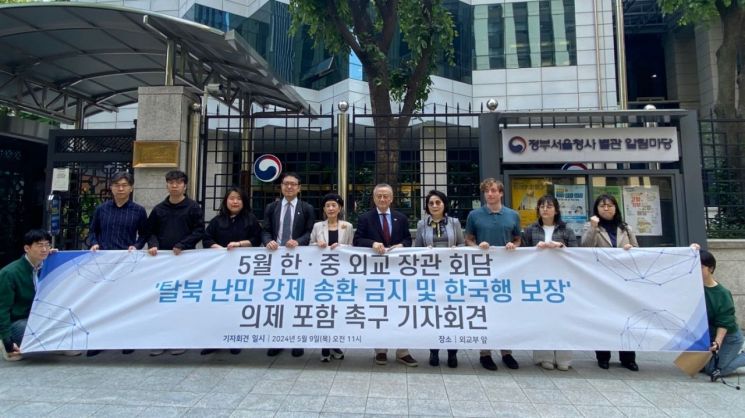 On the 9th, North Korean human rights organizations and families of victims forcibly repatriated from North Korea held a joint press conference in front of the Ministry of Foreign Affairs building, urging that the upcoming Korea-China Foreign Ministers' Meeting, coinciding with Foreign Minister Cho Tae-yeol's visit to China, include "a ban on the forced repatriation of North Korean refugees and a guarantee of their safe passage to South Korea" as an agenda item.
 [Photo by North Korean Human Rights Citizens' Alliance]
On the 9th, North Korean human rights organizations held a joint press conference in front of the Ministry of Foreign Affairs building, demanding that Minister Cho include "a ban on forced repatriation of North Korean refugees and a guarantee of their right to go to South Korea" on the agenda of the Korea-China Foreign Ministers' meeting. They also pointed out that President Yoon's criticism last November of the forced repatriation of defectors as a "serious human rights violation" should be upheld. The event included organizations such as the North Korean Human Rights Citizens' Alliance (NKHR), Transition Justice Working Group (TJWG), Justice for North Korea Solidarity (JFNK), Mulmangcho, and the Families of Korean War POWs Association, along with families of forced repatriation victims Kim Gyuri and Kim Hyuk.
Lee Young-hwan, representative of the Transition Justice Working Group, criticized, "Sending an ambassador to Putin's inauguration, which Western countries boycotted after Russia vetoed the Security Council's North Korea sanctions expert panel, is a blatant deviation from 'value diplomacy.' It directly undermines the international community's expectations for South Korea to rise as a global pivotal state." He emphasized, "Minister Cho Tae-yeol must let the public know what was gained and what was conceded to China, including the forced repatriation issue, during this visit to China."
Moon Sung-mook, head of the Unification Strategy Center at the Korea Institute for National Strategy, urged, "Minister Cho should clearly state that it is inappropriate for China, a party to the Refugee Convention, to consider North Korean defectors as 'illegal entrants' and forcibly repatriate them."
© The Asia Business Daily(www.asiae.co.kr). All rights reserved.
![Clutching a Stolen Dior Bag, Saying "I Hate Being Poor but Real"... The Grotesque Con of a "Human Knockoff" [Slate]](https://cwcontent.asiae.co.kr/asiaresize/183/2026021902243444107_1771435474.jpg)

















