Market analysts are pouring in with interpretations that the Bank of England's (BOE) decision to keep the base interest rate at 5.25% strengthens the possibility of a rate cut as early as June. Among the nine Monetary Policy Committee members, the number advocating for a cut increased to two this month. Additionally, BOE Governor Andrew Bailey's remarks such as "a June cut is not ruled out" and "the situation is moving in the right direction" were also seen as dovish (favoring monetary easing). Fueled by expectations of a rate cut, the London stock market hit record highs for the fifth consecutive trading day.
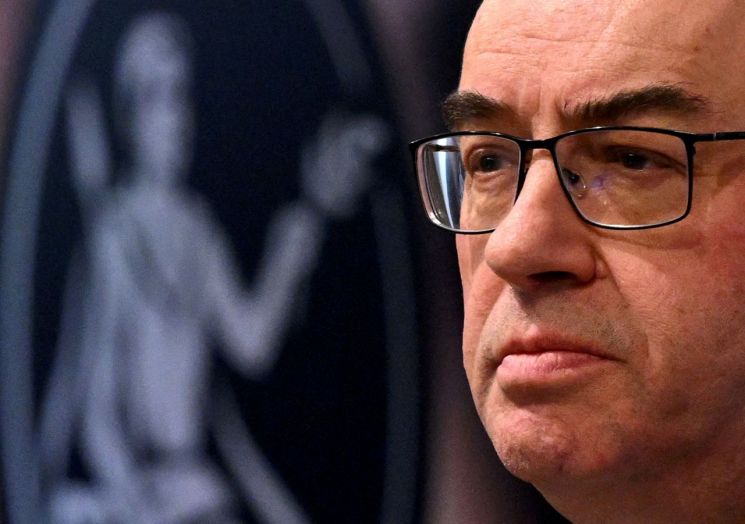
UK Holds Base Rate Steady... Bailey Says "Cut Not Ruled Out"
The Bank of England (BOE), the UK's central bank, maintained the base interest rate at 5.25% per annum at its Monetary Policy Committee meeting on the 9th (local time). Among the nine committee members, seven voted to keep the rate unchanged, while two proposed a 0.25 percentage point cut. In its statement, the BOE said, "The committee will consider upcoming data releases and what information these provide regarding the assessment that the risks to inflation persistence have diminished." This phrase was not present in the previous Monetary Policy Committee statement.
While a rate hold in May had been anticipated early on, market attention focused on Governor Andrew Bailey's press conference remarks. Bailey noted, "There has been encouraging news regarding inflation," and assessed that "inflation is expected to fall close to the 2% target within the next two months." He added, "More evidence related to inflation is needed before cutting rates," but also stated, "The situation is moving in the right direction."
Regarding the possibility of a rate cut in June, Bailey said it was "neither ruled out nor a foregone conclusion." He forecasted, "There is a high likelihood that rates will be cut and monetary policy will become less restrictive within a few quarters." He also mentioned that the rate cut could be larger than market expectations. He said, "Before the June meeting, we will have two sets of complete data on inflation and the labor market," which "could help inform new judgments." The BOE's next meeting is scheduled for the 20th of next month.
"Sent a Signal for June Cut" Market Cheers, Why?
The market widely interprets that the BOE has sent a signal for a rate cut in June. At the beginning of the year, three of the nine Monetary Policy Committee members advocated for rate hikes, but since March, there have been no such calls. This month, those advocating for a cut increased from one to two. Swati Dhingra has maintained a cut stance for three consecutive meetings. Notably, Deputy Governor David Ramsden shifted from advocating a hold to a cut. Bloomberg News assessed this as "a clear signal that the BOE, which was in tightening mode just four months ago, is now planning to ease policy."
Governor Bailey's remarks released that day were generally dovish. While he emphasized the fundamental point that more evidence is needed to confirm inflation is moving toward the 2% target before cutting rates, he repeatedly described the current situation as "encouraging" and "moving in the right direction." The UK's Consumer Price Index (CPI) inflation rate, which once surged above 11%, has eased to the 3% range. According to Bloomberg News, this is the first time since 2022 that the UK's CPI inflation rate has fallen below that of the United States. Henry Cook, Chief Economist at MUFG, commented, "If inflation and wage pressures improve over the coming weeks, the door to a rate cut will be wide open at the next meeting (in June)."
In particular, Bailey made dovish remarks regarding potential variables for the BOE's future actions, such as the U.S. Federal Reserve (Fed) and upcoming elections. He differentiated the UK from the U.S., where rate cut expectations have retreated due to recent 'last mile' concerns (the final stretch before reaching the target), stating, "The inflation dynamics in the UK are different from those in the U.S.," and emphasized, "It is important to distinguish between them." Bloomberg News described this as "completing Governor Bailey's pivot (policy shift)." Additionally, in a CNBC interview that day, Bailey emphasized the independence of the central bank while confirming that a rate cut before the election is possible.
Currently, the BOE is also under political pressure to cut rates. The ruling Conservative Party, facing elections in the second half of the year, hopes for a rate cut to reduce the public's interest burden before the election. This context explains why UK Chancellor of the Exchequer Jeremy Hunt welcomed the positive assessment of the CPI and said, "The BOE has opened the possibility of considering a rate cut." Hunt also said that day, "What we want is sustainable low interest rates," and added, "What is encouraging is that the BOE Governor expressed genuine optimism for the first time that we are on that path."
"Need to Watch Data" Some Expect First Rate Cut in August
However, as inflation still exceeds the target, there are also growing opinions that a cautious approach to cutting rates is necessary. Contrary to the inflated expectations of a June pivot, the BOE's statement that day clearly indicated that future monetary policy decisions will depend on upcoming data.
Anna Leach, Chief Economist at the Confederation of British Industry (CBI), the UK's largest business lobbying group, said, "A delicate balance is needed to manage inflationary pressures," and predicted, "The first rate cut is likely in August." McKinsey economist Terra Allas also warned, "We have not yet overcome inflation," and cautioned that volatility could increase during the disinflation process. She noted, "At a lower level than the U.S., the UK could face a situation similar to the U.S.," expressing concerns about the so-called last mile.
Meanwhile, buoyed by expectations of a rate cut, the London stock market reached record highs. On that day, the FTSE 100 index, composed of UK blue-chip stocks, closed up 0.33% compared to the previous session. This marked the fifth consecutive trading day of closing record highs since the 2nd, representing the longest upward streak since January 2017.
© The Asia Business Daily(www.asiae.co.kr). All rights reserved.
![Clutching a Stolen Dior Bag, Saying "I Hate Being Poor but Real"... The Grotesque Con of a "Human Knockoff" [Slate]](https://cwcontent.asiae.co.kr/asiaresize/183/2026021902243444107_1771435474.jpg)
















