The political sphere has stepped in amid the 'Line Yahoo incident,' where the Japanese government and companies are pressuring Naver to sell shares. However, due to the complex intertwining of Korea-Japan relations and corporate interests, lawmakers are maintaining a somewhat cautious stance.
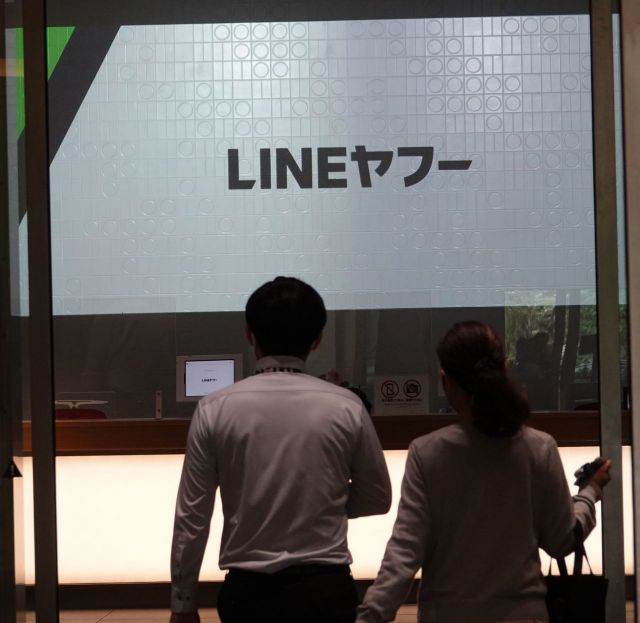 On the afternoon of the 9th, people are entering Tokyo Garden Terrace Kioi Tower in Chiyoda-ku, Tokyo, Japan, where Line Yahoo is located. The words "Line Yahoo" are written in front of the walking people. [Image source=Yonhap News]
On the afternoon of the 9th, Yoon Sang-hyun, a member of the People Power Party, held a press conference at the National Assembly in Yeouido, Seoul, stating, "Line Yahoo, under pressure from the Japanese government, has moved to oust Naver," and added, "The government must not stand idly by. It should actively protect domestic companies expanding overseas and promptly block the repercussions on Korea-Japan relations." On the 10th, Ahn Cheol-soo, also from the People Power Party, wrote on Facebook, "The Japanese government's actions are anti-market measures comparable to those against hostile countries," and argued, "We must prioritize respecting Naver's position and provide practical support to the company."
The opposition parties also criticized the government. No Jong-myeon, spokesperson for the Democratic Party of Korea, said in a written briefing, "This is not merely a management dispute or share negotiation between major shareholders but an issue of Korean technology being taken by Japan," and pointed out, "The government must definitely prevent Japan's 'Line invasion' and protect Korean technology." Lee Hae-min, a member-elect of the Innovation Party for Justice, stated at a National Assembly press conference, "The normalization of Korea-Japan relations advocated by President Yoon Seok-yeol is another name for submissive diplomacy toward Japan," and asked, "Does the Korean government not know how to protest and demand corrective measures?"
Lawmakers from both Korea and Japan also met directly. On the 3rd, Yoon and other Korean and Japanese lawmakers met at a hotel in Seoul during the 'Korea-Japan Strategic Forum' hosted by the Sejong Institute to share their respective positions regarding the Line Yahoo incident. Yoon said, "The Japanese lawmakers were completely unaware of the Line Yahoo incident," and added, "I told them I would go to the Japanese government to convey (the Korean side's position)."
Ruling and Opposition Parties Criticize Government but... "Reluctant to Make It a Major Issue"
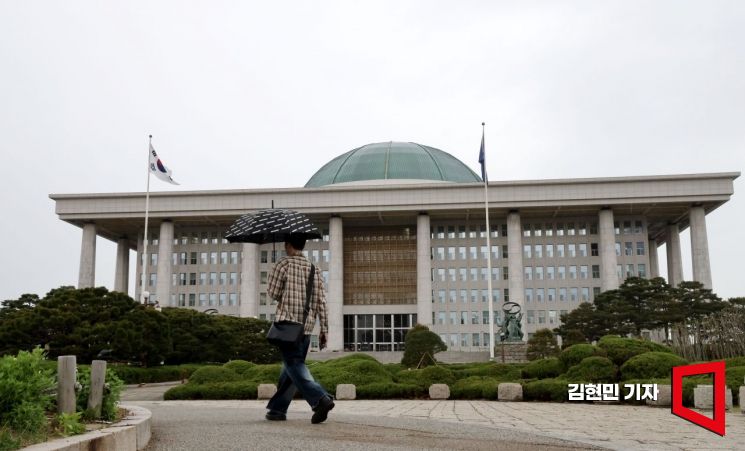 On the 15th, dark clouds heavily covered the National Assembly building. With the 22nd general election concluded on the 10th, attention is focused on how the 21st National Assembly, with just over a month left in its term, will resolve pressing issues such as pension reform and the abolition of the financial investment tax. Photo by Hyunmin Kim kimhyun81@
However, although both ruling and opposition parties share a common stance, it has not translated into concrete actions. The opposition's anti-Japanese attacks are also not strong. Lawmakers said they have no choice but to be cautious because Korea-Japan relations and corporate interests are at stake. An opposition lawmaker said, "I understand the government is negotiating with the Japanese government behind the scenes," and added, "In this situation, the government feels burdened if the National Assembly makes the Line Yahoo incident a major issue."
Furthermore, "Naver has conveyed the view that it is in a difficult position and needs more time," and explained, "When companies operating overseas get involved in diplomatic issues, it is hard for the National Assembly to intervene. From the company's perspective, this is a matter of profit and survival."
Another reason for the cautious approach is the cultural differences between Japan and Korea. Japan only introduced the 'My Number' system, similar to Korea's resident registration number, in 2016. Even then, concerns about potential leaks caused difficulties in its establishment. Yoon said, "Japan is a society that is 'ultra-sensitive' beyond sensitive, which is different from Korea." Professor Lee Won-duk of the Department of Japanese Studies at Kookmin University explained, "In Japan, there was public discomfort with the idea of personal information being managed on overseas servers," and added, "The Line Yahoo personal information leak incident gave the Japanese government a justification."
© The Asia Business Daily(www.asiae.co.kr). All rights reserved.
![Clutching a Stolen Dior Bag, Saying "I Hate Being Poor but Real"... The Grotesque Con of a "Human Knockoff" [Slate]](https://cwcontent.asiae.co.kr/asiaresize/183/2026021902243444107_1771435474.jpg)
















