One of the emerging topics in the pharmaceutical and bio industries recently is 'open innovation.' Open innovation, meaning 'open innovation,' refers to the concept of companies collaborating with other companies, universities, or research institutes to share resources and create new products. Especially in the pharmaceutical and bio sectors, given the characteristics of new drug development that takes over 10 years and costs trillions of won, it has recently been emphasized as a way to reduce time and costs. There are various stages, from the most common form of technology export (licensing out) to joint ventures and mergers and acquisitions (M&A).
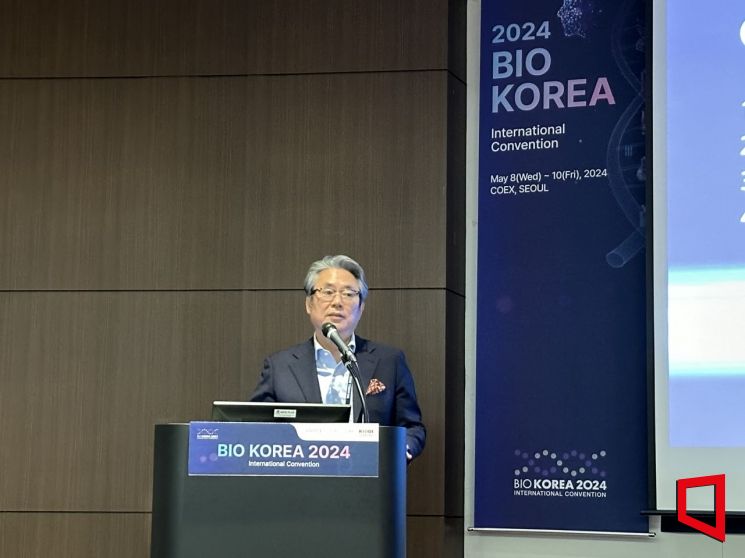 Heo Kyunghwa, CEO of the Korea Innovative Medicines Consortium (KIMCo), is giving a presentation during the 'Global Open Innovation' session at Bio Korea 2024 Conference held at COEX in Gangnam-gu, Seoul on the 9th.
 [Photo by Lee Chunhee]
On the 9th, Huh Kyunghwa, CEO of the Korea Innovative Medicines Consortium (KIMCo), emphasized at the 'Global Open Innovation' session during Bio Korea 2024 Conference held at COEX in Gangnam-gu, Seoul, that for successful open innovation, "what global big pharma focuses on are platform technologies, proof-of-concept (PoC) candidate substances, and scientific data," and that these must be secured.
In particular, CEO Huh emphasized platform and scientific data. Citing the example of Ligand Chem Bio (formerly LegoChem Bio), she said, "Success was possible because there was platform technology capable of creating various assets, not just a single asset." She added, "Scientific data is king," explaining that especially due to the difficulty in valuing new drugs, having such data is essential for smooth valuation and successful partnering.
Lee Seungjoo, CEO of Orum Therapeutics, which successfully licensed out a candidate substance to Bristol-Myers Squibb (BMS) last year with a contract payment of $100 million and a total amount of $180 million (about 246.8 billion KRW), also focused on introducing their platform technology. Orum Therapeutics is recognized as a pioneer in the degrader-antibody conjugate (DAC) technology, which combines the emerging global pharmaceutical and bio core platform antibody-drug conjugate (ADC) with a new method called targeted protein degradation (TPD). CEO Lee said, "We believed it could provide benefits by combining the advantages of the two modalities," adding, "Since technology development requires a lot of capital and manpower, we will strive to find partners and hope to make more deals like the one with BMS in the future."
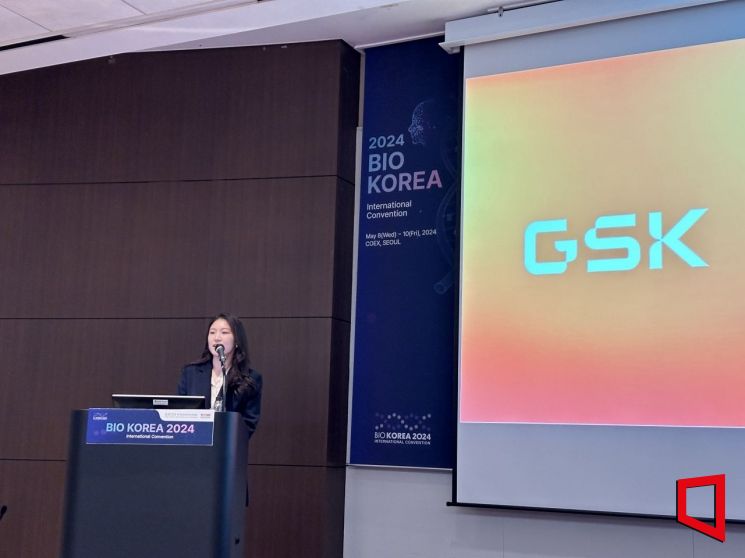 Lee Sang-eun, Director of GlaxoSmithKline (GSK), is presenting at the 'Global Open Innovation' session during Bio Korea 2024 Conference held on the 9th at COEX, Gangnam-gu, Seoul.
 [Photo by Lee Chun-hee]
Meanwhile, big pharma companies such as BeiGene, GlaxoSmithKline (GSK), and MSD also agreed with these conditions and actively promoted their desired visions while seeking new partners.
Evan Goldberg, Vice President of Business Development at BeiGene, stated, "Open innovation in the global market requires shared values and vision," presenting the vision of "providing medicines to more people." He continued, "We need to see how this can be achieved through collaboration," explaining, "A shared goal of supplying commercialized products worldwide is important for collaboration."
Lee Sang-eun, Business Development (BD) Director at GSK, said, "GSK is expanding its portfolio by building various pipelines through active partnership alliances," citing examples such as establishing a joint venture (JV) with Japan's Shionogi Pharmaceutical for the development of human immunodeficiency virus (HIV) treatments. He added, "Many Korean biotechs have almost no exit strategies, such as M&A not going well," and suggested, "GSK is also very interested in expanding the therapeutic area through new targets, so it is necessary to explore ways to provide prevention and treatment through shared goals and values with other companies."
Koji Yasuhiro, Director at MSD, emphasized, "MSD invests heavily in external innovation, spending half ($30.5 billion) of last year's revenue ($60.1 billion) on R&D," highlighting that "blockbusters like Keytruda, Gardasil, Molnupiravir, and Lynparza were all developed with external partners." He mentioned the 2020 licensing agreement for the liver disease treatment epinofegduotide with Hanmi Pharmaceutical and the formulation conversion platform ALT-B4 licensing agreement with Alteogen, saying, "We want as many companies as possible to propose new ideas and utilize them together," and urged, "It is time to sign agreements with other Korean companies, so please show a lot of interest."
© The Asia Business Daily(www.asiae.co.kr). All rights reserved.
![Clutching a Stolen Dior Bag, Saying "I Hate Being Poor but Real"... The Grotesque Con of a "Human Knockoff" [Slate]](https://cwcontent.asiae.co.kr/asiaresize/183/2026021902243444107_1771435474.jpg)
















