Cute Emoticons Instead of Formal Text
Playing a Role in Easing Rigid Organizational Atmosphere
Many people have likely experienced using emoticons to respond flexibly when faced with somewhat awkward situations at work. The fact that many office workers empathized with the 'office worker Min Hee-jin' persona in Min Hee-jin, CEO of Adore's 'Determined Press Conference' targeting HYBE, is in this context. Many responded with "That's just like me" when Min, through a KakaoTalk conversation with Park Ji-won, CEO of HYBE, humorously expressed complex emotions using emoticons. Emoticons have long become an essential communication tool for office workers.
On the 11th, KB Financial Group Management Research Institute analyzed in a report that emojis and emoticons are emerging as a new communication trend among office workers. As emojis and emoticons have established themselves as tools to convey emotions and intentions that are difficult to express in words, communication methods have changed. They are evaluated to have softened rigid organizational atmospheres with stiff language and relieved tension through light humor. Emojis refer to images themselves, while emoticons mean pictures composed of text such as letters, symbols, and numbers.
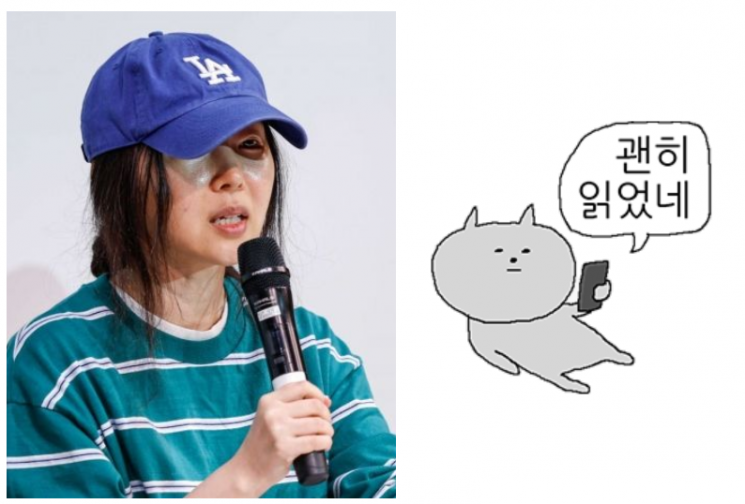
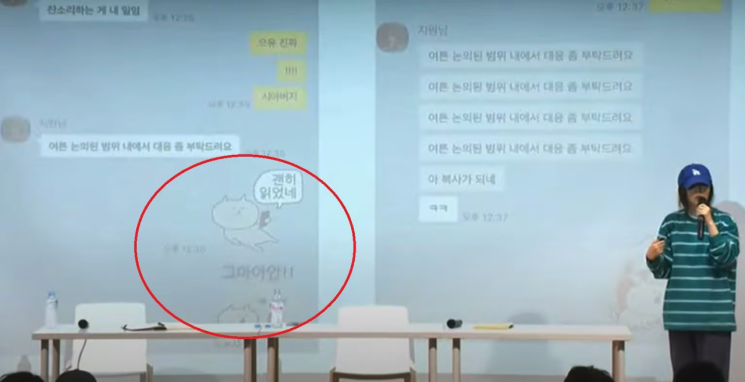 KakaoTalk emoticons revealed during CEO Min Hee-jin's press conference. [Photo source=Online community]
The expansion of the emoticon market has been greatly influenced by the national messenger KakaoTalk. Especially in workplaces where KakaoTalk is widely used for work, a culture of expressing emotions and communicating through various emoticons has been formed.
According to Kakao, as of 2023, the average monthly number of emoticon users is 30 million, and the cumulative number of emoticon purchasers is 27 million. This means that more than half of the entire population has communicated using emoticons. The number of subscribers to Kakao's subscription product 'Emoticon Plus' exceeded 2 million as of December last year. In the same year, 116 emoticons generated cumulative sales of over 1 billion KRW, and 1,852 emoticons recorded sales exceeding 100 million KRW. This is an achievement reached in just over ten years since the emoticon service began in 2011.
As emojis and emoticons become a new language trend, more companies are using them for marketing or improving organizational culture. Toss Bank launched its own emoji 'Tosspace' in 2022. This is interpreted as an attempt to break away from the conservative image of financial companies and emphasize freshness and dynamism. Samsung Electronics Mobile Experience (MX) Division's Framework R&D Group eliminated inefficient reply culture by using emoticons. When checking content, they use a confirmation emoticon, and when wanting to praise an opinion, they use a thumbs-up emoticon.
The report stated, "Emojis and emoticons are expanding their positive influence as means to enhance the value of marketing, communication, and organizational culture," and advised, "Continuous updates are necessary when using emojis and emoticons." It also explained, "They have the strength to facilitate smooth communication and build consensus between generations as a means to connect with the MZ generation, who have distinct tastes and are familiar with mobile devices," and "They can also strengthen connectivity with the future Alpha generation, who have grown up in a digital environment."
However, there are points to be cautious about when using emoticons. Using them without considering the situation and context can cause misunderstandings or make the other party uncomfortable. For companies, there is also the possibility of damaging brand trust and professionalism. Goldman Sachs pointed out in its 'Millennial Generation Analysis' report that "using emoticons inappropriate for professional topics can trigger negative consumer reactions."
© The Asia Business Daily(www.asiae.co.kr). All rights reserved.
![Clutching a Stolen Dior Bag, Saying "I Hate Being Poor but Real"... The Grotesque Con of a "Human Knockoff" [Slate]](https://cwcontent.asiae.co.kr/asiaresize/183/2026021902243444107_1771435474.jpg)

















