Defense Tasks Including Grain Management Act, Agricultural Security Act, and Democratic Merit Act
High-Level Radioactive Waste Special Act Also a Pending Task for the 21st National Assembly
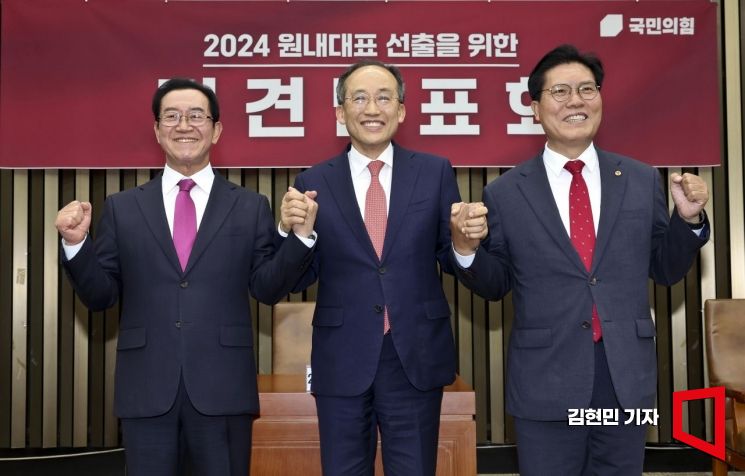 Lee Jong-bae (from left), Choo Kyung-ho, and Song Seok-jun, members of the National Assembly running for the People Power Party floor leader election, join hands at the policy presentation meeting held at the National Assembly on the 8th to elect the floor leader. Photo by Hyunmin Kim kimhyun81@
The floor leader who will lead the People Power Party in a situation where the opposition holds the majority will be elected on the afternoon of the 9th. The newly appointed floor leader will immediately face the challenge of countering the legislative offensive of the opposition, which holds the majority of seats, and pushing through long-awaited bills.
The race is a three-way contest among Lee Jong-bae (4-term, Chungbuk Chungju) from the Chungcheong region, Chu Kyung-ho (3-term, Daegu Dalseong) from the Yeongnam region, and Song Seok-jun (3-term, Gyeonggi Icheon) from the metropolitan area. Although there is an interpretation that Chu has an advantage since more than half of the 22 elected members with voting rights are from the Yeongnam region, a variable is that some elected members may feel uncomfortable with the criticism of being a 'reverted Yeongnam Party.'
The newly elected floor leader will immediately face the legislative push by the major opposition party in the remaining less than a month of the 21st National Assembly. The Democratic Party plans to hold a plenary session on the 28th to process the amendments to the Grain Management Act, the Agricultural and Fishery Products Distribution and Price Stabilization Act (Agricultural Act), the Fair Transactions in Franchise Business Act amendment, and the Democratic Merit Recognition Act. These bills had been pending in the Legislation and Judiciary Committee for more than 60 days and were referred to the plenary session last month solely by the Democratic Party in the relevant standing committee. The reason these bills were not processed at the plenary session held on the 2nd was that a 30-day consensus period was required.
The People Power Party opposes the Grain Management Act and Agricultural Act amendments, which focus on price support for rice and other agricultural products, arguing that they will cause massive fiscal expenditures. The Democratic Party insists that the amendments will definitely pass, stating that they have conceded on provisions pointed out by the government and ruling party. The Democratic Party also claims to have resolved one of the contentious issues in the Grain Management Act, the 'mandatory rice purchase' clause. Since the Grain Supply Management Committee, chaired by the Vice Minister of Agriculture, Food and Rural Affairs, decides on market isolation, the government has decision-making authority. However, since experts and farmers also participate in the committee, there is an opinion that the government cannot simply oppose mandatory purchases.
The Franchise Business Act and Democratic Merit Recognition Act were referred to the plenary session solely by the Democratic Party in the National Assembly's Political Affairs Committee on the 23rd of last month. The Franchise Business Act centers on granting franchisees collective bargaining rights against franchisors. The Democratic Merit Recognition Act focuses on recognizing democratization movement deceased, injured, their families, and bereaved families as democratic merit recipients. The People Power Party and the franchise industry argue that the Franchise Business Act effectively grants labor union rights to franchisees as business operators and should not be processed unilaterally.
Kang Min-guk, the People Power Party's Political Affairs Committee secretary, said on the 23rd of last month, "Even a single franchise can have multiple unions, so conflicts between headquarters and franchisees are inevitable." The government and ruling party have opposed the Democratic Merit Recognition Act, citing reasons such as it being a 'self-benefit law for activists.' On the other hand, Hong Seong-guk, the Democratic Party's Political Affairs Committee secretary, said while processing the Democratic Merit Recognition Act, "Those convicted under the National Security Act and Criminal Act were excluded, and support for education, employment, loans, and housing supply, which had caused controversy over preferential treatment among bereaved families, was drastically removed."
Passing the Special Act on High-Level Radioactive Waste (High-Level Special Act) in the 21st National Assembly is also a task for the new floor leader. The core of the High-Level Special Act is to create a permanent disposal facility for spent nuclear fuel currently stored in temporary facilities at each nuclear power plant. Both ruling and opposition parties agree on the need to pass the High-Level Special Act, but two contentious issues remain: whether to determine the storage facility capacity based on 'operational period generation' or 'design life generation,' and the specification of the target date for the management facility. The Democratic Party is reportedly opposing the passage of the High-Level Special Act due to concerns that the pro-nuclear government and ruling party will expand the share of nuclear power.
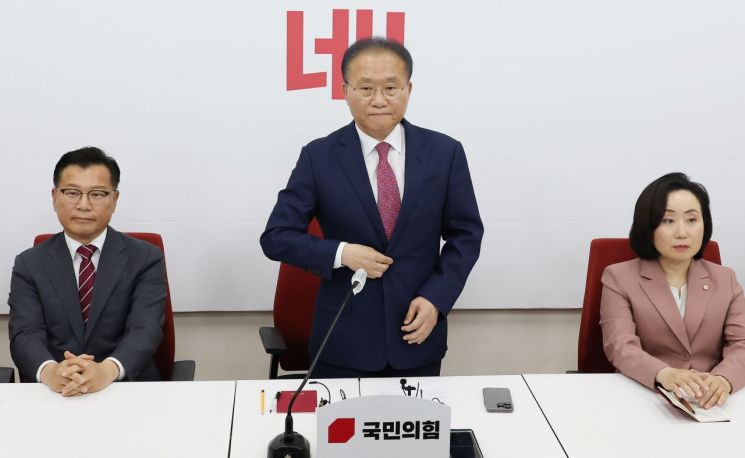
Former People Power Party floor leader Yoon Jae-ok also said at his retirement press conference on the 8th, "If the High-Level Special Act is not passed in this National Assembly, we will face a fatal environmental threat starting in 2030," adding, "Although an agreement was reached between the floor leaders of both parties on this bill, it could not be brought to the plenary session due to opposition from some opposition members. I hope the 21st National Assembly can pass this bill unconditionally." He also said, "Please understand how mentally painful it was as the representative of a minority ruling party to always have to beg and plead with the opposition floor leader and even the Speaker of the National Assembly, unable to hold my head high." The newly elected floor leader today will also have to lead the party in a minority ruling situation, so a difficult path is expected.
© The Asia Business Daily(www.asiae.co.kr). All rights reserved.
![Clutching a Stolen Dior Bag, Saying "I Hate Being Poor but Real"... The Grotesque Con of a "Human Knockoff" [Slate]](https://cwcontent.asiae.co.kr/asiaresize/183/2026021902243444107_1771435474.jpg)
















