A remittance organization that profited from the Kimchi premium through virtual assets was caught by customs authorities.
On the 7th, the Gwangju Customs Office of the Korea Customs Service announced that it had identified two ethnic Koreans from China (Joseonjok) and one Korean for violating the Foreign Exchange Transactions Act (unregistered foreign exchange business) and sent them to the Gwangju District Prosecutors' Office without detention.
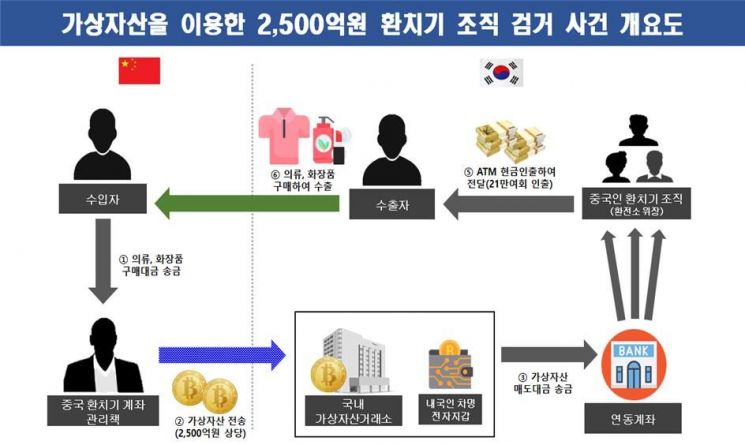
They operated a remittance organization that acted as an intermediary to remit payment for goods to domestic accounts for Chinese visitors who came to Korea to purchase K-clothing and cosmetics. The method involved receiving virtual assets such as Bitcoin and Tether from local remittance operators in China and transferring them to domestic virtual asset exchanges to deliver payment for goods.
Using this method, from 2021 until January of this year, they withdrew virtual asset sale proceeds worth approximately 250 billion KRW through a total of 210,000 transactions using ATMs during late night and early morning hours, and delivered the withdrawn remittance funds to Chinese shoppers, enabling them to purchase Korean clothing and cosmetics for export to China from places such as Seoul and Jeju.
The profit they earned from remitting virtual assets (Kimchi premium) was revealed to be about 30 million KRW per month on average.
In particular, the remittance organization established a legally registered currency exchange office in Seoul to evade the supervision of foreign exchange authorities, but in reality, it was used as a place for remittance using virtual assets. To conceal their remittance activities, they opened electronic wallets at domestic virtual asset exchanges under borrowed names, and when withdrawing virtual asset sale proceeds in cash, they used more than 100 domestic borrowed-name accounts and cash cards, demonstrating meticulousness in their crimes.
The Gwangju Customs Office found the suspicious situation where foreign currency (export proceeds) did not accumulate domestically due to virtual asset remittance despite the increase in exports of K-clothing and cosmetics, and only virtual assets accumulated. During the investigation, they secured CCTV footage showing the organization members withdrawing cash at multiple locations on the same day, leading to the detection of the remittance crime.
A Gwangju Customs official said, “Recently, virtual asset transactions are evolving into a new channel for illegal funds such as smuggling,” and added, “Customs will actively crack down on foreign exchange crimes using virtual assets by utilizing virtual asset tracking and analysis programs.”
© The Asia Business Daily(www.asiae.co.kr). All rights reserved.
![Clutching a Stolen Dior Bag, Saying "I Hate Being Poor but Real"... The Grotesque Con of a "Human Knockoff" [Slate]](https://cwcontent.asiae.co.kr/asiaresize/183/2026021902243444107_1771435474.jpg)















