Private Think Tank NEAR Foundation Forum
Industry-Academia Experts Gather to Discuss the Need for Subsidies
Opinions Also Raised on the Necessity of Strategic Subsidy Allocation
"This is a semiconductor subsidy war. China provided the fuel, and the United States ignited the fire. Once even one country starts giving subsidies, those who do not give become the fools in this ruthless game."
Kim Hyuk-jung, a senior researcher at the Korea Institute for International Economic Policy, said this on the 30th at the Korea Chamber of Commerce and Industry while attending as a presenter at the private think tank NEAR Foundation forum. At the forum titled 'Global Semiconductor War: Can Korea Join the Ranks of Winners?', Kim emphasized that the United States is introducing semiconductor laws not only at the national level but also at the state government level, stating, "We also need to provide (subsidies)."
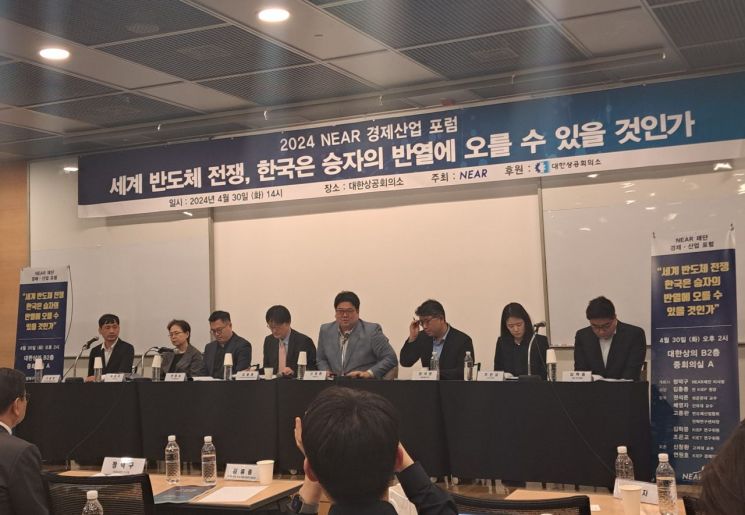 Participants speaking at the 'Global Semiconductor War, Can Korea Join the Ranks of Winners?' forum hosted by the private think tank NEAR Foundation, held at the Korea Chamber of Commerce and Industry on the 30th /
 At the forum, experts from various fields including the semiconductor industry and academia gathered to share their thoughts on semiconductor subsidies. Recently, not only the United States and China but also major countries such as Japan and Europe have been competing to provide semiconductor subsidies to enhance their domestic semiconductor industry competitiveness, and the main discussion was that our country needs to expand direct support such as subsidies to strengthen competitiveness.
Shin Chang-hwan, a professor in the Department of Electrical and Electronic Engineering at Korea University, pointed out that one of the key factors for Korea to secure leadership in the global market is government support. Specifically, he believes that "investment and deregulation at the national level comparable to or exceeding that of competing countries are necessary." Professor Shin said, "It is urgent to establish national strategies and policies so that the semiconductor industry can become a core pillar of the national economy." He also emphasized, "The government's direct subsidy policy is already lagging behind other advanced countries, and urgent measures are needed."
Yeon Won-ho, head of the Economic Security Team at the Korea Institute for International Economic Policy, noted that the subsidy discussion, which has been focused only on advanced semiconductor manufacturing, should be expanded to include fabless (design), materials-parts-equipment (SoBuJang), and legacy (general-purpose) sectors to consider strategic allocation. Yeon said, "The United States, Europe, and Japan use subsidies in semiconductor fields where they lack competitiveness," adding, "Rather than memory, where domestic competitiveness is high, subsidies should be given to vulnerable areas such as SoBuJang, design, and foundry." He also stressed, "Attention should not only be on advanced semiconductors but also on legacy sectors."
Professor Kwon Seok-jun of the Department of Chemical Engineering at Sungkyunkwan University expressed the opinion that "since subsidies are funded by national taxes, public consensus and political agreement are necessary." He added, "There are various forms of subsidies, so they should be considered separately," and "If the government needs to receive a share of the profits, it should do so." However, he emphasized the need to prevent companies from moving overseas due to subsidies from other countries, highlighting the necessity of expanding national support.
From the industry side, there was also an opinion that semiconductor subsidies directed at large manufacturing companies could benefit various SoBuJang companies. Ko Jong-hwan, head of the Strategy Research Center at the Korea Semiconductor Industry Association, explained, "If subsidies are given to semiconductor manufacturing companies, those companies can invest in facilities and use domestic equipment, thereby growing businesses with SoBuJang partners," adding, "This can create a trickle-down effect."
Meanwhile, the forum also included opinions emphasizing the need to support basic science, which forms the foundation of semiconductors, along with advice to flexibly respond to the newly reorganizing semiconductor supply chain. Bae Young-ja, a professor of Political Science and Diplomacy at Konkuk University, said, "Currently, the concrete form of the (new) semiconductor alliance has not been realized," advising, "The Korean-style semiconductor alliance should develop beyond choosing between the U.S. and China, dispersing risks while strengthening Korea's technological capabilities."
© The Asia Business Daily(www.asiae.co.kr). All rights reserved.
![Clutching a Stolen Dior Bag, Saying "I Hate Being Poor but Real"... The Grotesque Con of a "Human Knockoff" [Slate]](https://cwcontent.asiae.co.kr/asiaresize/183/2026021902243444107_1771435474.jpg)
















