Operating profit of 6.6 trillion won for the entire company... Last year's operating profit easily surpassed
Memory semiconductor sales increased to 17 trillion won range
'Galaxy S24' strong sales also contributed to performance growth
HBM3E 8-stack sales expected to be reflected as early as the end of Q2
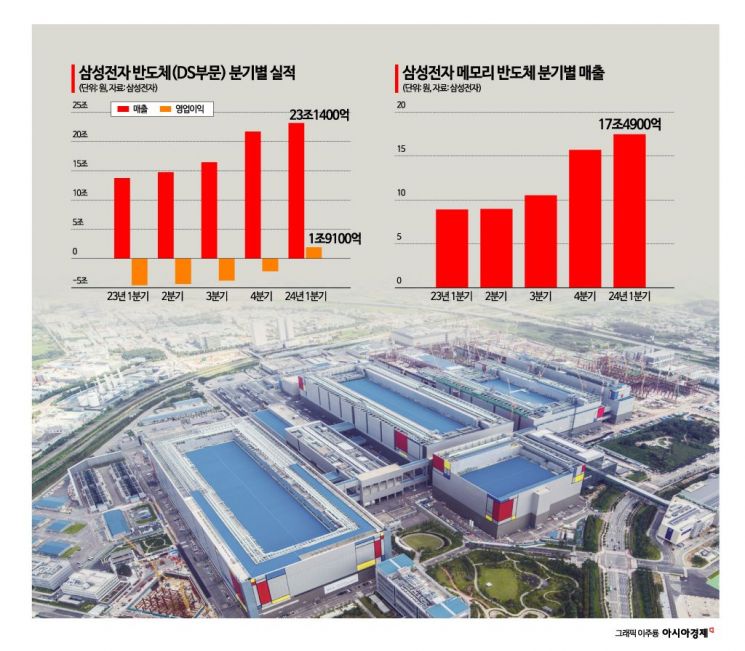
Samsung Electronics' Semiconductor (DS) division succeeded in a revival in the first quarter of this year. Following a return to profitability after five quarters, it drove the company's performance to the extent of accounting for 29% of the total operating profit. The effect of memory production cuts led to price increases in DRAM and NAND flash, reducing inventory valuation losses, which became the background for better-than-expected strong performance in the market. In particular, as the memory semiconductor market entered a recovery phase, related business sales recorded around 17 trillion KRW.
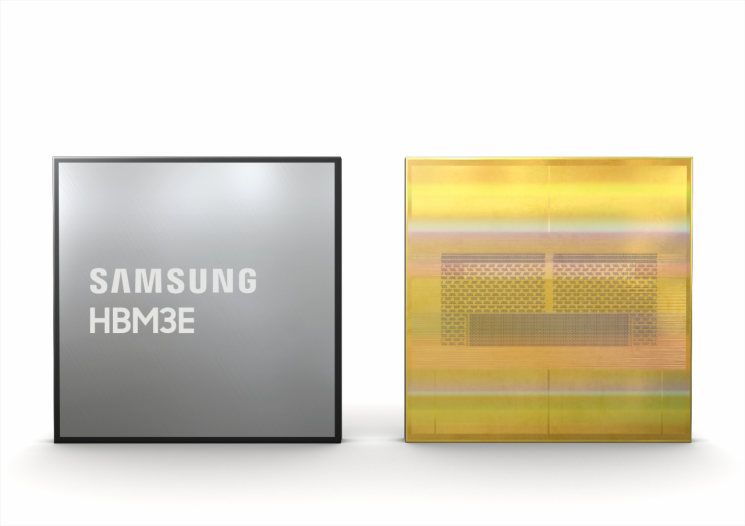
Samsung Electronics expects semiconductor performance to continue to grow in the second quarter due to the effect of rising memory prices. To actively respond to artificial intelligence (AI) demand, it plans to mass-produce the 5th generation high-bandwidth memory (HBM) HBM3E 12-stack product within the second quarter. The HBM 8-stack product has already started initial mass production and is expected to be reflected in sales as early as the end of the second quarter. The company explained that the supply scale of HBM this year will increase more than threefold compared to last year.
Samsung Semiconductor Operating Profit 1.9 Trillion KRW... Return to Profitability After Five Quarters
Samsung Electronics announced on the 30th through a public disclosure that it recorded consolidated sales of 71.92 trillion KRW and operating profit of 6.61 trillion KRW in the first quarter. The semiconductor division recorded sales of 23.14 trillion KRW and operating profit of 1.91 trillion KRW. This is the first time the semiconductor division has recorded a quarterly profit since the fourth quarter of 2022, after five quarters. The total operating profit for the first quarter exceeded the operating profit earned throughout last year (6.57 trillion KRW).
The increased reversal of inventory valuation loss provisions due to rising prices of core products DRAM and NAND significantly contributed to profitability improvement. This means the burden of inventory losses decreased as product prices rose. Memory showed strong overall purchasing demand due to market expectations of continuous price increases, and demand for double data rate (DDR) 5 and high-capacity solid-state drives (SSD) remained strong following the previous quarter.
System LSI saw increased supply of system-on-chip (SoC), sensors, and other components for major customers' new products. However, performance improvement was slower than expected due to decreased DDI sales caused by panel demand slowdown.
Foundry (semiconductor contract manufacturing) experienced delayed sales improvement due to ongoing inventory adjustments by major customers, but the deficit narrowed somewhat. Additionally, by stabilizing 4nm (1nm = one-billionth of a meter) process yields and significantly expanding product production centered on major customers, it achieved the largest-ever first-quarter order record.
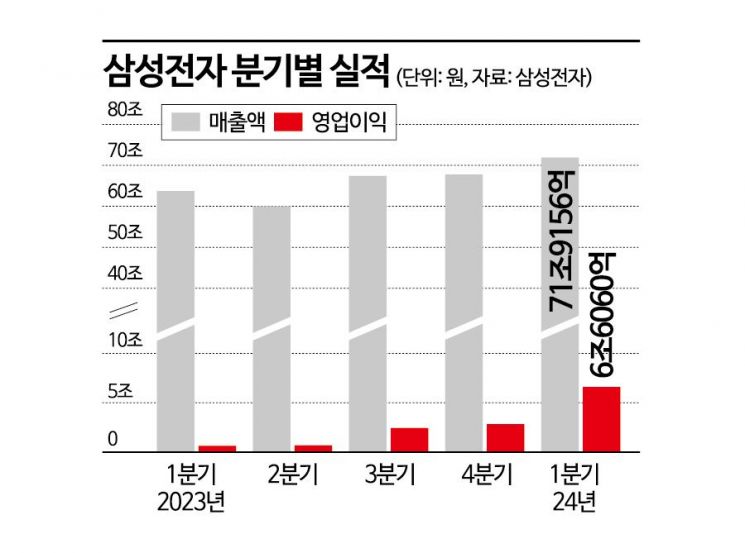
The overall first-quarter performance, including semiconductors, recorded consolidated sales of 71.92 trillion KRW and operating profit of 6.61 trillion KRW. This represents increases of 12.8% and 931.9%, respectively, compared to the same period last year. Quarterly sales recovering to the 70 trillion KRW level is the first time in five quarters since the fourth quarter of 2022 (70.46 trillion KRW).
The strong sales of the flagship smartphone 'Galaxy S24,' launched at the end of January, also contributed to the performance increase. The mobile experience (MX) division, responsible for smartphones, recorded sales of 33.53 trillion KRW and operating profit of 3.51 trillion KRW. The Galaxy S24 series equipped with AI is evaluated to have succeeded in early popularity, breaking pre-order sales records for the S series in major global regions. The industry estimates the average selling price (ASP) of Samsung Electronics smartphones in the first quarter rose nearly 30% from the previous quarter to around 330?340 USD (approximately 440,000?450,000 KRW), reflecting a higher proportion of premium models.
Samsung Electronics plans to accelerate securing future competitiveness by spending the largest-ever quarterly research and development (R&D) expenses. First-quarter facility investment was 11.3 trillion KRW, with 9.7 trillion KRW for semiconductors and 1.1 trillion KRW for displays, an increase of 600 billion KRW compared to the same period last year.
Expansion of HBM3E Mass Production Amid Memory Price Increase
The semiconductor division, which had continued negative growth with nearly 15 trillion KRW in losses last year, recorded an operating profit of 1.91 trillion KRW in the first quarter, successfully returning to profitability after five quarters. Although the System LSI and Foundry divisions experienced sluggish performance, the Memory division led the overall semiconductor performance recovery.
Within Samsung Electronics' semiconductor division, memory sales in the first quarter recorded 17.49 trillion KRW, approximately a 96% increase compared to the same period last year. DRAM ASP rose about 20%, and NAND ASP increased to the low 30% range, exceeding market expectations. The company explained that both DRAM and NAND successfully returned to profitability through this.
The strong performance trend is expected to continue into the second quarter. Kim Jae-jun, Vice President of Samsung Electronics Memory Business Division, said at the first-quarter conference call on the 30th, "The continuous increase in AI server supply and expansion of cloud services will increase demand not only for HBM directly affected by AI but also for general servers and storage," forecasting that memory price increases will continue.
Samsung Electronics is optimizing its business portfolio by shifting production and operations toward servers and storage, such as HBM, DDR5, and high-capacity SSDs, rather than PCs or mobiles. In the second quarter, it plans to increase shipments of server DRAM and SSD by 50% and over 100%, respectively, compared to the same period last year.
Samsung Electronics plans to mass-produce and ship 1nm 32Gb (gigabit) DDR5-based 128GB (gigabyte) products in the second quarter. It will also develop and provide samples of ultra-high-capacity 64TB (terabyte) SSDs in the same quarter. Notably, Samsung started initial mass production of the HBM3E 8-stack product this month and plans to mass-produce the 12-stack product within the second quarter.
Market research firm TrendForce forecasts that the DRAM market sales scale this year will increase by 62.25% year-on-year to 84.15 billion USD, with HBM accounting for 20.1% of this. Samsung Electronics plans to expand HBM production capacity (CAPA) and accelerate production of HBM3E 12-stack products. The company explained that by the end of the year, the proportion of HBM3E in total HBM sales will exceed two-thirds. Also, HBM3E 8-stack sales are expected to be reflected as early as the end of the second quarter.
Vice President Kim said, "This year, the supply scale of HBM is increasing more than threefold compared to last year on a bit basis, and the volume has already been agreed upon with customers. We plan to supply at least twice as much next year compared to this year, and we are smoothly negotiating with customers regarding that volume as well."
The System LSI division plans to focus on stable supply of flagship SoCs and sensors in the second quarter, supported by the recovery in smartphone sales. It also expects to ship new wearable products based on advanced processes.
The Foundry division expects double-digit sales growth in the second quarter compared to the previous quarter as customer inventory adjustments conclude and line utilization improves. With an increased proportion of advanced processes below 5nm, it expects sales this year to exceed market growth rates.
'Galaxy S24' Success Effect... Mobile Division Sales 33 Trillion KRW
Samsung Electronics' mobile experience (MX) and network (NW) divisions, responsible for smartphone sales, recorded sales in the 33 trillion KRW range in the first quarter of this year. Despite a shrinking global smartphone market, they achieved results exceeding the previous year by successfully popularizing the first AI smartphone, the 'Galaxy S24' series. In the second half, they plan to drive performance by launching the foldable 'Galaxy Z6' series and Samsung Electronics' first smart ring, the 'Galaxy Ring.'
According to Samsung Electronics' first-quarter performance disclosure on the 30th, MX and NW divisions recorded sales of 33.53 trillion KRW, a 5.4% increase from 31.82 trillion KRW in the same quarter last year. Operating profit decreased by 440 billion KRW due to rising component prices but increased by 780 billion KRW from 2.73 trillion KRW in the fourth quarter of last year to 3.51 trillion KRW.
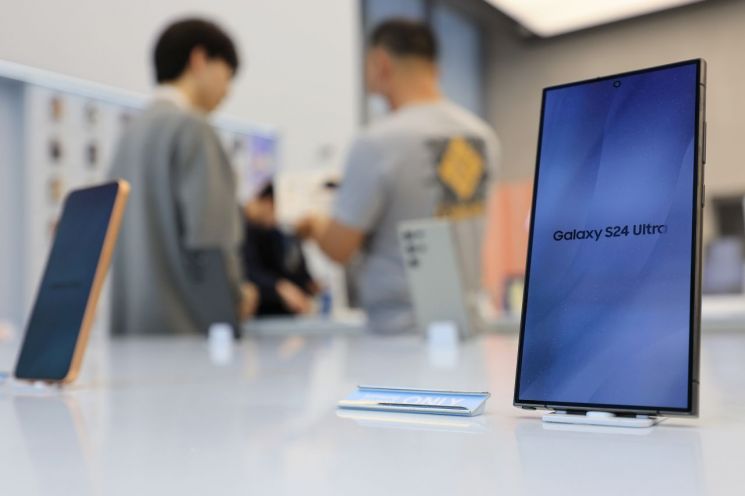
This was thanks to strong global sales of the Galaxy S24 series launched in January this year. The Galaxy S24 series, promoted as the industry's first on-device AI phone, succeeded in popularity, setting a record for the shortest time to surpass 1 million units sold among S series in Korea. According to Hana Securities, cumulative sales of the Galaxy S24 series reached 6.53 million units two months after launch. It also succeeded in emerging markets like India and Pakistan, where mid-to-low-priced products are preferred, showing pre-sale records and product shortages. It is receiving positive responses in global markets such as North America and Europe. Samsung Electronics recorded shipments of 60.1 million units in the first quarter, reclaiming the No. 1 global smartphone market share (20.8%) from competitor Apple.
Samsung Electronics explained, "The high usage rate of Galaxy AI features installed in the first AI phone, Galaxy S24, drove sales expansion," adding, "This led to growth in sales and profits while maintaining double-digit profitability."
However, it forecasts that shipments and ASP will decline in the second quarter as the market enters an off-season. Therefore, it plans to defend performance by encouraging consumer upselling to AI phones like the Galaxy S24. In the second half, it will launch the new foldable Galaxy Z6 series, also equipped with generative AI functions. Beyond smartphones, it will expand the Galaxy AI ecosystem by releasing Samsung Electronics' first smart ring, the Galaxy Ring. The company emphasized, "We will strive to secure profitability through operational process efficiency and simultaneously prepare for the future by continuously investing in Galaxy AI expansion and advancement."
Living Appliance Sales Expected to Increase in Q2
Samsung Electronics plans to focus on finding sales expansion opportunities in the TV business (VD division) in the second quarter despite unfavorable conditions due to demand slowdown in emerging markets. It will increase sales of strategic products by launching differentiated new models such as Neo QLED and OLED and secure profitability through operational efficiency.
In the living appliance business, it expects sales growth in the second quarter by expanding sales of Bespoke AI new products such as all-in-one washer-dryers and hybrid refrigerators and strengthening air conditioner sales entering the seasonal peak. In the second half, it plans to improve the business structure and cost efficiency focusing on high-value-added businesses such as system air conditioners and built-in products while expanding premium product sales.
© The Asia Business Daily(www.asiae.co.kr). All rights reserved.
![Clutching a Stolen Dior Bag, Saying "I Hate Being Poor but Real"... The Grotesque Con of a "Human Knockoff" [Slate]](https://cwcontent.asiae.co.kr/asiaresize/183/2026021902243444107_1771435474.jpg)

















