Seo Young-kyo and Yang Jeong-suk, 3 Proposals Including Ministry of Justice
High Possibility of Reconsideration in the 22nd National Assembly
The Constitutional Court has put a brake on the statutory portion system that guarantees inheritance shares to family members who did not receive property through a will from the deceased, passing the ball to the National Assembly. The opposition party is pushing for the full implementation of this law and pressuring for the convening of a special session of the National Assembly. However, with the term of the 21st National Assembly nearing its end, the related proposed laws are expected to be discarded.
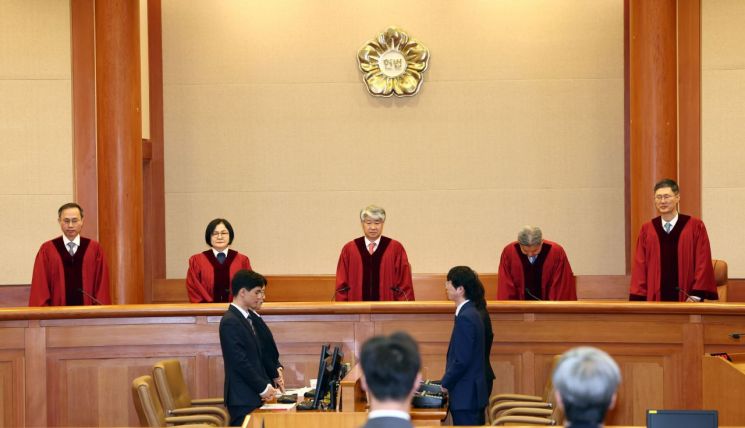 Chief Justice Lee Jong-seok of the Constitutional Court and the justices are entering the Grand Bench of the Constitutional Court in Jongno-gu, Seoul, on the 25th for the ruling on the constitutional review of Article 1112 of the Civil Act and the statutory system of reserved portions, as well as the constitutional complaint. Photo by Yonhap News
On the 25th, the Constitutional Court ruled that the statutory portion system, which forces siblings to inherit an estate, is unconstitutional. Furthermore, it declared that the absence of a supplementary system to deprive members who did not fulfill their familial duties of the right to receive the statutory portion violates the Constitution, issuing a constitutional discordance decision on Articles 1112, Clauses 1 to 3 of the Civil Act. According to this decision, the effect of the relevant law will only be recognized until December 31 of next year.
The statutory portion system became controversial after the death of singer the late Goo Hara in 2019, when her biological mother, who had not been in contact for over 20 years, demanded inheritance. Subsequently, bills revising the statutory portion system, including the 'Goo Hara Prevention Act,' were proposed in the National Assembly. No Jong-eon, the representative lawyer of Law Firm Jonja who handled Goo's case and the legislative petition for the Goo Hara Prevention Act, said, "The Constitutional Court's judgment reflects the changed perceptions of society and family."
The proposed amendments to the Civil Act related to the statutory portion submitted to the National Assembly are broadly divided into three categories. First is the amendment proposed by Seo Young-kyo of the Democratic Party of Korea in June 2020. This bill directly includes cases where an heir fails to fulfill child-rearing obligations as grounds for disqualification from inheritance and is considered the representative bill of the Goo Hara Prevention Act. The bill received support from as many as 50 signatories, including Representative Seo. However, since the Civil Act only states "a person who neglects support obligations," further work is needed to specify what actions constitute neglect of support obligations.
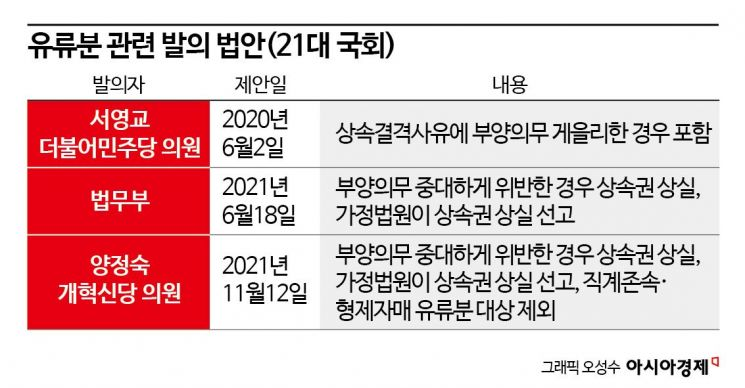
The amendment proposed by the Ministry of Justice in June 2021 defines the authority responsible for judging child-rearing obligations. Its purpose is also to cause heirs who seriously violate support obligations to the decedent, spouse, or direct relatives to lose inheritance rights, but it requires a family court ruling on the loss of inheritance rights. Additionally, the decedent's spouse or others must file a claim for loss of inheritance rights with the family court within six months from the date they become aware that a person who failed to fulfill the obligation has become an heir.
The bill proposed by Yang Jeong-sook of the Reform New Party in November 2021 went further than the Ministry of Justice's proposal. It established provisions allowing the family court to rule on the loss of inheritance rights upon request by the decedent's spouse or co-heirs. It also deleted provisions guaranteeing the rights of the decedent's direct ascendants and siblings to receive statutory portions, limiting statutory portions to only minor direct descendants.
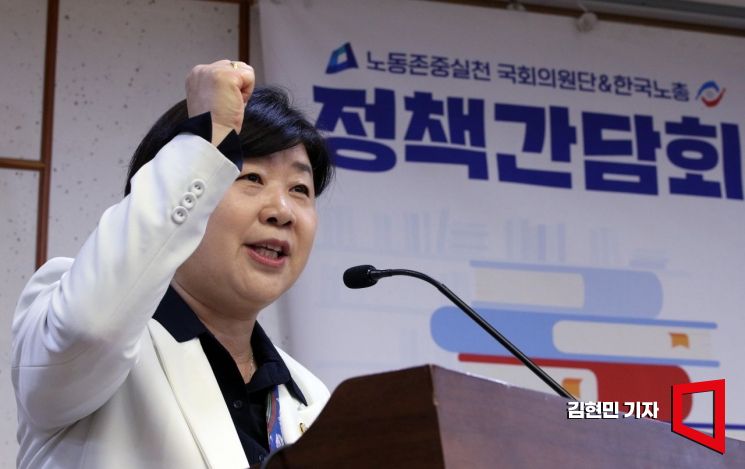 Seo Young-kyo, Supreme Council Member of the Democratic Party of Korea, is giving a greeting at the 1st Policy Meeting between the Labor Respect Practice Parliamentary Group and the Federation of Korean Trade Unions held on the 4th at the National Assembly Members' Office Building in Yeouido, Seoul. Photo by Kim Hyun-min kimhyun81@
All these bills were submitted and underwent preliminary review at the first subcommittee of the Legislation and Judiciary Committee on November 15 last year. However, there has been little progress during the discussion phase. The Ministry of Justice and Representative Seo's side have failed to bridge their differences regarding the requirement for family court judgment. The Ministry argues that the law cannot uniformly regulate support obligations, while Representative Seo contends that under the Ministry's proposal, claims for loss of inheritance rights must be filed with the family court before the decedent's death, rendering it ineffective. With only one month left in the term of the 21st National Assembly, these bills are expected to be discarded and likely reconsidered in the 22nd National Assembly.
However, the Democratic Party is leveraging these bills to pressure for the convening of a special session next month. The day before, the Democratic Party emphasized at a Supreme Council meeting held at the National Assembly in Yeouido, Seoul, that the Goo Hara Prevention Act is a livelihood bill and vowed to pass it during the special session. Representative Seo said, "The Ministry of Justice and others view the Goo Hara Prevention Act positively, but if it moves to the 22nd National Assembly, not only the members of the National Assembly but also the Ministry of Justice's situation may change," adding, "If it is not passed during this special session, the passage of the Goo Hara Prevention Act will be postponed indefinitely."
© The Asia Business Daily(www.asiae.co.kr). All rights reserved.
![Clutching a Stolen Dior Bag, Saying "I Hate Being Poor but Real"... The Grotesque Con of a "Human Knockoff" [Slate]](https://cwcontent.asiae.co.kr/asiaresize/183/2026021902243444107_1771435474.jpg)

















