Collection of Chinese Road Data Necessary for Autonomous Driving Possible
U.S. electric vehicle company Tesla has taken one step closer to launching its Full Self-Driving (FSD) service in China.
According to major foreign media outlets including Bloomberg on the 29th (local time), citing sources, Tesla and Chinese IT giant Baidu have agreed on a licensing contract for mapping technology implementation for autonomous driving.
As a result, Tesla will not only be able to legally operate FSD software on Chinese roads but also collect environmental data around vehicles such as road layouts, traffic signs, and nearby buildings. All intelligent driving systems operating on Chinese roads must obtain a mapping license, and foreign companies must partner with local companies holding such licenses.
Additionally, sources said Baidu plans to provide Tesla with a navigation system containing lane-level information. However, it remains unclear which company?Tesla or Baidu?will own the collected data. The partnership between Baidu and Tesla began in early 2020, and Tesla is already known to have equipped its China-launched vehicles with Baidu’s navigation maps.
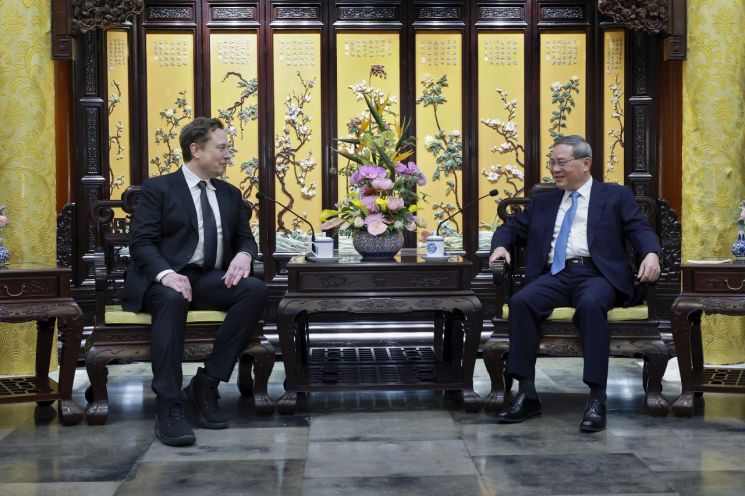
This contract signing is seen as a green light for Tesla’s FSD launch in China. Earlier, on the 28th, Tesla CEO Elon Musk visited Beijing at the invitation of the China Council for the Promotion of International Trade (CCPIT) and held a meeting with Premier Li Qiang. It appears that Musk persuaded regulatory authorities to approve the FSD launch in China to expand Tesla’s electric vehicle sales within the country. Tesla launched FSD in 2020 and currently offers the service in several countries including the U.S. However, it has yet to receive approval for launch in China.
Following the meeting, news emerged that Model 3 and Model Y vehicles produced at Tesla’s Shanghai Gigafactory have passed all safety inspections related to automobile data processing in China. Currently, China restricts the data Tesla can collect in sensitive areas for national security reasons and prohibits transmitting such data to external countries like the U.S.
Dan Ives, senior analyst at Wedbush Securities, described Musk’s surprise visit to China as a "watershed moment," stating, "This visit will not only open new horizons for China’s FSD technology but also represents a golden opportunity for Tesla’s long-awaited FSD launch in China, which has been a missing puzzle piece."
Meanwhile, Tesla’s vehicle deliveries in the first quarter of this year totaled 386,810 units, down 8.5% compared to the same period last year. This marks the first decline in four years since the COVID-19 pandemic in 2020. Tesla’s first-quarter sales in China fell by 4% during the same period. After announcing the first-quarter results, CEO Musk revealed plans to expand the lineup of lower-priced electric vehicles.
© The Asia Business Daily(www.asiae.co.kr). All rights reserved.
![Clutching a Stolen Dior Bag, Saying "I Hate Being Poor but Real"... The Grotesque Con of a "Human Knockoff" [Slate]](https://cwcontent.asiae.co.kr/asiaresize/183/2026021902243444107_1771435474.jpg)
















