To the Ruling Party: "Lack of Understanding of the People's Will, Need for Change"
To the Medical Association: "Stop the Strike, Medical Sector Must Normalize"
"We do not oppose the Nakdong River water intake, but obtaining the consent of the residents must come first."
On the 25th, Park Wan-su, Governor of Gyeongnam Province, made this remark at a press conference held at the provincial government press center regarding sharing Nakdong River water with Busan City.
Earlier, on the 12th, Uiryeong County and Busan City signed a mutual cooperation agreement on the Nakdong River Basin Clean Water Supply System Construction Project (Nakdong River Water Intake Diversification Project).
The agreement mainly involves taking in 90 tons of filtered riverbank water from the Nakdong River around Changnyeong and Uiryeong counties and distilled water from Hwanggang in Hapcheon County daily, supplying 420,000 tons to Busan and 480,000 tons to eastern Gyeongnam respectively.
In response, residents of Uiryeong have opposed the project, urging measures to prevent damage to farms such as depletion of groundwater in hinterland farmland.
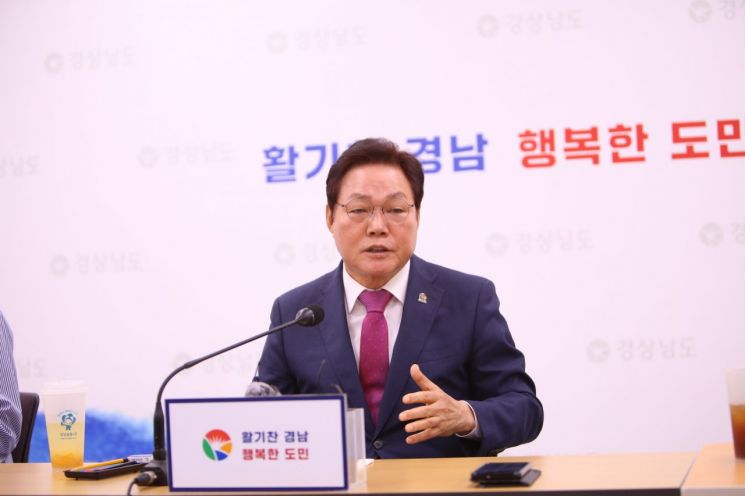 Park Wan-su, Governor of Gyeongnam Province, is answering reporters' questions at a press conference.
 [Photo by Lee Se-ryeong]
Governor Park stated, "Our position is that the consent of the residents must be obtained first, along with sufficient compensation and damage countermeasures for any harm to the residents," adding, "This stance has been consistent."
He said, "Since Uiryeong County and Busan City are independent local governments, Gyeongnam Province cannot interfere with their agreement," and added, "It seems the agreement was made because Busan City's intention and will were strong. Rather than judging whether it was good or bad now, I hope the water intake proceeds smoothly."
He continued, "The Ministry of Environment is currently conducting a study analyzing the regional impact of the water intake. Once the study results come out and a plan on how to proceed with the project is established, the province's position on cooperation will also be clarified."
"The Ministry of Environment should actively communicate its position to the residents and seek their opinions in some form," he emphasized, "Since both Busan City and Gyeongnam residents benefit from obtaining Nakdong River water, we must work together."
Regarding the Democratic Party's proposal to provide 250,000 KRW per person nationwide as a livelihood recovery support fund, Governor Park pointed out, "Supporting people in difficulty can be considered if the government and ruling and opposition parties agree, but giving it universally to all citizens is not desirable."
When asked to evaluate the general election, he said, "The results reflect the public's evaluation that the government and ruling party did not sufficiently heed public sentiment," and criticized, "The People Power Party needs to change."
"Those who play important roles as lawmakers or within the party must actively understand the people's hearts and strive accordingly to be a party that can be chosen in the next election," he said. "A party has no reason to exist if it is not chosen by the people. Efforts to gain the people's choice are essential."
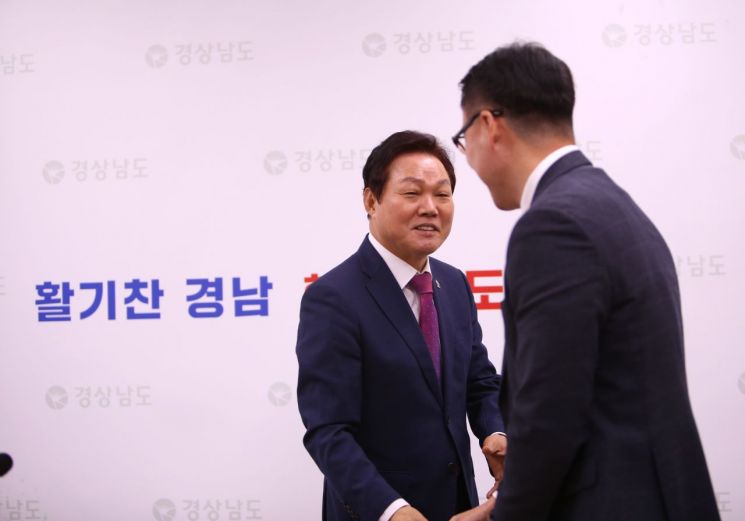 Gyeongnam Province Governor Park Wansu is greeting reporters before the press conference.
 [Photo by Lee Seryeong]
Regarding cooperation with opposition parties during the 8th term of the provincial government, he said, "Since the National Assembly is dominated by the opposition, in the second half of the provincial government, we plan to place more emphasis on the National Assembly than in the first half," adding, "We plan to spend a lot of time securing cooperation from the National Assembly on regional issues such as the Special Act on Aerospace City to build the Aerospace Complex City in Sacheon, the location of the Aerospace Administration."
Governor Park also mentioned that amid the ongoing two-month-long strike by medical residents opposing the increase in medical school quotas, a motorcycle traffic accident victim in Haman had to visit 48 emergency rooms in hospitals across Gyeongnam, Daegu, and Ulsan regions before finally receiving treatment in Gyeonggi Province.
He explained, "On the day, the situation was reported to the Gyeongnam Emergency Medical Situation Room, and although they sought a hospital, there was no medical staff available to provide treatment anywhere," adding, "Before the medical strike, there was about one emergency medical request per day, but now it has increased to 7 to 8 per day."
"Since the government is moving toward not insisting on a quota of 2,000, I hope medical organizations will actively engage in negotiations with the public in mind," he said. "The medical sector must return to normal quickly so that residents do not suffer from long delays in receiving treatment."
He also mentioned that there is ongoing discussion about selecting five medical school quota spots at Gyeongsang National University as regional doctor special admissions.
Regarding the integration of National Changwon University, Provincial Geochang University, and Provincial Namhae University, he set the goal of submitting the integration application in the second half of this year and obtaining approval by February next year.
Governor Park said, "On July 1, the 8th term of the Gyeongnam provincial government will enter its second half," adding, "We plan to focus on somewhat different areas such as residents' welfare and safety compared to the first half and strengthen the political functions of the provincial government."
"The Nakdong River is one of Gyeongnam's natural assets," he added, "We will also make efforts to better care for and utilize the Nakdong River's environment, ecosystem, and water quality preservation."
© The Asia Business Daily(www.asiae.co.kr). All rights reserved.