Sales of 12.4296 trillion KRW... Record High for Q1
Strong HBM and Rising NAND Prices Impact
TSMC Announces Entry into 'A16' Process
Expected to Bridge 2nm and 1.4nm Nodes
SK Hynix succeeded in turning a profit in the first quarter of this year, delivering results that exceeded market expectations. This was due to strong sales of high value-added products such as High Bandwidth Memory (HBM) and rising prices of NAND flash.
SK Hynix announced on the 25th that its operating profit for the first quarter of this year reached 2.886 trillion KRW, marking a turnaround of 734% compared to the same period last year. This is the second-best record since 2018, the peak period of the semiconductor boom.
During the same period, sales amounted to 12.4296 trillion KRW, an increase of 144.3% compared to the same period last year. This is the highest ever for a first quarter. The operating profit margin was 23%, and net profit reached 1.917 trillion KRW.
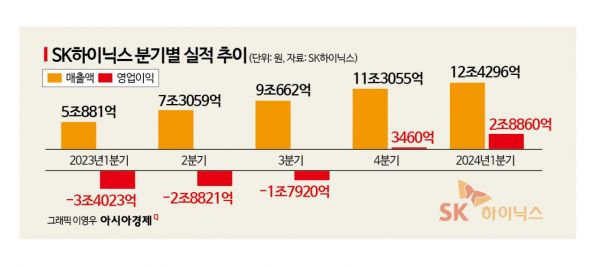
These results significantly surpassed market forecasts. The consensus for SK Hynix's first-quarter sales and operating profit were 12.1575 trillion KRW and 1.8551 trillion KRW, respectively. Sales slightly exceeded the consensus by 2.2%, while operating profit surpassed it by 55.5%.
By customer segment, sales of AI memory such as HBM increased. SK Hynix explained that NAND sales also rose, centered on premium products like eSSD, leading to an increase in the average selling price (ASP).
SK Hynix is emphasizing that this performance is not temporary. A company official stated, "We believe we have entered a clear trend of performance rebound, escaping the long-lasting downturn."
In response to the expanding demand for AI memory, SK Hynix plans to expand the supply of the world's first mass-produced 5th generation HBM (HBM3E). Additionally, it plans to launch a 10-nanometer (1nm = one billionth of a meter) 5th generation (1b) based 32Gb Double Data Rate (DDR)5 product within the year to strengthen its leadership in the high-capacity server DRAM market. NAND will continue product optimization to sustain the performance improvement trend.
TSMC of Taiwan, which has formed an alliance with SK Hynix for 6th generation HBM (HBM4), announced plans on the same day to enter the 1.6-nanometer 'A16' process in the second half of 2026. This strategy aims to bridge between the 2-nanometer and 1.4-nanometer processes scheduled for 2025 and 2027, respectively.
On the 24th (local time), TSMC held the North America Technology Symposium in Santa Clara, California, USA, where it unveiled the A16 process plan for the first time. Y.J. Mia, TSMC's Chief Operating Officer (COO), emphasized, "The new chip manufacturing technology, the A16 process, can supply power from the back of the semiconductor chip, enabling higher speeds. This is a field where we are competing with Intel."
TSMC and Samsung Electronics have been targeting production starts for the 2-nanometer process in 2025 and the 1.4-nanometer process in 2027. Given the large gap between 2 nanometers and 1.4 nanometers, TSMC has inserted the 1.6-nanometer process in between.
© The Asia Business Daily(www.asiae.co.kr). All rights reserved.
![Clutching a Stolen Dior Bag, Saying "I Hate Being Poor but Real"... The Grotesque Con of a "Human Knockoff" [Slate]](https://cwcontent.asiae.co.kr/asiaresize/183/2026021902243444107_1771435474.jpg)















