The Female Majority Structure Remains, but the 22nd National Assembly Likely to Differ
Shift to a "Will Do My Duty Even If Criticized" Stance
Possibility of a Hardline Speaker Emerges and Other Changes
After the overwhelming victory in the general election, the opposition's offensive has become fierce. In the 22nd National Assembly, the opposition's offensive is expected to be conducted at a 'high-intensity' level far beyond that of the 21st National Assembly. Opposition parties such as the Democratic Party of Korea seem ready to even discard the pretense of 'cooperation.'
According to political circles on the 21st, opposition parties including the Democratic Party have taken a hardline stance since the general election. At the full meeting of the Agriculture, Forestry, Livestock, Food, and Maritime Affairs Committee held on the 18th, the first standing committee meeting after the general election, five bills including the amendment to the Grain Management Act were directly referred to the plenary session without the ruling party's participation. While seven members from the People Power Party opposed the direct referral and did not attend the meeting, a total of 12 members, including 11 from the Democratic Party and independent lawmaker Yoon Mi-hyang, participated in a secret ballot and passed the bills.
The opposition argues that compared to the previous Grain Management Act, which was scrapped after the president exercised the right to request reconsideration (veto), the government's purchase obligations have been eased. However, the People Power Party countered, saying, "The Democratic Party unilaterally processed the request for plenary session referral without consultation on the agenda and schedule," calling it "a legislative rampage by the massive opposition that disregards the National Assembly Act."
Regarding the negotiation for the organization of the 22nd National Assembly, which marks the beginning of the term, the Democratic Party's momentum is also extraordinary. They openly express their intention not to concede the chairmanship of the Legislation and Judiciary Committee, which was considered the second party's share, nor the chairmanship of the National Assembly Steering Committee, which was thought to belong to the ruling party, to the People Power Party. Political circles predict that the 22nd National Assembly will operate under a different logic than the 21st National Assembly.
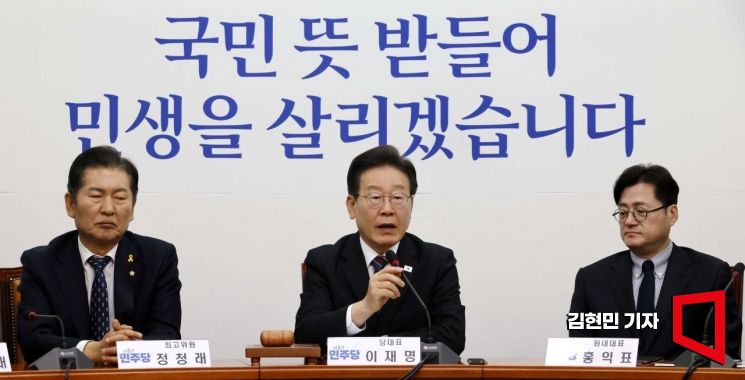 Lee Jae-myung, leader of the Democratic Party of Korea, is speaking at the Supreme Council meeting held at the National Assembly on the 17th. Photo by Hyunmin Kim kimhyun81@
What has changed?
① Changed Views on Cooperation
Through the general election, the Democratic Party's perception of cooperation has significantly changed. Until now, the Democratic Party expressed that values such as parliamentary democracy and cooperation should be observed at least normatively. However, this perception has largely disappeared after the recent general election. In response to criticism like "What did you do with 180 seats until now?" they answer, "From now on, even if we get criticized, we will do what needs to be done."
Chu Mi-ae, the Democratic Party's newly elected representative for Hanam City Gap in Gyeonggi Province and a potential next National Assembly Speaker, criticized the 21st National Assembly on MBC Radio on the 19th, saying, "(The Democratic Party) avoided and hesitated," and "lost balance and was swayed by what the prosecution said."
Im Oh-kyung, the Democratic Party's floor spokesperson, also said at a meeting with reporters, "From the beginning of the 21st National Assembly, we were criticized by the public for continuing consultation and discussion with the ruling party rather than pushing through," adding, "We will not make the same mistake twice. If it is for the people's livelihood, we intend to push forward actively." In a phone interview with Asia Economy, Im said, "If we cooperate by making concessions and dividing the spoils, it will end up like the latter half of the 21st National Assembly," and "Rather than cooperating with the People Power Party, which does nothing and only acts greedily, the Democratic Party should do what it must even if it gets criticized."
② Aiming Beyond the Limitations of a Minority-Led Legislature
Recent statements and response strategies from the opposition reveal a will to go beyond the legislative branch's limited roles of 'legislation' and 'checks and balances.'
Lee Jae-myung, leader of the Democratic Party, said at an emergency economic situation briefing by the Democratic Party's Livelihood Economy Crisis Countermeasures Committee held at the National Assembly on the 17th, "It is frustrating that the government holds executive authority while the National Assembly basically performs oversight and legislation, often only urging from a third-party standpoint. It would be good if the National Assembly could discover things it can do directly," adding, "I hope we take the maximum practical measures possible, even through the form of dispositive laws."
Dispositive laws refer to laws that directly create specific and individual rights or obligations for the people without intermediate mediation, such as executive enforcement by the administration or judicial rulings. These are concrete measures with automatic enforceability, but there is criticism that legislation may infringe on administrative functions and violate the separation of powers.
Lee himself acknowledged that "there are controversial parts" but mentioned dispositive laws, conscious of the limitations of the legislative branch alone.
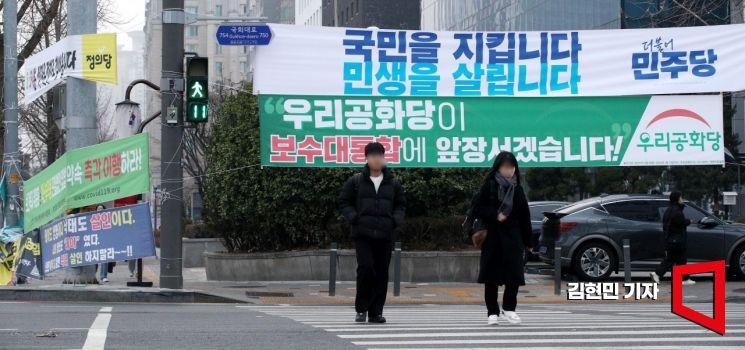 On the 5th, party banners were hung on the road in front of the National Assembly building in Yeouido, Seoul. Photo by Hyunmin Kim kimhyun81@
In response, Yoon Jae-ok, floor leader of the People Power Party and acting party leader, opposed Lee's mention of dispositive laws, saying, "It violates the spirit of the Constitution." After a meeting with party organization heads outside the National Assembly on the 19th, Yoon said in a Q&A session with reporters, "What (Lee) is talking about does not align with the fundamental constitutional spirit of the separation of powers," adding, "There is a clear distinction between what the National Assembly and the government should do. Until now, both have fulfilled their responsibilities while adhering to these principles and boundaries." He added, "It is not desirable to attempt to go beyond the basic principles or common sense of state governance just because you won the election," and said, "If there are unconstitutional laws depending on the situation, we will file a constitutional complaint."
Additionally, emphasizing responsibility for livelihood issues, the Democratic Party is expected to actively seek ways to produce effective results that confirm the efficacy of the majority party, going beyond the legislative branch's limitations of legislation and oversight in budget and lawmaking.
③ A National Assembly Speaker Emphasizing Innovation Over Parliamentary Neutrality Is Approaching
The likelihood of a National Assembly Speaker who does not hide 'partisanship' has increased. Within the Democratic Party, Chu Mi-ae, who will become a six-term lawmaker, and Cho Jung-sik are competing for the position of Speaker for the first half of the 22nd National Assembly.
Notably, both candidates reject the traditional role of the Speaker as a balancer or mediator. Chu has repeatedly emphasized that "the Speaker is not neutral." Regarding the 21st National Assembly, he criticized, "There were many aspects where the Speaker failed to meet expectations by wavering, not communicating fiercely with the people, not proposing alternatives to break through, and ultimately presenting something different from the core of the original bill while emphasizing cooperation." Secretary-General Cho is also actively promoting himself as "a Speaker who will work in harmony with Democratic Party leader Lee Jae-myung."
Even if the Speaker does not hold party membership, if the Speaker has partisanship and holds extensive discretionary power over parliamentary operations such as agenda setting and the prerogative to bring bills directly to the floor, the People Power Party's only card might be a 'resolution urging the Speaker's resignation.' However, due to their minority status, they cannot do more than submit such a resolution, nor can they adopt it.
For this reason, the People Power Party has proposed changing the Speaker election method to allow any senior member to run, present their platforms in the plenary session, and be selected. They argue that even in a minority-led legislature, the Speaker should be elected with consideration of the ruling party's votes. On the 19th, Representative Choi Hyung-doo suggested via social media, "Abandon the current method of electing the Speaker through a primary within the majority party followed by a yes/no vote in the plenary session, and follow the National Assembly Act. This way, a truly respected Speaker can emerge," adding, "When multiple candidates compete within the first party, the second party can at least vote for a trustworthy figure."
④ Reform Conservatives Have Also Joined the Opposition
The diversification of the opposition is another new change. On the 19th, the six opposition parties and the Marine Corps Reserve Union held a joint press conference at the National Assembly demanding the swift enactment of the special investigation law for Chae Sang-byung. The event, which drew attention as Cho Kuk, leader of the Cho Kuk Innovation Party, and Lee Jun-seok, leader of the Reform New Party, appeared together, confirmed that the entire opposition can coordinate seamlessly depending on the issue.
The Democratic Party has formed a united front through the proportional satellite party called the Democratic United Front in this general election. Opposition cooperation has largely been institutionalized. Additionally, the Reform New Party with three seats and the New Future Party with one seat have positioned themselves within the opposition. Moreover, with the inclusion of the Reform New Party led by Lee Jun-seok, who has a strong reform conservative color, the opposition's landscape has broadened not only in terms of seat numbers but also in public opinion. Although the 22nd National Assembly will have a similar minority-led seat distribution as the 21st, the People Power Party's position is much narrower politically.
© The Asia Business Daily(www.asiae.co.kr). All rights reserved.
![Clutching a Stolen Dior Bag, Saying "I Hate Being Poor but Real"... The Grotesque Con of a "Human Knockoff" [Slate]](https://cwcontent.asiae.co.kr/asiaresize/183/2026021902243444107_1771435474.jpg)
















