Touching around 1,400 KRW in the morning for the first time since November 2022
Concerns over Middle East war escalation weaken pivot expectations
The continuously rising won-dollar exchange rate has finally reached 1,400 won. The market expects the won-dollar exchange rate to continue its upward trend for the time being, potentially approaching the mid-1,400 won range.
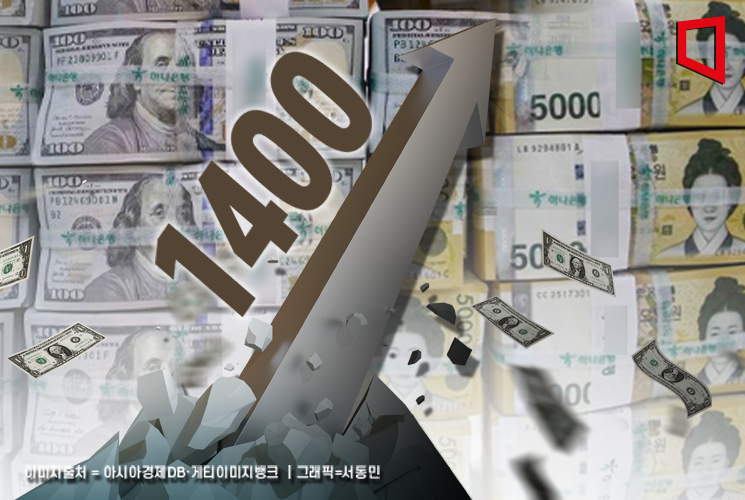
On the 16th, in the Seoul foreign exchange market, the won-dollar exchange rate opened at 1,389.9 won, up 5.9 won from the previous day, and continued to rise, touching the 1,400 won mark at 11:31 a.m. Since then, it has been fluctuating in the high 1,390 won range.
Experts observe that due to domestic and international conditions such as Middle East instability and retreating expectations of a pivot (direction change), the exchange rate could rise to the mid-1,400 won range within this month without intervention from authorities.
Moon Da-woon, a researcher at Korea Investment & Securities, explained, "If Israel takes active retaliation and geopolitical risks expand, a secondary ceiling could form around 1,440 won. However, since the Bank of Korea recently held a 'market situation review meeting' and verbally intervened, it seems unlikely to rise beyond that."
Researcher Moon added, "Because the won-dollar exchange rate rose too quickly, volatility has increased, and the upward momentum could be reversed." He suggested an average won-dollar exchange rate of 1,350 won for the second quarter. He expects the soaring exchange rate to stabilize and decline again by June. He also noted, "However, if the won-dollar exchange rate does not significantly drop to the 1,300 won range after May, the average forecast will need to be revised upward."
Min Kyung-won, an economist at Woori Bank, also said, "If the closing price breaks through 1,400 won, our forecast is that the second quarter's peak upper limit will be around 1,420 won, but since this is an unprecedented level, we need to keep the possibility open for further increases." He explained, "There was resistance around the 1,440 won level in November 2022, but that does not necessarily mean it is a psychological level that would prevent further rises. Without clear intervention from authorities, it could rise even more."
Park Sang-hyun, a research fellow at Hi Investment & Securities, said, "The 1,400 won level itself is rare, having been recorded only three times since the foreign exchange crisis, so it is difficult to say how much higher it can go. However, domestically, with the worsening domestic economy and real estate project financing (PF) issues, it seems unlikely to fall easily."
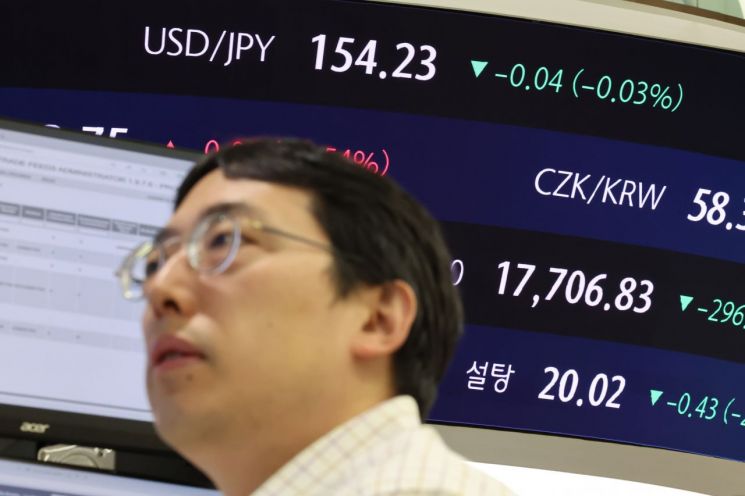
The robust U.S. economic situation is delaying expectations for interest rate cuts, influencing the rise in the won-dollar exchange rate. The most recent indicator is the U.S. March retail sales data released on the 15th (local time), which showed a 0.7% increase from the previous month, significantly exceeding the forecast of 0.3%. Early in the year, the market expected a pivot in the second quarter, but this expectation continues to be postponed. The International Finance Center stated in its June 16 international finance bulletin, "While the possibility of an interest rate cut in June cannot be ruled out, considering overall economic conditions, the first rate cut is expected to occur at the end of the year."
Last weekend, Iran directly attacked Israel for the first time, escalating the war risk in the Middle East. As geopolitical risks increase, the value of the safe-haven dollar rises. Due to the expansion of the Middle East war risk, Dubai crude and Brent crude prices are already moving around $90 per barrel. The government has decided to extend the fuel tax reduction, originally scheduled to end this month, by two months, reflecting growing concerns over rising international oil prices.
If oil prices rise, inflation, which had entered the 'last mile' (the path to reaching the 2% inflation target), could rise again. Consequently, expectations for a U.S. interest rate cut at least by early the third quarter continue to be delayed. According to the CME FedWatch Tool, the probability of a federal funds rate cut in July stands at only 40.6% in the futures market.
© The Asia Business Daily(www.asiae.co.kr). All rights reserved.
![Clutching a Stolen Dior Bag, Saying "I Hate Being Poor but Real"... The Grotesque Con of a "Human Knockoff" [Slate]](https://cwcontent.asiae.co.kr/asiaresize/183/2026021902243444107_1771435474.jpg)
















