Thousands Laid Off at SAP and Tesla
Apple Also Announces First Post-COVID Layoffs
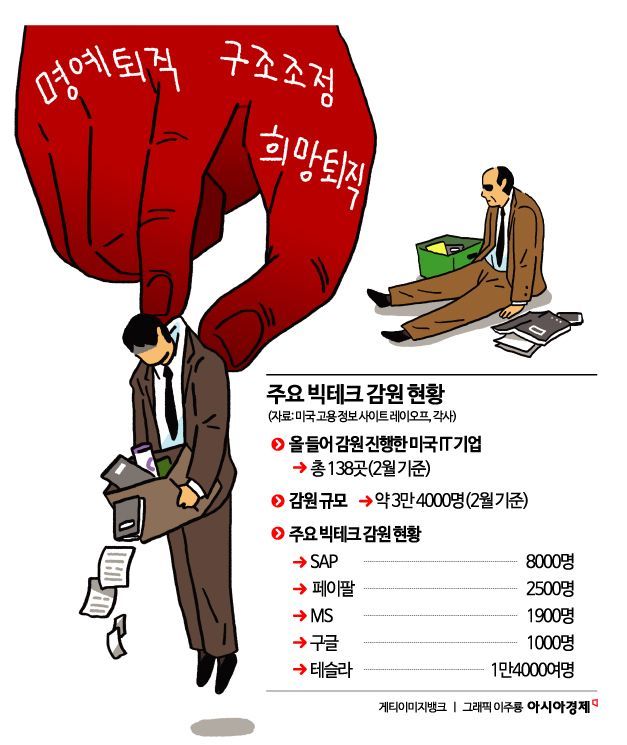
SAP 8,000 employees, PayPal 2,500 employees, Microsoft (MS) 1,900 employees, Google 1,000 employees.
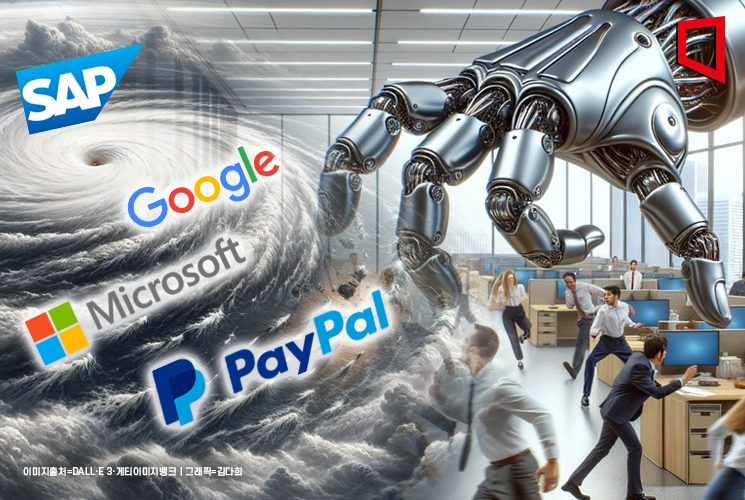
This year, a wave of layoffs has swept through big tech companies. The ‘money war’ among big tech firms vying for AI (artificial intelligence) supremacy is the starting point of this storm. Analysts say that the restructuring of existing personnel to focus resources on AI is leading to mass layoffs.
Struggling with sluggish electric vehicle sales, Tesla has decided to cut 10% of its global workforce. Elon Musk, Tesla’s CEO, announced this plan in an email to employees on the 15th (local time). As of the end of last year, Tesla had 140,473 employees worldwide, so the scale of layoffs is expected to be around 14,000. Among those affected by the layoffs are Drew Baglino, Senior Vice President and one of Tesla’s four key executives alongside Musk, and Rohan Patel, Vice President of Public Policy and Business Development.
Apple, once considered a ‘layoff-free zone,’ could not escape the cold winds either. According to major foreign media, Apple recently laid off more than 600 employees from its Apple Car and smartwatch projects. This marks the first large-scale workforce reduction since the COVID-19 pandemic by Apple CEO Tim Cook, who had previously emphasized that layoffs were a last resort.
Since the beginning of the year, major layoffs at big tech companies have continued. U.S. online payment service provider PayPal plans to lay off 2,500 employees. Alphabet, Google’s parent company, has cut more than 1,000 technical and advertising staff and plans to eliminate about 100 jobs at YouTube as well. E-commerce company eBay is also set to lay off 1,000 employees, which is 9% of its full-time workforce. Snap, which operates the short-form messenger ‘Snapchat,’ announced it will reduce about 500 employees, or 10% of its total workforce, within the first quarter.
According to the U.S. employment information site Layoff, a total of 138 local IT companies have conducted layoffs through February this year. The total number of layoffs reached approximately 34,000. Typically, big tech companies carry out restructuring at the beginning of the year when they set annual business plans. However, this year’s layoffs are analyzed to be driven more by strategic decisions than seasonal factors.
The main reason is to concentrate funds and personnel on AI. Mark Zuckerberg, Meta’s CEO, said during the early-year earnings announcement, "We need to control labor costs to invest in AI over the long term." Sundar Pichai, Google’s CEO, also lamented in an internal announcement last January, "The reality is that difficult choices (layoffs) must be made to create the capacity to invest in priorities (AI)." They are letting go of existing employees in large numbers to secure AI specialists.
The value of AI talent has already skyrocketed. The market for AI personnel is said to be so competitive that salaries are essentially negotiable at any level. OpenAI offered Google’s core AI talent multi-million-dollar salaries and stock packages worth up to $10 million (about 1.35 billion KRW). As of January this year, it is known that OpenAI offered PhD-level AI researchers an annual salary of $865,000 (about 1.17 billion KRW).
However, those considered A-grade experts are still a minority. Musk stated on the social networking service X, "This is the craziest talent war I’ve ever seen," adding, "OpenAI is aggressively recruiting Tesla employees, so we will increase compensation."
Besides personnel, securing funds for semiconductors and other resources to respond to the AI era is also challenging. Big tech companies are venturing beyond their own AI models into AI semiconductor development, which requires massive capital. They are also investing trillions of won in startups to expand the AI ecosystem. Last month, Amazon invested $2.75 billion (about 3.7 trillion KRW) in Anthropic, considered a rival to OpenAI. This was a follow-up investment following $1.25 billion (about 1.7 trillion KRW) last year. MS, Nvidia, and others also bet $700 million (about 940 billion KRW) on AI robot startup Figure AI.
© The Asia Business Daily(www.asiae.co.kr). All rights reserved.
![Clutching a Stolen Dior Bag, Saying "I Hate Being Poor but Real"... The Grotesque Con of a "Human Knockoff" [Slate]](https://cwcontent.asiae.co.kr/asiaresize/183/2026021902243444107_1771435474.jpg)
















