LGU+ and Professor Lee Kyung-han's Team Publish Quantum Communication White Paper
Classification of Quantum Information Technology... Redefining the Essence of Quantum Communication
Efficiency Improvement Predicted When Using Ultra-Large AI Models
LG Uplus and a research team from Seoul National University have joined forces to publish a white paper on quantum information technology, presenting a roadmap for related technologies to academia, government, and industry.
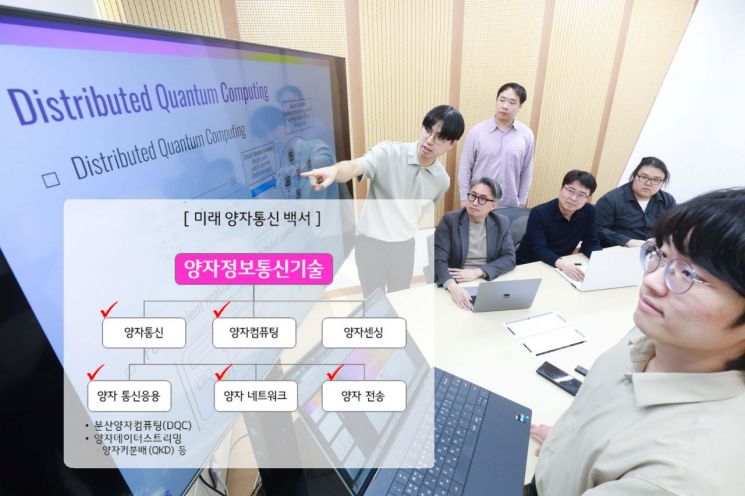
On the 14th, LG Uplus announced that it had published the "Future Quantum Communication White Paper" (hereafter referred to as the white paper) together with Professor Lee Kyunghan's research team from the Department of Electrical and Computer Engineering at Seoul National University (NXC Lab researchers Minjae Lee, Dongsu Kwak, and Chanjung Park, integrated master's and doctoral course students). The white paper broadly classifies quantum information technology into quantum communication, quantum computing, and quantum sensing, and provides a detailed introduction to the technological trends and development directions of quantum communication.
Recently, quantum technology has emerged as the center of global technological innovation. The government is supporting this by announcing an investment plan worth 3 trillion won through the "Korea Quantum Science and Technology Strategy" for 2035, and interest from the private sector is also growing. LG Uplus and the NXC Lab published the white paper to present a research and development and utilization roadmap for quantum information technology to academia, government, and companies worldwide.
Quantum communication refers to the transmission of information between interconnected quantum computers and quantum sensors, and is broadly classified into quantum transmission technology that delivers quantum states, quantum network technology as infrastructure for quantum information transmission, and quantum communication application technologies that utilize these.
In the domestic market, "quantum key distribution," one of the application cases of quantum communication, is known as a representative example of quantum communication. However, the white paper defines this as part of quantum data streaming and states that the essence of quantum communication is the transmission of quantum information between quantum computers and sensors.
The white paper forecasts that as the applications of quantum technologies such as quantum computing and quantum sensing expand in the future, the demand for quantum communication will also increase.
In particular, it is expected to efficiently handle ultra-large artificial intelligence (AI) models that are difficult to process with current computing. Just as clustering, which effectively transmits data among tens of thousands of computers, is gaining attention in the recent generative AI era, the quantum computing era will require efficient quantum distributed computing for cluster formation among quantum computers. This is expected to lead to significant performance improvements in intelligent applications, language models, and image recognition.
Additionally, significant changes are anticipated in fields such as chemical engineering, logistics, and finance.
Professor Lee said, "Quantum key distribution, one of the applied technologies, has been mistakenly known as representing quantum communication, but I hope this white paper will raise interest in quantum communication and serve as an opportunity to invigorate the entire ecosystem."
© The Asia Business Daily(www.asiae.co.kr). All rights reserved.
![Clutching a Stolen Dior Bag, Saying "I Hate Being Poor but Real"... The Grotesque Con of a "Human Knockoff" [Slate]](https://cwcontent.asiae.co.kr/asiaresize/183/2026021902243444107_1771435474.jpg)















