Amazingly Well Preserved... Created in AD 40-50
Academia Calls It "One of Pompeii's Most Remarkable Discoveries"
Several well-preserved fresco murals have been discovered in Pompeii, Italy, a world-renowned archaeological site. The archaeological community regards this as one of the most remarkable discoveries in Pompeii.
On the 11th (local time), ANSA news agency and the British daily The Guardian reported, "A remarkably well-preserved fresco mural was found in an ancient private residence on Via di Nola, one of the longest streets in Pompeii."
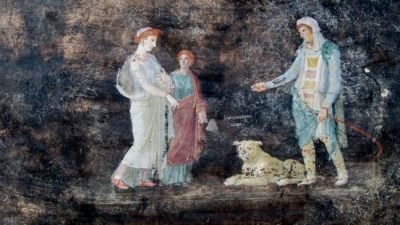
Fresco is a technique where pigments are applied onto wet lime plaster before it dries, considered one of the oldest painting methods or forms in human art history.
The murals depicting figures from Greek mythology were painted on all four walls of a banquet hall measuring 15 meters wide and 6 meters high, which were painted black. Gabriele Chuktriegel, director of the Pompeii Archaeological Park, estimated that these works were created between 15 BCE and 40?50 CE.
Director Chuktriegel explained, "The banquet hall walls were painted black likely to conceal the soot from oil lamps," adding, "Pompeiians gathered here for banquets after sunset, and after drinking a few glasses of wine, the flickering light would have made the paintings appear to come alive."
The murals depict scenes such as the Trojan prince Paris meeting Queen Helen of Sparta for the first time in Greek mythology. Another work shows the Greek sun god Apollo courting Cassandra, the princess of Troy, and also features Leda, Helen’s mother, with Zeus who had transformed into a swan.
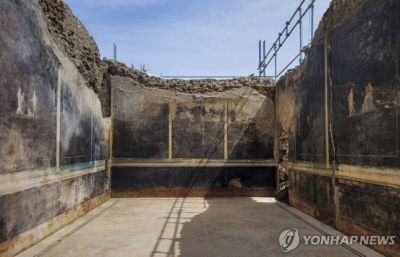
Pompeii was one of the most prosperous cities in the ancient Roman Empire but was reduced to ruins by the eruption of Mount Vesuvius in 79 CE. The site was uncovered during 16th-century canal construction, leading to the first excavation in 1748, and today the city’s layout has been partially restored to give an idea of its past form.
Pompeii is highly valued archaeologically for its excellent preservation and insight into the era, and was designated a UNESCO World Heritage Site in 1997. It is also the second most visited archaeological site in the world. The British BBC reported, “Archaeologists have rated the newly discovered fresco murals as one of Pompeii’s most astonishing finds.”
Gennaro Sangiuliano, Italy’s Minister of Culture, said, “Pompeii reveals something beautiful and meaningful with every excavation,” calling it “a true treasure trove that never ceases to amaze and inspire.”
© The Asia Business Daily(www.asiae.co.kr). All rights reserved.