Constituency Analysis and Regime Judgment Strategy Led to Election Success
But Expansion of 'Young Male Support Base' Faces Limitations
Lee Jun-seok, leader of the Reform New Party, succeeded in entering the National Assembly after four attempts, thanks to strategically targeting constituencies with a strong young voter base and skillfully leveraging the public sentiment for regime judgment. It is his first time wearing a National Assembly badge in 13 years since entering politics in 2011. The district Lee ran in, Hwaseong-si in Gyeonggi Province, was a stronghold of the Democratic Party of Korea, but he caused an upset by defeating the Democratic candidate Gong Young-woon, who was favored to win with 39.73% of the vote, by a margin of 2.68 percentage points. The limitation of the Reform New Party’s expansion remains a challenge that Lee, now a member of the National Assembly, will have to face going forward.
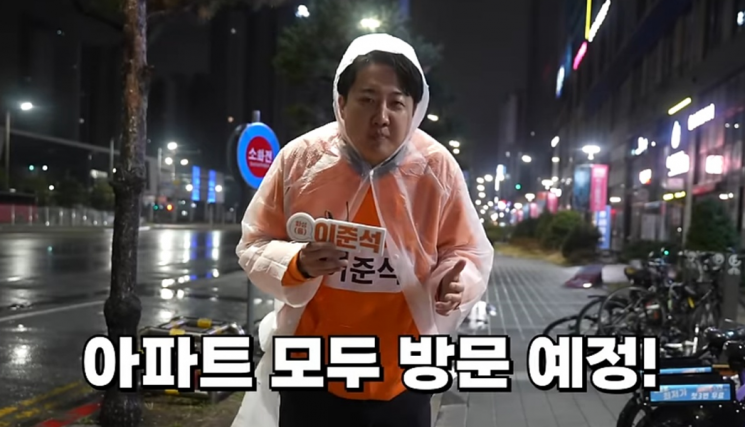 Lee Jun-seok, leader of the Reform New Party, is campaigning by visiting 100 apartment complexes in Hwaseong, Gyeonggi Province. Photo by YouTube Yeouido Reconstruction Association capture.
How Was the Last-Minute Comeback Possible?
Lee became the protagonist of the last-minute comeback thanks to his precise political engineering analysis of the constituency. Having previously run in Seoul Nowon-byeong in the 2016 20th general election, the 2018 by-election, and the 2020 21st general election, this run in Hwaseong-si, Gyeonggi Province was a new challenge. The Reform New Party explained Lee’s choice of Hwaseong-si as the 'youngest constituency,' where over 40% of voters are aged 39 or younger. As a representative young politician, Lee was seen as having an advantage in winning the hearts of these voters.
Of course, Lee did not have a smooth path throughout the campaign. Initially, this area was classified as a Democratic Party stronghold, with high support for the Democratic candidate Gong. The more challenging it became, the more Lee showed desperate determination during his campaign. He toured around 100 apartment complexes in the Dongtan area and even conducted a 48-hour non-stop campaign, leading the election efforts. When Lee’s parents also stepped forward to support the all-out campaign, voters perceived this as a sign of desperation and earnestness. Lee also fully demonstrated his personal skills. In TV and radio debates against the major candidates from both ruling and opposition parties, he relentlessly pursued the controversy over Gong’s 'dad’s chance' (favoritism due to his father’s influence), gaining momentum.
The expectation surrounding 'presidential hopeful Lee Jun-seok' also attracted voters’ support. Historically, voters tend to support presidential hopefuls in general elections, and Lee was interpreted to have benefited somewhat from this expectation. Additionally, the 22nd general election was influenced by a 'regime judgment' wave, making Lee’s anti-Yoon (anti-Yoon Suk-yeol) stance advantageous.
In 2022, while serving as the leader of the People Power Party, Lee clashed with President Yoon Suk-yeol and was dishonorably forced to resign amid allegations of sexual bribery. Lee has strongly criticized President Yoon, claiming he was 'ousted by the regime.' Lee’s first remarks after winning the election were also a message directed at President Yoon. He raised his voice, saying, "It is necessary to reflect on why a person who led the party to a great victory had no choice but to switch parties and run."
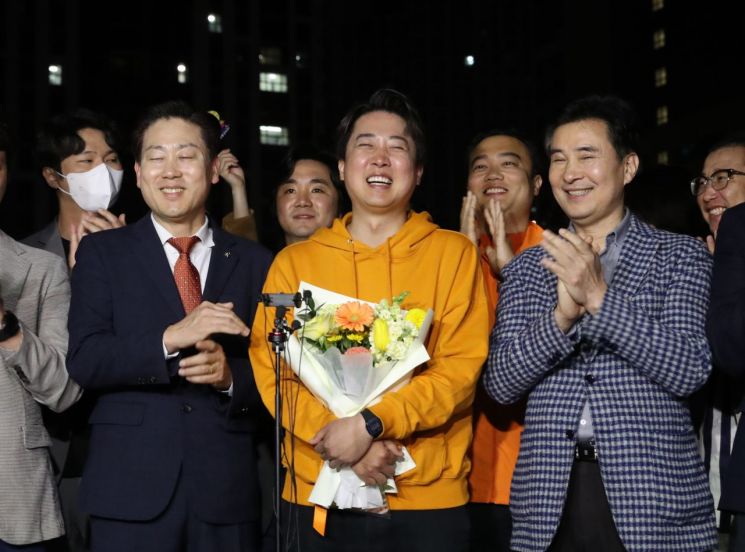 Reform New Party candidate Lee Jun-seok, running for Hwaseong-si in the 22nd National Assembly election, is seen celebrating on the morning of the 11th at Yeoul Park in Hwaseong-si, Gyeonggi-do, as his victory becomes likely. Photo by Yonhap News
The Challenge of the Reform New Party’s Expansion Limitations
Although Lee succeeded in entering the National Assembly after four attempts, the limitation of the Reform New Party’s expansion remains a challenge. In the 2021 Seoul mayoral by-election, Lee stood at the center of 'gender conflict,' serving as a spokesperson for men in their 20s and solidifying his political position. The 'Lee Jun-seok phenomenon' at that time was largely analyzed as a result of Lee stimulating the anti-feminist sentiment of 'Idaenam' (men in their 20s), leading to their consolidation. Lee also made full use of anti-feminist sentiment in the last presidential election. At that time, the People Power Party ran its campaign with the major pledge of 'abolishing the Ministry of Gender Equality and Family.'
As a result, Lee’s favorability among female voters in their 20s and 30s is relatively low. According to KBS exit polls, among voters in their 20s and 30s who voted for the People Power Party, support for the Reform New Party was 9.8% and 8.2%, respectively. Compared to 4.9% for those in their 40s, 3.9% in their 50s, 2.0% in their 60s, and 1.0% for those aged 70 and above, support among younger voters is considerably higher. However, support among young female voters was very low. Specifically, support among male voters under 20 was 13.7%, but only 4.0% among female voters. In their 30s, male support was 10.9%, while female support was 4.8%.
Choi Jin, president of the Presidential Leadership Research Institute, commented on Lee’s election factors, saying, "Hwaseong-si is a constituency where Lee Won-wook, a Reform New Party member, served three terms, and inheriting much of his organization likely helped a lot in this election." He added, "The inherited constituency organization, Lee’s image as a young politician, and the fact that it is the youngest constituency created synergy."
Regarding Lee’s future presidential path, he said, "Lee said in his victory speech that he wants to become a 'genuine politician,' but he will need to change his style and patterns from what he has done so far." He continued, "If he was previously known as a politician who only gave harsh criticism and blunt advice, he must now reinvent himself as a leader who proposes constructive alternatives to overcome various problems."
© The Asia Business Daily(www.asiae.co.kr). All rights reserved.
![Clutching a Stolen Dior Bag, Saying "I Hate Being Poor but Real"... The Grotesque Con of a "Human Knockoff" [Slate]](https://cwcontent.asiae.co.kr/asiaresize/183/2026021902243444107_1771435474.jpg)

















