Part-Time Worker in Training Makes Beverage Using Concentrated Dye
Research Shows Excessive Blue Dye Can Trigger Hyperactivity
A child customer drank concentrated food coloring due to a mistake by an employee at a famous franchise coffee shop. On the 7th, Mr. A revealed through social media (SNS) that his child drank a blue-colored beverage made at the coffee shop. Mr. A explained, "When I saw the child's mouth turn blue after drinking the beverage, I had a gut feeling that it shouldn't be consumed," and he called the store to inquire.
After checking the closed-circuit television (CCTV) footage, the store admitted the mistake, saying, "A part-time worker in training accidentally made the drink using concentrated blue food coloring." Mr. A received a refund for the drink and initially tried to move past the situation without further action. However, something surprising happened the next day. The child, after going to the bathroom, had blue-colored stool, and the toilet water was also blue.
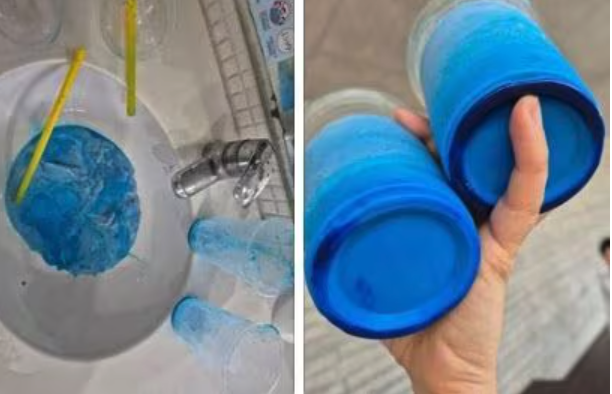
Concerned, Mr. A said, "I don't know if there is any problem inside the child's stomach. It was the same color as the blue cleaning agent used for toilets," and added, "I am monitoring the child's condition." Netizens who saw this reacted with comments such as, "The child must have been very surprised in the bathroom," "It would be good if the store notified customers in advance," and "Even if the food coloring is harmless to the human body, as a parent, I would be very worried." In response to a netizen's advice, "I once read a pharmacist's post saying not to feed blue food coloring even if it is edible," Mr. A said, "That made me even more upset," and added, "I immediately felt something was wrong from the start. I am watching the child's condition."
Tar dyes used for food coloring are food additives used to give color to food. The health effects of tar dyes have been a global concern. Yellow No. 4 is considered an asthma-inducing substance in the European Union, Red No. 3 may influence tumor development, and Blue No. 1 has been found in studies to cause hyperactivity in children.
In South Korea, the acceptable daily intake (ADI) for edible tar dyes is set, and intake and usage amounts are restricted. The daily allowable amount per kilogram of body weight is 25 mg for Green No. 3, 0.15 mg for Red No. 2, and 0.1 mg for Red No. 3, among others.
© The Asia Business Daily(www.asiae.co.kr). All rights reserved.
![Clutching a Stolen Dior Bag, Saying "I Hate Being Poor but Real"... The Grotesque Con of a "Human Knockoff" [Slate]](https://cwcontent.asiae.co.kr/asiaresize/183/2026021902243444107_1771435474.jpg)















