Korean 22nd National Assembly Election On-site Report
"Also Influences the Direction of the Next Presidential Election"
Local Chinese media evaluated the opposition's landslide victory in South Korea's 22nd National Assembly election by stating that "President Yoon Seok-yeol has failed his midterm exam."
On the 10th, the local outlet Xin Jing Bao (Xinjingbao) referred to the exit poll results from South Korea's three major broadcasters, saying, "This election will not only determine the power structure of the National Assembly for the next four years but also influence the direction of the next presidential election." Li Min, associate researcher at the Asia-Pacific Research Institute of the China Institute of International Studies, told Xin Jing Bao, "If the People Power Party ends in a crushing defeat as predicted by the exit polls, President Yoon will fail his midterm exam, and his remaining term will become difficult."
They also assessed that, similar to when Yoon was elected president in 2022, he failed to remove obstacles to passing key reform bills amid a 'Yeo-so-ya-dae (여소야대, ruling party minority, opposition majority)' situation. They mentioned, "Since the ruling party did not secure a majority in the National Assembly, President Yoon's key reform bills were repeatedly rejected in the legislature."
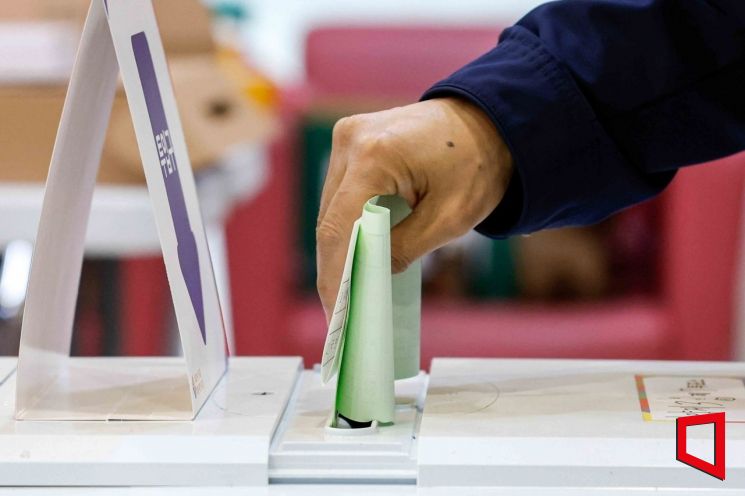 On the 10th, the 22nd National Assembly election day, voters visited the 7th polling station in Jayang 3-dong, Gwangjin-gu, Seoul to cast their votes. Photo by Jinhyung Kang aymsdream@
Furthermore, "Since its inauguration, the Yoon Seok-yeol administration has been under pressure due to various issues such as rising inflation, an aging population, and doctors' strikes," and "It also struggled with several scandals, including allegations regarding First Lady Kim Geon-hee's luxury handbag, resulting in approval ratings lingering around 30-40%," the report explained. Li Tianguo, associate researcher at the Asia-Pacific and Global Strategy Research Institute of the Chinese Academy of Social Sciences, diagnosed, "South Korea is experiencing rapid inflation and rising living costs, which are affecting disposable income. Many voters want to elect figures who can propose economic revitalization measures."
He criticized, "This election will be one lacking in public welfare and policy," adding, "As the election day approached, political parties focused more on attacking opponents rather than on the public's interests or policy superiority." He further stated, "This election revealed the polarization in South Korean politics, where opponents with differing views are seen as enemies," referencing the assault incidents involving Lee Jae-myung, leader of the Democratic Party, and Bae Hyun-jin, a member of the People Power Party.
Additionally, the report noted that President Yoon's 'leek price' related gaffe also influenced the election, stating, "Opposition candidates mocked President Yoon's detachment from ordinary citizens' lives by shaking leeks at campaign rallies and criticized the government for failing to properly control inflation."
Xin Jing Bao also predicted that Han Dong-hoon, emergency response committee chairman, who gained prominence during this election, could rapidly rise from a political newcomer to a leading candidate for the next presidential race. Other ruling party candidates mentioned included Seoul Mayor Oh Se-hoon and former Minister of Land, Infrastructure and Transport Won Hee-ryong.
© The Asia Business Daily(www.asiae.co.kr). All rights reserved.
![Clutching a Stolen Dior Bag, Saying "I Hate Being Poor but Real"... The Grotesque Con of a "Human Knockoff" [Slate]](https://cwcontent.asiae.co.kr/asiaresize/183/2026021902243444107_1771435474.jpg)















