March FOMC Minutes Released
"No Confidence in 2% Inflation Slowdown"
"Seasonal Factors vs Broad Increase" Conflict
Goldman Sachs Cuts Rate Cuts This Year from 3 to 2
Officials of the U.S. Federal Reserve (Fed) expressed concerns at last month's Federal Open Market Committee (FOMC) meeting that the pace of inflation slowdown was not fast enough. Regarding this year's inflation trend, which has exceeded expectations, views within the Fed were sharply divided over whether it was a temporary factor or a structural trend. As the debate over inflation intensifies and the March Consumer Price Index (CPI) also surpassed market forecasts, investors are effectively abandoning hopes for a rate cut in June and are now leaning toward July or September as the likely timing for the first rate cut.
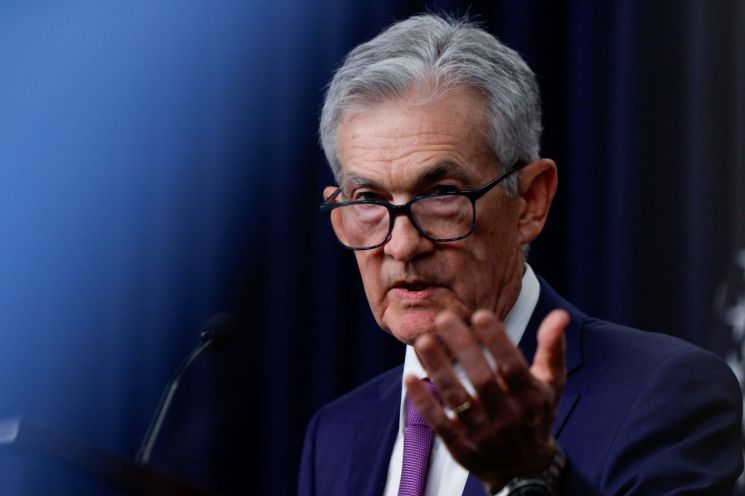
According to the March FOMC minutes released by the Fed on the 10th (local time), members reaffirmed a cautious stance that greater confidence is needed that inflation is slowing to the 2% target before cutting interest rates.
The minutes stated, "Participants generally mentioned uncertainties about the persistence of high inflation," and "recent data did not bolster their confidence that inflation is steadily slowing to 2%."
Some Fed officials expressed concerns that geopolitical turmoil and rising energy prices could further stimulate inflation. There were also views that monetary easing policies could increase inflationary pressures.
According to the minutes, Fed officials focused their discussions on inflation. Opinions were divided regarding the inflation figures for January and February, which exceeded market expectations. Fed Chair Jerome Powell mentioned the possibility that inflation rose due to seasonal factors, but some officials disagreed. The minutes noted, "Some participants pointed out that the recent inflation increase was relatively broad-based and should not be simply dismissed as statistical noise."
However, most Fed officials agreed that it would be appropriate to cut rates at some point this year. The minutes stated, "Policymakers generally noted that the disinflation process is proceeding along a somewhat bumpy path."
There was also consensus on slowing the pace of quantitative tightening, known as balance sheet reduction, in the near future. Quantitative tightening is a measure by which the Fed absorbs liquidity from the market by selling bonds or not reinvesting proceeds from maturing bonds from its $7.4 trillion holdings. Most Fed officials appeared to want to reduce the current pace of quantitative tightening by about half. They were concerned that not slowing the pace could effectively act as upward pressure on interest rates.
The March FOMC minutes were released on the same day that the U.S. CPI was reported to have exceeded market expectations for the third consecutive month. Broad discussions about inflation uncertainty among Fed officials have heightened caution regarding the inflation trend. According to the U.S. Department of Labor, the March CPI rose 0.4% month-over-month and 3.5% year-over-year, surpassing expert forecasts of 0.3% and 3.4%, respectively. The core CPI, which the Fed closely monitors, also increased 0.4% month-over-month and 3.8% year-over-year, exceeding market expectations of 0.3% and 3.7%. Housing costs and gasoline price increases contributed to more than half of the monthly CPI rise. Housing costs rose 0.4% month-over-month, and gasoline prices increased by 1.7%.
The market sentiment now largely dismisses expectations for a rate cut in June, placing more weight on a July cut. According to the Chicago Mercantile Exchange (CME) FedWatch tool, the federal funds futures market on that day priced in about a 17% chance that the Fed would cut rates by at least 0.25 percentage points at the June FOMC meeting, down from 57% the day before and 72% a month earlier. The probability of a 0.25 percentage point or greater cut in July was 41%, sharply down from 84% the previous day. The chance of a rate cut of 0.25 percentage points or more in September was recorded at 66%.
Global investment bank Goldman Sachs also lowered its forecast for the number of rate cuts this year from three to two immediately after the March CPI release. Last month, Goldman Sachs expected the Fed to begin cutting rates in June and to reduce rates three times in June, September, and December, but after the CPI announcement, it revised its forecast to two cuts in July and November.
The market is even discussing the possibility of rate hikes. Former U.S. Treasury Secretary Larry Summers appeared on Bloomberg TV that day and reiterated, "The next rate move should be seriously considered as a hike rather than a cut," estimating the probability of a Fed rate increase at 15-25%.
© The Asia Business Daily(www.asiae.co.kr). All rights reserved.
![Clutching a Stolen Dior Bag, Saying "I Hate Being Poor but Real"... The Grotesque Con of a "Human Knockoff" [Slate]](https://cwcontent.asiae.co.kr/asiaresize/183/2026021902243444107_1771435474.jpg)















