Kia CES Investor Day on the 5th
Global Sales Target of 4.3 Million Units by 2030
Eco-Friendly Vehicle Sales at 2.48 Million Units, 58% Share
Adjusting EV Target Pace... Expanding HEV Proportion
2030 PBV Sales Target of 250,000 Units
Kia announced its goal to increase the proportion of eco-friendly vehicles in global sales to 58% by 2030. In response to the recent slowdown in electric vehicle (EV) market demand, the company plans to expand its hybrid (HEV) lineup and increase the introduction of affordable electric vehicles in the subcompact and smaller segments.
On the 5th, Kia held the '2024 CEO Investor Day' at the Conrad Hotel in Yeouido, where it unveiled its mid- to long-term business strategy. At the event, Kia set a target to sell 4.3 million units globally by 2030, the same figure as announced at last year’s Investor Day.
However, the company slowed down its EV sales target while increasing its hybrid goals, thereby expanding the overall eco-friendly vehicle sales target. At the event, Kia announced that by 2030, 2,482,000 units, accounting for 58% of global sales, will be eco-friendly vehicles. This is a 3 percentage point increase from the previous target of 55% set last year.
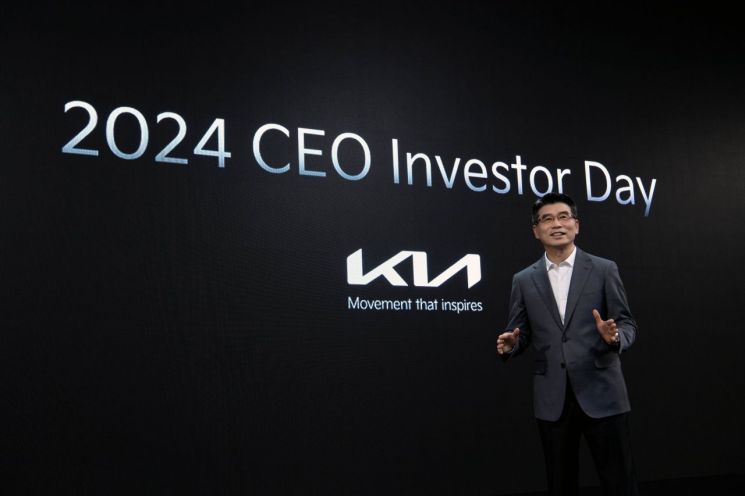 Song Hoseong, President of Kia, is explaining Kia's mid- to long-term business strategy and financial goals at the '2024 CEO Investor Day.'
 [Photo by Kia]
Electric Vehicle Growth Slows... Expanding Hybrid Lineup
Kia expects the growth rate of the EV market to slow from this year through 2026. To respond to this, Kia plans to expand its hybrid lineup. The number of hybrid models, which was six in 2024, will increase to eight by 2026 and nine by 2028, aiming to offer hybrid models across most major vehicle segments. By 2028, hybrids are expected to account for 19% (800,000 units) of total sales.
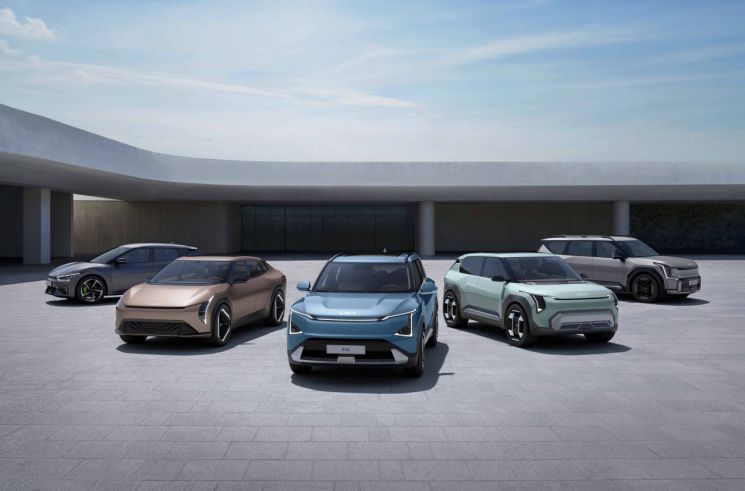
The EV market will focus on expanding market share with popular models in the subcompact and smaller segments. In key markets such as Korea, North America, and Europe, Kia plans to operate a total of six popular models, starting with the small sport utility vehicle (SUV) EV3, followed by EV2, EV4, EV5, and others.
Additionally, to flexibly respond to changes in global EV demand, Kia will produce both electric and internal combustion engine vehicles concurrently at domestic and overseas plants. Two plants, Autoland Gwangmyeong Plant 2 and Hwaseong EVO Plant, will be dedicated EV production facilities, expanding production of popular models.
Direct Competition with Chinese EVs in Middle East, Southeast Asia, and Latin America Markets
Kia is strengthening product competitiveness in emerging markets where Chinese brands are aggressively increasing their market share. Connected car services will be expanded to the Middle East, Asia-Pacific, and Latin America regions, covering a total of 74 countries by 2026 (up from 41 countries currently). The number of models equipped with over-the-air (OTA) wireless software updates will increase from five Hyundai models to 18, and the installation rate of advanced driver assistance systems (ADAS) will be raised to over 63%, targeting convenience to capture the market.
Furthermore, Kia is accelerating its approach to emerging markets by utilizing its China plants. After two years of preparation, Kia has established a system to produce vehicles for emerging markets at its Chinese factories. Accordingly, the company aims to increase sales in emerging markets from 80,000 units in 2023 to approximately 250,000 units by 2027.
Differentiated PBV Strategy... Targeting 250,000 Units by 2030
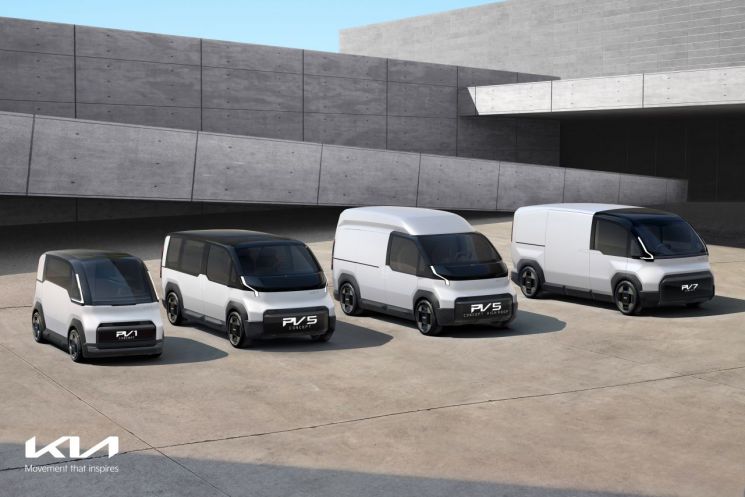
Kia has also set plans to create new sales demand through purpose-built vehicles (PBVs). By leveraging the PBV platform and flexible production system, the company aims not only to enter the B2B market but also to actively attract B2C demand.
To this end, Kia will launch its first mid-size PBV, the PV5, in 2025 and begin full-scale PBV business operations. The largest PBV in the lineup, the PV7, offering the most spacious interior, is scheduled for release in 2027. Kia expects to sell 150,000 units of the PV5 and 100,000 units of the PV7 annually by around 2030, totaling 250,000 units.
Operating Profit Margin Target of 11.9% This Year... 38 Trillion KRW Investment in Future Vehicles Over 5 Years
Kia has set a global sales target of 3.2 million units (wholesale basis) for this year, a 3.6% increase compared to the previous year. Two new models will be launched this year: the small electric SUV EV3 and the K4, which will be produced at the Mexico plant.
The financial goal for this year is to achieve a double-digit operating profit margin of 11.9%. The sales target is 101.1 trillion KRW, with an operating profit target of 12 trillion KRW.
Regarding future investment plans, Kia announced it will invest 38 trillion KRW over five years, an increase of about 5 trillion KRW compared to the previous five-year plan (2023?2027). Of this, 15 trillion KRW will be allocated to future businesses. The investment distribution is 65% for electrification, 19% for PBVs, 8% for SDV transformation, 5% for AAM and robotics, and 3% for others.
Kia will continue its shareholder return policy aimed at maximizing shareholder value. The company plans to maintain a dividend payout ratio of 20?35% based on net income. Additionally, Kia will repurchase 500 billion KRW worth of treasury shares annually over five years and cancel 50% of the repurchased shares. Notably, if financial targets are met cumulatively by the third quarter this year, an additional 50% cancellation will be implemented, demonstrating an active shareholder return policy.
© The Asia Business Daily(www.asiae.co.kr). All rights reserved.
![Clutching a Stolen Dior Bag, Saying "I Hate Being Poor but Real"... The Grotesque Con of a "Human Knockoff" [Slate]](https://cwcontent.asiae.co.kr/asiaresize/183/2026021902243444107_1771435474.jpg)

















