Introduction of the Nation's First 4-Day Workweek in the Public Sector
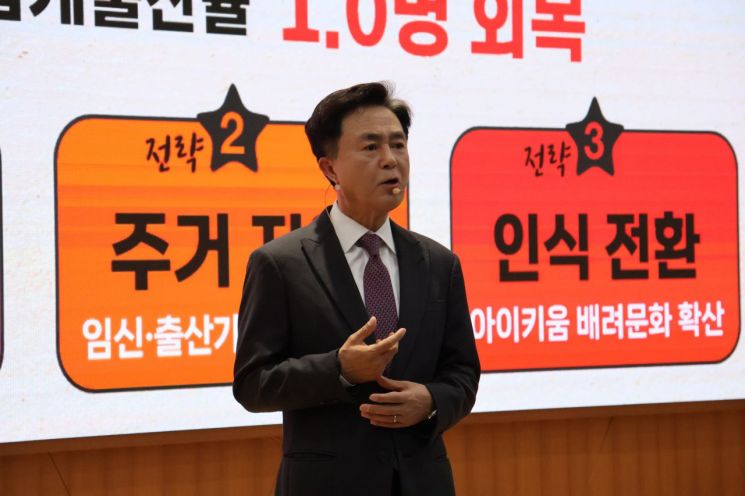 Governor Kim Tae-heum of Chungnam is unveiling the Chungnam-style full-care caregiving policy on the 3rd. / Naepo = Photo by Kim Ah-young
"If you have a child, we will take responsibility until they become an adult."
On the 3rd, Kim Tae-heum, Governor of Chungnam Province, made this statement while unveiling the 'Chungnam-type Full-Care Childcare Policy.'
Governor Kim said, "We recognize the present as the last golden time in the national extinction crisis and have selected low birthrate countermeasures as a core task of provincial administration," adding, "We will support everything with the goal of restoring Chungnam's total fertility rate to 1.0 by 2026."
According to the province, Chungnam's total fertility rate has been declining every year since it dropped to 0.96 in 2021.
The province views the "childcare burden on dual-income couples and working moms" as the biggest cause of the low birthrate problem and focuses on "24/7 complete care."
For the care of infants and toddlers aged 0 to 5, 24-hour dedicated childcare facilities will be established to eliminate blind spots in childcare during weekday nights, weekends, and holidays. This year, at least one facility will be established in each city and county, totaling 25 facilities.
For elementary school students aged 6 to 12, the province will secure available local facilities to the maximum extent to supplement the shortage of Neulbom Schools. Operating hours of existing childcare facilities such as community child centers will also be extended until 10 p.m. A pool of instructors, including retired teachers, will be formed to support teaching staff.
For middle and high school students aged 13 to 18, who face high private education costs, public academies will be operated. Public academies will first be established in hopeful cities and counties in the southern region, and famous Seoul academies will be commissioned to operate them.
Housing issues are also seen as one of the main causes of low birthrate, and the special supply of public apartments will be expanded. The special supply ratio of public apartments for pregnant and childbirth families will be significantly increased up to 100%.
The four-day workweek system will be implemented for the first time in public institutions.
Employees with children aged 0 to 2 at the provincial office and affiliated public institutions will be required to work from home once a week. Employees with children aged 9 to 12 will be provided with up to two additional hours of elementary school childcare time per day.
Childbirth and childcare will be recognized as achievements, and performance grades of A or higher will be awarded. Special promotion opportunities will be provided to public officials with three or more children. This applies to both female and male employees.
A campaign to "change the workplace atmosphere that is wary of childbirth and childcare" will also be promoted so that workers can take parental leave and reduced working hours whenever they want. Excellent small and medium-sized enterprises that encourage childbirth will receive childcare support funds of up to 100 million KRW.
The province plans to invest 463.7 billion KRW by 2026 to promote the Chungnam-type Full-Care Childcare Policy. Excluding the existing housing supply policies, 70.7 billion KRW is expected to be newly invested.
Along with this, proposals for government policies were also presented.
Governor Kim said, "The government and local governments should unify cash support policies provided at childbirth," and "Systems that disadvantage marriage should be thoroughly reviewed so that benefits for married people are greater than for singles."
He continued, "In a situation where the burden on young people trying to get married is high, inheritance and gift taxes are barriers to intergenerational asset transfer," and proposed, "Considering that the average marriage cost exceeds 300 million KRW, the tax exemption amount for property received as gifts from direct ascendants should be expanded to 500 million KRW."
© The Asia Business Daily(www.asiae.co.kr). All rights reserved.
![Clutching a Stolen Dior Bag, Saying "I Hate Being Poor but Real"... The Grotesque Con of a "Human Knockoff" [Slate]](https://cwcontent.asiae.co.kr/asiaresize/183/2026021902243444107_1771435474.jpg)















