Equipment Arrival by Year-End After October Completion
2nm Semiconductor Production in 2027 "On Schedule"
"Send Additional 100 to US IBM Within Year for Total 200 Trained"
Atsuyoshi Koike, president of Rapidus, a semiconductor company formed by a consortium of major Japanese corporations, announced plans to complete factory construction within this year and start operating a prototype production line in April next year, aiming for mass production of cutting-edge 2-nanometer (nm; 1 nanometer is one billionth of a meter) semiconductors by 2027. Backed by the Japanese government's large-scale support exceeding 8 trillion yen, Rapidus has reiterated its intention to accelerate 2-nanometer semiconductor mass production, demonstrating its determination to lead the revival of the domestic semiconductor industry.
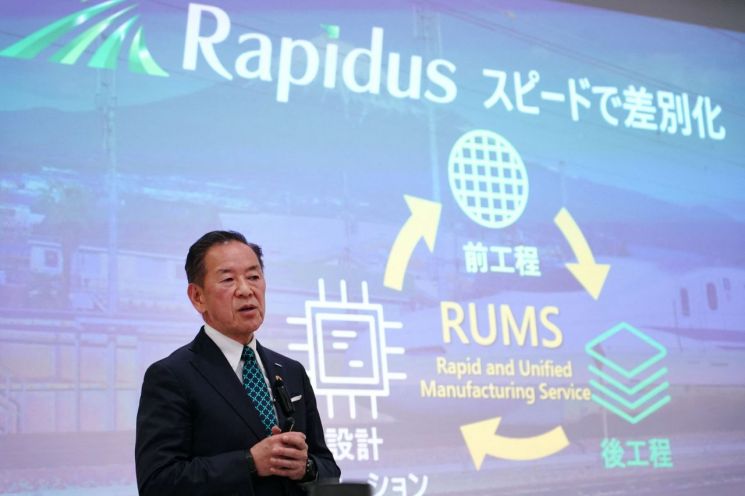
According to the Nihon Keizai Shimbun and others on the 3rd, Koike made these remarks at a press conference in the prefecture following the Ministry of Economy, Trade and Industry's announcement of an additional 590 billion yen (approximately 5.25 trillion won) in support the previous day. The Japanese government initially provided 70 billion yen in development funds during Rapidus's establishment phase and added 260 billion yen last April. With the additional 590 billion yen support, the total semiconductor subsidies Rapidus can receive have increased to 920 billion yen (approximately 8.2 trillion won). Rapidus was established by eight leading Japanese companies, including Toyota, Kioxia, Sony, NTT, and SoftBank, to promote the domestic production of advanced semiconductors.
Koike stated, "An important milestone has been set in the process toward operating the 2-nanometer prototype line in April 2025," adding, "The factory will be completed in October this year, and equipment will be installed by the end of the year." He emphasized, "Although there are detailed challenges, I am confident that we will steadily take steps toward the originally targeted 2027 mass production and realize it."
Koike also announced plans to begin research and development (R&D) on back-end process technologies. It is known that 50 billion yen of the government support funds will be used for developing back-end process technologies. This is the first time the Japanese government has supported back-end process technology development. For cutting-edge semiconductors, enhancing technological capabilities in back-end processes such as packaging and testing is as important as performance improvements through miniaturization.
Koike explained, "Research and development is being conducted at Seiko Epson's Chitose facility, and the factory under construction in Chitose City, Hokkaido, aims to be the world's first to integrate front-end and back-end processes in one location," adding, "We are not planning to build a new factory solely for back-end processes."
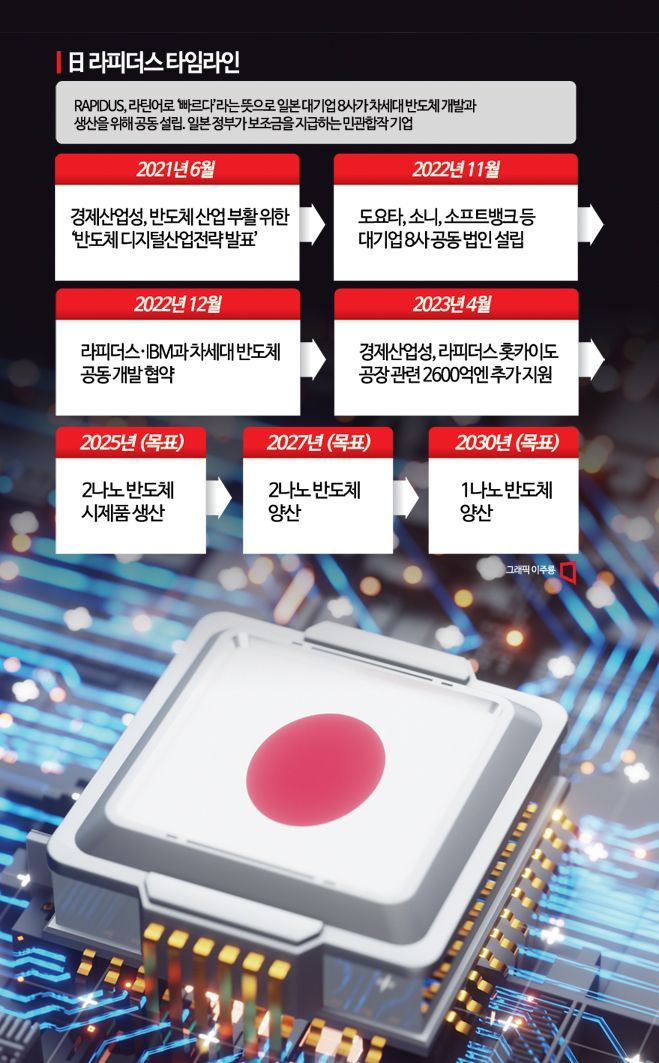
Regarding the critical issue of securing personnel necessary for semiconductor factory construction, Koike revealed, "Currently, 100 Rapidus employees are learning manufacturing technology at IBM's headquarters in Albany, New York." He added, "We plan to send an additional 100 employees within this year, so 200 will be trained. Skilled engineers who remember when Japan was the world leader in semiconductor sales are active in the U.S."
He also said, "On the 1st of this month, new employees joined, bringing the total number of employees to over 300. We intend to have a balanced composition of new university graduates and experienced engineers in the future," adding, "We are not overly concerned about issues related to recruiting engineers."
When asked about Rapidus's competitiveness, Koike said, "We aim to produce semiconductors at more than twice the speed of our competitors," and added, "We will significantly reduce costs by partnering with Japan's excellent materials and equipment companies." Regarding partnerships, he stated, "In addition to the research base in Hokkaido, we will collaborate with overseas research institutions such as the Fraunhofer Institute in Germany," and emphasized that they will cooperate with all research institutions and materials and equipment companies.
Although Rapidus has received large-scale support from the Japanese government, it recognizes that massive funds are required for semiconductor mass production and that additional financing is necessary. Regarding future funding, Koike said, "For mass production, 5 trillion yen is needed, of which 2 trillion yen is required for development," adding, "We will continue to prepare for funding for mass production and explain when the time comes. We want to secure funds by clarifying our technological capabilities."
Meanwhile, the Japanese government has been actively pursuing semiconductor domestic production competition following supply chain disruptions caused by the COVID-19 pandemic. After announcing Rapidus's additional support at a cabinet meeting the previous day, Minister of Economy, Trade and Industry Gen Saito stated, "Generative artificial intelligence (AI) and autonomous driving are core to Japan's entire industry," and added, "The Ministry of Economy, Trade and Industry will do its utmost to ensure the project's success."
© The Asia Business Daily(www.asiae.co.kr). All rights reserved.
![Clutching a Stolen Dior Bag, Saying "I Hate Being Poor but Real"... The Grotesque Con of a "Human Knockoff" [Slate]](https://cwcontent.asiae.co.kr/asiaresize/183/2026021902243444107_1771435474.jpg)
















