Line 3 North-South Axis 29km, Line 4 East-West Passage 17.9km, Line 5 Downtown North-South Connection 12.9km
Urban Railway Line 2 Branch Planned to Open Simultaneously with Tram in 2028
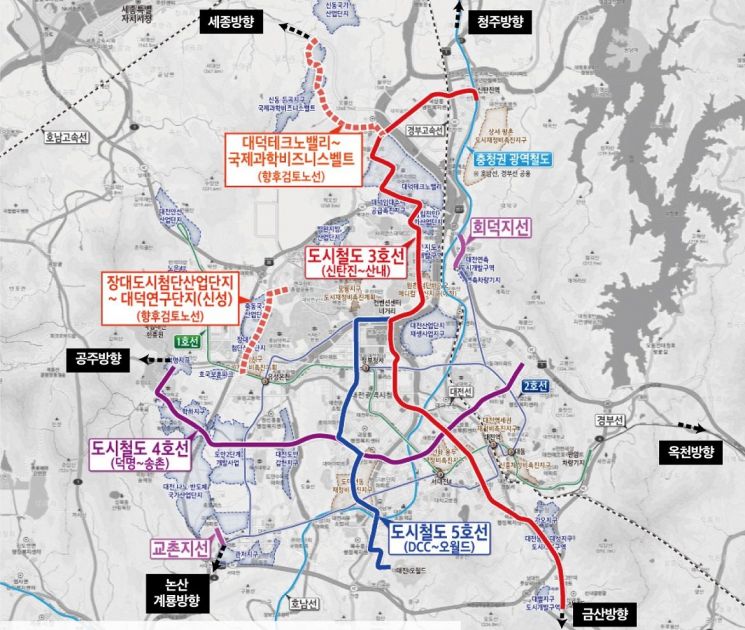
This year, alongside the planned vehicle orders and construction commencement for Daejeon Urban Railway Line 2, a blueprint for the expansion of Daejeon's public transportation infrastructure through Urban Railway Lines 3, 4, and 5 has been presented.
On the 1st, Daejeon City announced plans for new routes of Urban Railway Lines 3, 4, and 5 totaling 59.8 km in length, as well as a 2.03 km branch line for Urban Railway Line 2, as part of the urban railway network construction plan during a city administration briefing.
The simultaneous promotion of Urban Railway Lines 3, 4, and 5 is a flagship pledge of the 8th elected administration aimed at alleviating downtown traffic congestion and transitioning to a rail-centered public transportation system. The urban railway network plan (draft) was established through a study conducted by the Korea Transport Institute, a specialized transportation research organization.
According to the Daejeon urban railway network plan (draft) announced that day, future urban railway construction projects are planned to include main lines for Lines 3, 4, and 5 totaling 59.8 km, two tram branch lines totaling 2.03 km for Line 2, and two additional lines totaling 9.9 km for future review. The vehicle system will be implemented as a light rail transit method, which can be introduced when the demand exceeds 50,000 daily users.
Urban Railway Line 3 will connect Sintanjin?Dunsan?Busa?Seokgyo?Gao?Sannae, spanning a total length of 29 km, linking Daedeok, Yuseong, Seo-gu, Jung-gu, and Dong-gu along a north-south axis. Among the three lines, it is predicted to have the highest daily ridership of approximately 75,000 passengers (based on 2031 projections).
Urban Railway Line 4 was initially proposed as a circular route around Gapcheon and Yudeungcheon during the 8th elected administration’s pledge. However, considering actual demand and other factors, the optimal route was revised to an east-west line connecting Deokmyeong?Hakhah?Doan?Seonhwa?Daejeon Complex Terminal?Songchon, with a total length of 17.9 km. It is analyzed to serve about 64,000 passengers daily. This line is adjacent to the Gyochon-dong National Industrial Complex, a national project covering 5.29 million square meters (1.6 million pyeong), which is expected to promote industrial complex development as well as new residential land development and redevelopment, significantly increasing future demand.
Urban Railway Line 5 will connect Daejeon Convention Center?Government Complex?Doma Byeondong Redevelopment Promotion District?Daejeon O-World, spanning 12.9 km and linking the city center north to south. It is expected to serve approximately 54,000 passengers daily. As part of the 'Transportation Innovation Strategy,' the current government’s CTX line (Chungcheong Regional Express Railway) Government Complex Station is planned to be established on this route, which is expected to significantly increase actual ridership beyond initial forecasts.
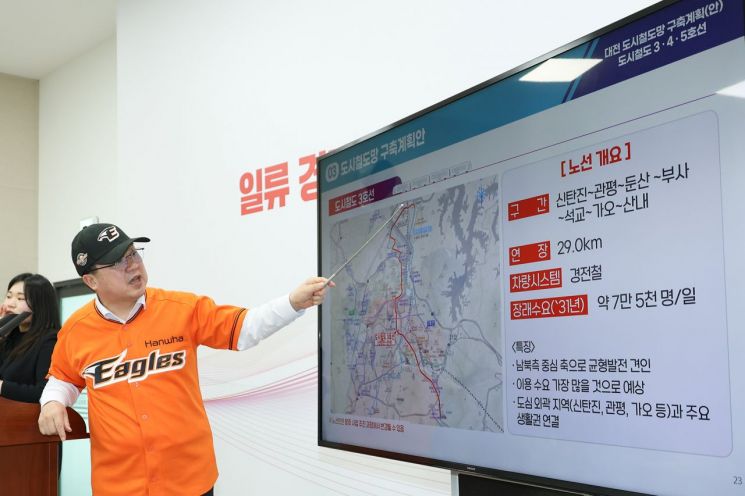 Daejeon Mayor Lee Jang-woo is explaining the draft urban railway network plan on the 1st. / Daejeon City
The Line 2 tram branch lines will cover 1.22 km between Yeonchuk District and Hoedeok Station, and 0.81 km between Jinjam Intersection and Gyochon Samgeori. To improve downtown accessibility, a total project cost of 34.5 billion KRW will be invested, aiming for simultaneous opening with Line 2 upon tram completion in 2028.
The light rail vehicle system to be introduced on Lines 3, 4, and 5 will include not only existing subway and elevated systems but also new transportation modes such as trackless trams. Specifics will be finalized during the preliminary feasibility study phase after the urban railway network plan is established, considering cost-effectiveness and other factors.
Separately from the Lines 3, 4, and 5 urban railway network plan, the city will invest 15 billion KRW to implement a pilot project for new transportation modes on a 6.2 km section of Doandong-ro (from Gasuwon Intersection to Yuseong Oncheon Intersection), targeting opening by the end of 2025.
Following overseas field surveys in countries such as France and Switzerland, the city plans to pilot four 3-module rubber-tired trams with a capacity of 180 passengers each, battery-based station charging, operating at 15 to 20-minute intervals. Based on the pilot project results, Daejeon City will consider expanding the application.
The Daejeon urban railway network plan (draft) will undergo administrative procedures including preliminary consultation with the Ministry of Land, Infrastructure and Transport this year, public hearings, council opinion gathering, and review by the National Transportation Committee, aiming for final government approval by the end of 2024.
Mayor Lee Jang-woo of Daejeon stated, “The new urban railway lines will integrate with the existing transportation system and serve as major arteries enhancing mobility and accessibility throughout the city.”
© The Asia Business Daily(www.asiae.co.kr). All rights reserved.
![Clutching a Stolen Dior Bag, Saying "I Hate Being Poor but Real"... The Grotesque Con of a "Human Knockoff" [Slate]](https://cwcontent.asiae.co.kr/asiaresize/183/2026021902243444107_1771435474.jpg)
















