"Property Division Claim Right Applies Only While Both Parties Are Alive"
It has been ruled that in a de facto marital relationship without a marriage registration, if one spouse dies, the surviving spouse is not recognized as having inheritance rights or the right to claim property division.
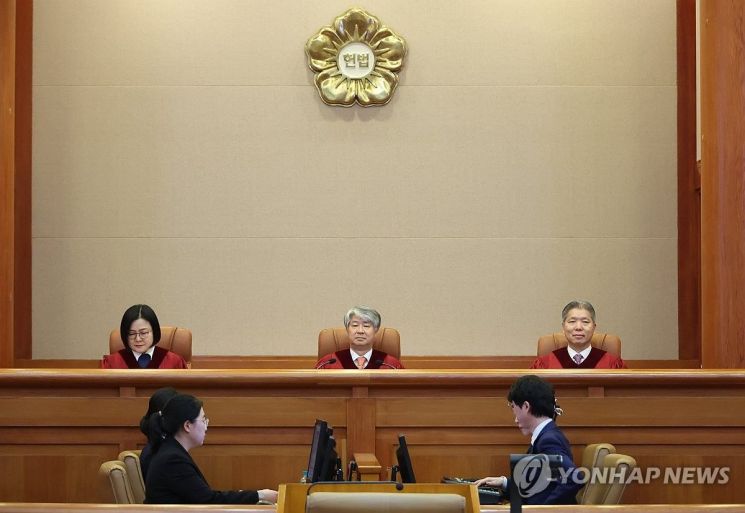
On the 28th, the Constitutional Court unanimously decided that Article 1003, Paragraph 1 of the Civil Act, which regards the ‘spouse’ in a legal marital relationship as an heir, does not violate the Constitution. This means that inheritance rights are not recognized for spouses in de facto marital relationships.

However, there were also remarks that legislative supplementation is needed for the dismissed claims for property division. A dismissal is a procedure that concludes the trial without judging the merits when there are defects or inappropriateness in the claim requirements.
The Constitutional Court ruled constitutional on the ‘spouse’ part of Article 1003, Paragraph 1 of the Civil Act, which does not recognize inheritance rights for de facto spouses. Regarding Articles 893-2, Paragraphs 1 and 2, which concern the right to claim property division, the court dismissed the claims.
A, who filed this constitutional complaint, lived with a de facto spouse for 11 years before suddenly losing them in 2018. A filed a lawsuit seeking the return of inheritance property received by B’s siblings, arguing that a de facto spouse also has inheritance rights. After the court dismissed the case, A filed a constitutional complaint challenging Articles 839-2 Paragraphs 1 and 2, and Article 843 of the Civil Act.
A argued that the inheritance provision, which completely denies inheritance rights to a surviving de facto spouse, violates the principle of proportionality and infringes on property rights and equality rights. A also claimed that the non-recognition of the right to claim property division is an unreasonable discrimination compared to legally married spouses.
Even in the relevant provisions, it only states that ‘one party in a consensual divorce may claim property division from the other party,’ without explicitly mentioning de facto spouses.
The Constitutional Court decided that there is no problem with the ‘spouse’ part of Article 1003, Paragraph 1 of the Civil Act. This provision states that a spouse has inheritance rights at the same level as the deceased’s parents or children (lineal ascendants and descendants) and can inherit property according to the legally prescribed ratio. The property received in this way is called the statutory portion. If there are no lineal ascendants or descendants, the spouse has sole inheritance rights.
Previously, in a 2014 decision, the Constitutional Court judged that the inheritance provision does not violate the Constitution, and this precedent was applied to the current case as well.
At that time, the court stated, “In legal relationships such as inheritance that affect third parties, de facto marriage cannot be treated the same as legal marriage, so it is difficult to see the inheritance provision as infringing on the equality rights of de facto spouses.”
The Constitutional Court said that even though social perceptions of de facto relationships have somewhat changed, the current law (Article 1003 of the Civil Act), which regards the spouse registered with the authorities as the deceased’s spouse, i.e., a spouse in a ‘legal marriage,’ must be followed.
Dismissal of Property Division Claims, Reasons...
The right to claim property division was dismissed by a 6 to 3 vote among the justices. The Constitutional Court stated, “The legislature has made the property division system applicable only when the marriage is dissolved while both parties are alive, such as in divorce, as a legislative matter for the right to claim property division,” and thus dismissed A’s claim as not permissible under the Constitutional Court Act.
However, Justices Kim Ki-young, Moon Hyung-bae, and Lee Mi-seon dissented, stating that it is a legitimate claim that the Constitutional Court should rule on, and that a constitutional inconsistency decision should be made regarding the non-recognition of the right to claim property division for a spouse in a de facto relationship when one party dies.
Justice Lee Young-jin, in a concurring opinion, said, “Legislative improvements are needed for inheritance or property division claim provisions to protect the property rights of surviving de facto spouses.”
© The Asia Business Daily(www.asiae.co.kr). All rights reserved.
![Clutching a Stolen Dior Bag, Saying "I Hate Being Poor but Real"... The Grotesque Con of a "Human Knockoff" [Slate]](https://cwcontent.asiae.co.kr/asiaresize/183/2026021902243444107_1771435474.jpg)
















