Explosive Surge in Complaints During Presidential and Local Elections
Current Law Allows Fighter Jet-Level Takeoffs and Landings
As the official election campaign for the April 10 general election has begun, complaints about noise issues are emerging. The music and speeches coming from the loudspeakers on campaign vehicles are too loud. Critics point out that under current law, noise levels equivalent to those produced by fighter jets during takeoff and landing are even permitted, rendering the regulations practically ineffective.
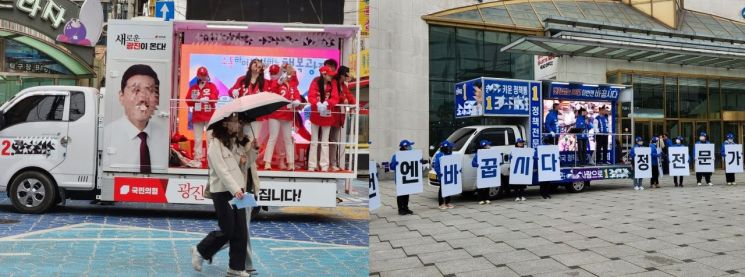 On the 28th, candidates from both the ruling and opposition parties are conducting election campaigns.
 [Photo by Im Chunhan]
On the 28th, Moon (79), whom we met in a residential area of Gwangjin-gu, Seoul, said, “It seems to be starting again, but I always thought it was noisy during elections,” and gave a wry smile, adding, “I can hear that music inside my house.” Near the Hwayang Jeil Alley Market, songs from the ruling party candidate’s campaign vehicle echoed, including phrases like “Please vote for me,” “Trust me,” and “Number ○, ○○○.” This area is across from Konkuk University and is densely populated with one-room apartments and villas.
Near Jamsil Station in Songpa-gu, Seoul, the opposition candidate’s vehicle broadcast speeches through a microphone with slogans such as “Punish the regime” and “Let’s change this time.” Housewife Kim (60) said, “Of course election campaigns are noisy,” and added, “We just have to endure it for now, what else can we do?” College student Jang (21) sighed, saying, “I think the election season has come again,” and “It’s noisy, but I try to understand as much as possible.” Most citizens complain that there is no effective solution.
Complaints Related to Campaign Noise Surge Every Election
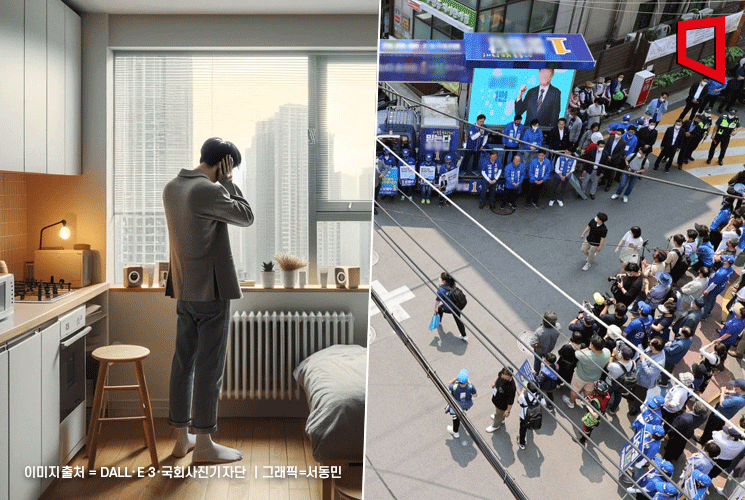
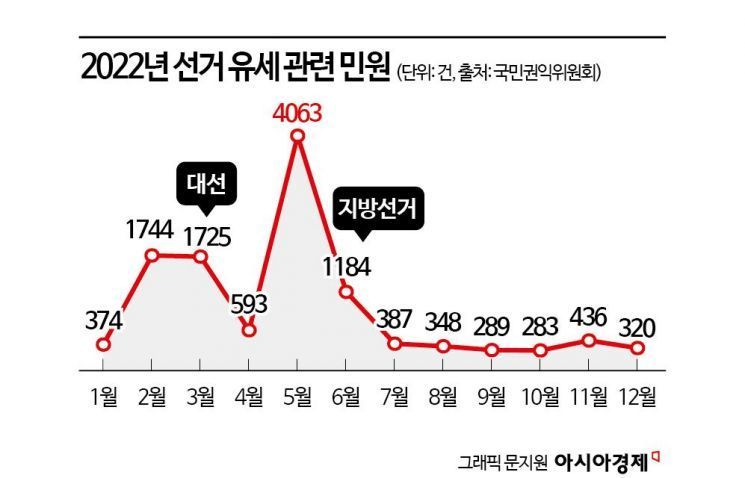
Noise complaints have been incessant during major elections. Related complaints have also increased explosively. According to the Anti-Corruption and Civil Rights Commission, election campaign-related complaints recorded in the 2022 complaint analysis system totaled 11,746, averaging 979 per month. This is about three times higher than in 2021 (386 cases) and 2023 (298 cases). Especially before the presidential election held on March 9 of that year, there were 1,744 and 1,725 complaints in February and March respectively, and around the June 1 nationwide local elections, 4,063 and 1,184 complaints were recorded in May and June respectively.
Noise Limits Established but Set Higher Than Fighter Jet Takeoff and Landing Decibels
In January 2020, the Constitutional Court ruled that the Public Official Election Act’s failure to set noise regulation standards for election campaigns infringed on citizens’ rights to live in a healthy and pleasant environment. In December 2021, the National Assembly prepared an amendment to the Public Official Election Act establishing noise limits for campaign vehicles and loudspeakers. According to the law, loudspeakers attached to vehicles must not exceed a rated output of 3 kW and a sound pressure level of 127 dB, and portable loudspeakers must not exceed 30 W output. However, for presidential and metropolitan/provincial governor elections, loudspeakers attached to candidate vehicles are allowed up to 40 kW rated output and 150 dB sound pressure level, and portable loudspeakers up to 3 kW. Violations are subject to fines of up to 10 million won.
Criticism has been raised that the noise limits under the Public Official Election Act are excessively lenient. According to the National Noise Information System, noise near railroads when trains pass is 100 dB, car horn noise is 110 dB, and noise generated during fighter jet takeoff and landing is 120 dB. Since the noise limit for campaign vehicles is higher than the decibel level of fighter jet takeoff and landing, the likelihood of actual enforcement is virtually nonexistent.
Professor Shin Yul of the Department of Political Science and Diplomacy at Myongji University said, “Noise pollution during election season is very serious and stricter regulations are needed,” and pointed out, “Don’t vehicles roam around apartment complexes and residential areas on weekends?”
He added, “From the candidates’ perspective, it’s desperate, so whether it’s perceived as noise or not, they do everything they can. Whether good or bad, they need to attract attention to raise or lower their approval ratings,” and said, “No matter how much times change, many people over 60 do not use social networking services (SNS), so campaign vehicles are used to target the middle-aged and older demographic.”
© The Asia Business Daily(www.asiae.co.kr). All rights reserved.
![Clutching a Stolen Dior Bag, Saying "I Hate Being Poor but Real"... The Grotesque Con of a "Human Knockoff" [Slate]](https://cwcontent.asiae.co.kr/asiaresize/183/2026021902243444107_1771435474.jpg)

















