Press Conference at BOK Annex on the 26th
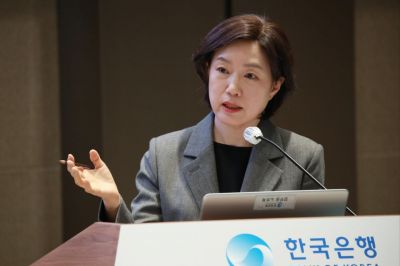
Seo Young-kyung, a member of the Monetary Policy Committee, said on the 26th, "When inflation stabilizes, normalizing (lowering) interest rates is expected to have a positive effect of stimulating domestic demand."
At a press briefing held that day under the theme "What Has the Pandemic Crisis Left Behind?: Experiences and Challenges of Monetary Policy," Seo said, "Interest rates in the tightening range have the effect of weakening consumption through the increased burden of loan repayments." He added, "It can be said that the current interest rate cut is more of a normalization," implying that lowering interest rates is essentially returning them to a normal level. The event was arranged ahead of Seo's retirement in April.
Seo analyzed that the current sluggish consumption is largely due to the ripple effects of tight monetary policy. He said, "The reason domestic consumption in our country has shown a slower recovery than expected since last year is largely due to the prolonged high interest rates," and added, "Although it has been suggested that the transmission mechanism of interest rate policy may have weakened due to structural changes such as aging, it seems that the sensitivity of domestic demand to interest rates has recently increased compared to the past, so further analysis on this is likely needed."
In response to a question from reporters about "what will be the most important variable in future interest rate policy decisions by the Bank of Korea," Seo mentioned "domestic demand recovery" in addition to inflation. He emphasized, "How quickly domestic demand recovers is important."
Regarding concerns about the expansion of household loans due to interest rate cuts, he expressed that there is not much to worry about. He acknowledged, "It is true that there are concerns about stimulating housing prices," but added, "Looking at the recent growth rate of household loans by financial institutions and the increase rate of housing transaction prices, the household loan growth rate is negative, and although the price increase rate has risen somewhat, it appears to have stabilized since March," and further explained, "Expectations for housing price increases are neither very high nor very low, so the risk of stimulation is not considered significant."
He continued, "Currently, real interest rates are positive (+), placing us in a tightening phase, so the normalization of monetary policy is not expected to cause significant financial imbalances immediately," but cautioned, "Based on past experience, as interest rates fall, the nonlinear impact on financial stability may increase, so it is necessary to pay attention to communication to ensure that economic agents’ expectations for future interest rate cuts are not excessive."
© The Asia Business Daily(www.asiae.co.kr). All rights reserved.
![Clutching a Stolen Dior Bag, Saying "I Hate Being Poor but Real"... The Grotesque Con of a "Human Knockoff" [Slate]](https://cwcontent.asiae.co.kr/asiaresize/183/2026021902243444107_1771435474.jpg)















