Ryu Ho-jeong, Park Won-seok, and Others Leave One After Another... 'Speaker' Weakens
Attempted to Shed 'Second Faction' Stigma... Joguk Innovation Party Surge
Proportional Support Rate at 3% Range... Crisis Theory of 'Must Prepare for Non-Representation'
The Justice Party, which has held the third position following the two major parties, is in a precarious situation. As key figures defect ahead of the general election, difficulties are expected in constituency competitions. Additionally, with a large number of progressive voters being absorbed by the Joguk Innovation Party, red flags have been raised regarding the securing of proportional representation seats for the Green Justice Party.
According to the National Election Commission on the 26th, 17 candidates affiliated with the Green Justice Party have completed registration for constituency candidacy. Candidates such as Sim Sang-jung (Goyang-si Gap, Gyeonggi), Yeo Young-guk (Changwon-si Seongsan-gu, Gyeongnam), and Jang Hye-young (Mapo-gu Eul, Seoul) have run. Fourteen candidates have declared their candidacy for proportional representation. Among them are former Health and Medical Workers' Union Chair Na Soon-ja at number 1, lawyer Kwon Young-guk at number 4, Standing Representative Kim Jun-woo at number 6, and former Director of the National Institute of Meteorological Sciences Jo Cheon-ho at number 8.
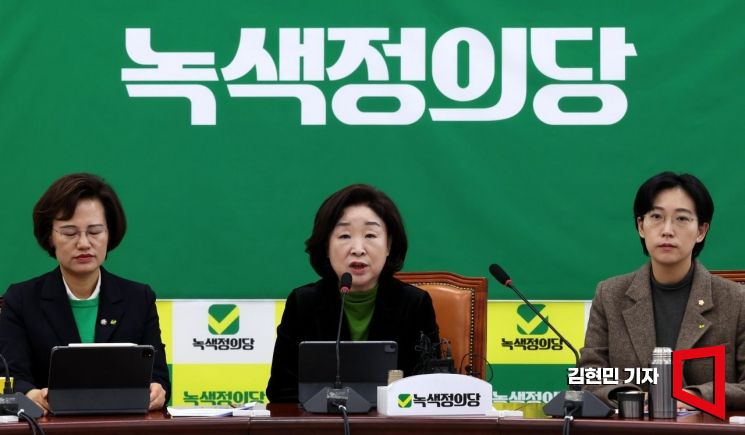 Sim Sang-seong, the newly appointed floor leader of the Green Party, is speaking at the floor leader election ceremony held at the National Assembly on the 20th. Photo by Hyunmin Kim kimhyun81@
The Justice Party has maintained the third position in the National Assembly as the second opposition party following the two major parties, but it is struggling repeatedly ahead of this general election. The crisis began during the last presidential election. At that time, Justice Party's presidential candidate Sim Sang-jung garnered only 2.37%, and in the by-election for the Gangseo District Office in Seoul held last October, candidate Kwon Su-jeong received just 1.83%. This was only 0.45 percentage points ahead of progressive party candidate Kwon Hye-in (1.38%).
The 'lack of prominent figures' is cited as a surface-level cause of the crisis. Ahead of the general election, former lawmakers Ryu Ho-jeong and Park Won-seok, as well as former Policy Committee Vice-Chair Cho Sung-joo, who was regarded as a 'policy expert,' each defected to the third zone. The weighty 'speakers' who could raise their voices under the Green Justice Party banner have diminished.
The competitiveness of constituency candidates has also weakened. Although the party had shown presence in the Incheon area, this time only one candidate, Kim Eung-ho (Bupyeong-gu Eul), is running. Lawmaker Bae Jin-kyo has declared he will not run, and former party leader Lee Jeong-mi, who performed well in Yeonsu-gu Eul in the last general election, is also not running.
In political circles, there is an observation that the crisis has manifested due to the Justice Party's policy line and the monopoly structure of the 'two major parties' intertwining. The issues the Justice Party focuses on?women, labor, and climate?are relatively difficult to attract popular interest. The policy line representing feminism and labor faces backlash from the conservative camp and has also provoked criticism of being the 'Democratic Party's second squad.' Furthermore, by refusing to unify with Lee Jae-myung, the Democratic Party candidate, during the last presidential election, the party is said to have alienated a significant portion of progressive voters who support the Democratic Party.
An official who left the Justice Party earlier this year said, "I think this is a limitation given to progressive parties in Korean politics, but in any case, I judged that there was no chance of winning under the current Justice Party banner," adding, "We need to reflect on the fact that the image we have shown so far has not been accepted by the public as innovation."
Struggling with Proportional Support in the 3% Range... 'Out-of-Parliament Party' Crisis Theory
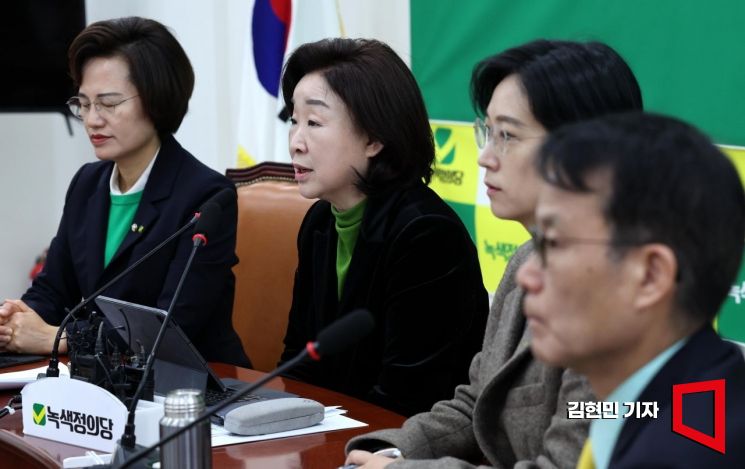 Sim Sang-seong, the newly appointed floor leader of the Green Party, is speaking at the floor leader election ceremony held at the National Assembly on the 20th. Photo by Hyunmin Kim kimhyun81@
The Justice Party proposed an electoral alliance with the progressive camp without joining hands with the Democratic Party to shed the stigma of being the 'Democratic Party's second squad.' In doing so, they formed the 'Green Justice Party' by joining forces with the Green Party. However, new third-zone parties have successively seized issues, and the emergence of the Joguk Innovation Party absorbing progressive voters has continued to create a difficult situation. In a party support survey conducted by Realmeter on behalf of Energy Economy Newspaper from the 21st to 22nd among 1,004 voters aged 18 and over nationwide, the Green Justice Party recorded 1.8%. This was a 0.3 percentage point increase from the previous week's survey (1.5%), but it lagged behind new parties such as the Reform New Party (3.8%) and New Future (3.1%), and was at a similar level to the Liberty Unification Party (1.7%).
Inside and outside the party, there is also a crisis theory that they may have to prepare for being an out-of-parliament party. To gain proportional representation seats, a party must secure more than 3% of valid votes in the general election or win at least five constituency seats. In a previous survey asking about voting intentions for proportional representation parties, only 3.1% of respondents chose the Green Justice Party. (The survey was conducted via automated telephone interviews with 97% mobile and 3% landline respondents, with a response rate of 4.5%. The sampling error is ±3.1 percentage points at a 95% confidence level. For more details, refer to the National Election Survey Deliberation Commission website.)
Kim Min-jung, spokesperson for the Green Justice Party, spoke about the concern that their 'speakers are smaller' compared to the two major parties but emphasized the party's policy clarity. Kim said, "While the two major parties have adopted youth politics, women's politics, and now climate politics as trends, the Green Justice Party has consistently upheld policy values regarding labor issues and the climate crisis."
When asked whether focusing on the vulnerable policy-wise makes it difficult to gain popular interest or support, she replied, "For example, if the human rights of the vulnerable, who form the majority in the population pyramid, are improved, the rights of the rest of the people will also rise together," adding, "Creating policies for minorities and the vulnerable ultimately benefits everyone."
© The Asia Business Daily(www.asiae.co.kr). All rights reserved.
![Clutching a Stolen Dior Bag, Saying "I Hate Being Poor but Real"... The Grotesque Con of a "Human Knockoff" [Slate]](https://cwcontent.asiae.co.kr/asiaresize/183/2026021902243444107_1771435474.jpg)
















