Mandatory Display of Energy Efficiency Grades Starting Next Month
From next month, it will be mandatory to display the combined energy consumption efficiency (electric energy efficiency) rating of electric vehicles. Accordingly, competition in electric vehicle energy efficiency is intensifying. The number of models with a level 1 electric energy efficiency rating has increased by six within a year.
An official from the Ministry of Trade, Industry and Energy stated on the 26th, "Starting in April, electric vehicles must mandatorily display efficiency ratings based on combined energy consumption efficiency," adding, "The purpose is to enhance consumer convenience through rating displays and simultaneously promote the development of high-efficiency electric vehicle technologies in the automotive industry."
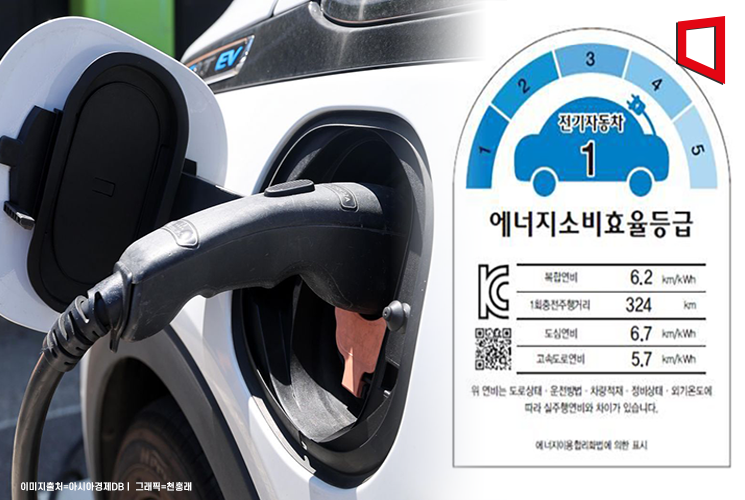
Earlier, in February last year, the Ministry of Trade, Industry and Energy announced an administrative notice for partial amendments to the "Regulations on Energy Efficiency and Rating Display of Automobiles." The main point of the amendment is to establish efficiency rating standards based on electric energy efficiency for electric vehicles and to impose the obligation of reporting and displaying electric energy efficiency ratings on automobile manufacturers.
Under the current automobile energy consumption efficiency and rating display system, since 2012, electric vehicles have displayed electric energy efficiency (km/kWh) and driving range per charge (km) externally. However, unlike internal combustion engine vehicles that display efficiency ratings based on fuel economy, electric vehicles have not separately displayed ratings based on electric energy efficiency. Therefore, the amendment requires, for the first time in the world, that electric vehicles' electric energy efficiency be rated and displayed/advertised so that consumers can easily compare the efficiency among available models, similar to internal combustion engine vehicles. In the United States, electric energy efficiency, driving range, and charging time are displayed, and in the United Kingdom, electric energy efficiency, driving range, and estimated electricity costs are shown, but electric energy efficiency ratings are not displayed.
The Ministry reflected feedback on the amendment and re-announced the notice in May of the same year. At that time, the enforcement date was set to September 1, and vehicles that completed reporting before the enforcement date could continue to use the existing display method until March 31 of this year. From April, it became mandatory to display electric energy efficiency ratings according to the amended notice.
The electric energy efficiency ratings are divided into five levels: ▲ Level 1: 5.8 km or more per 1 kWh ▲ Level 2: 5.7 to 5.0 km ▲ Level 3: 4.9 to 4.2 km ▲ Level 4: 4.1 to 3.4 km ▲ Level 5: 3.3 km or less.
Ahead of the mandatory display of electric vehicle efficiency ratings, vehicles with high electric energy efficiency are being released one after another. According to the Ministry of Trade, Industry and Energy, as of the end of 2022, there were only three level 1 models, accounting for 2% of the total, but by the end of last year, the number increased to nine models, representing 3.5%. Six models from Hyundai Motor Company, including the Ioniq 6 and Kona, Smart Solutions' Smart EV Z, and two Tesla Model 3 models are rated level 1. The number of level 2 models increased from 25 to 59, and level 3 models rose from 41 to 78.
© The Asia Business Daily(www.asiae.co.kr). All rights reserved.
![Clutching a Stolen Dior Bag, Saying "I Hate Being Poor but Real"... The Grotesque Con of a "Human Knockoff" [Slate]](https://cwcontent.asiae.co.kr/asiaresize/183/2026021902243444107_1771435474.jpg)















